Walls are described by what they are made of (brick, stone, cob, timber), how it is laid (bonds, courses, ashlar or rubble), and how it is finished (render, tile hanging, weatherboarding). Each region developed its own mix.
The wall is often the quickest way to place a house by region and age. Use this page to name what you see, and the style guides to see where each tradition appears.
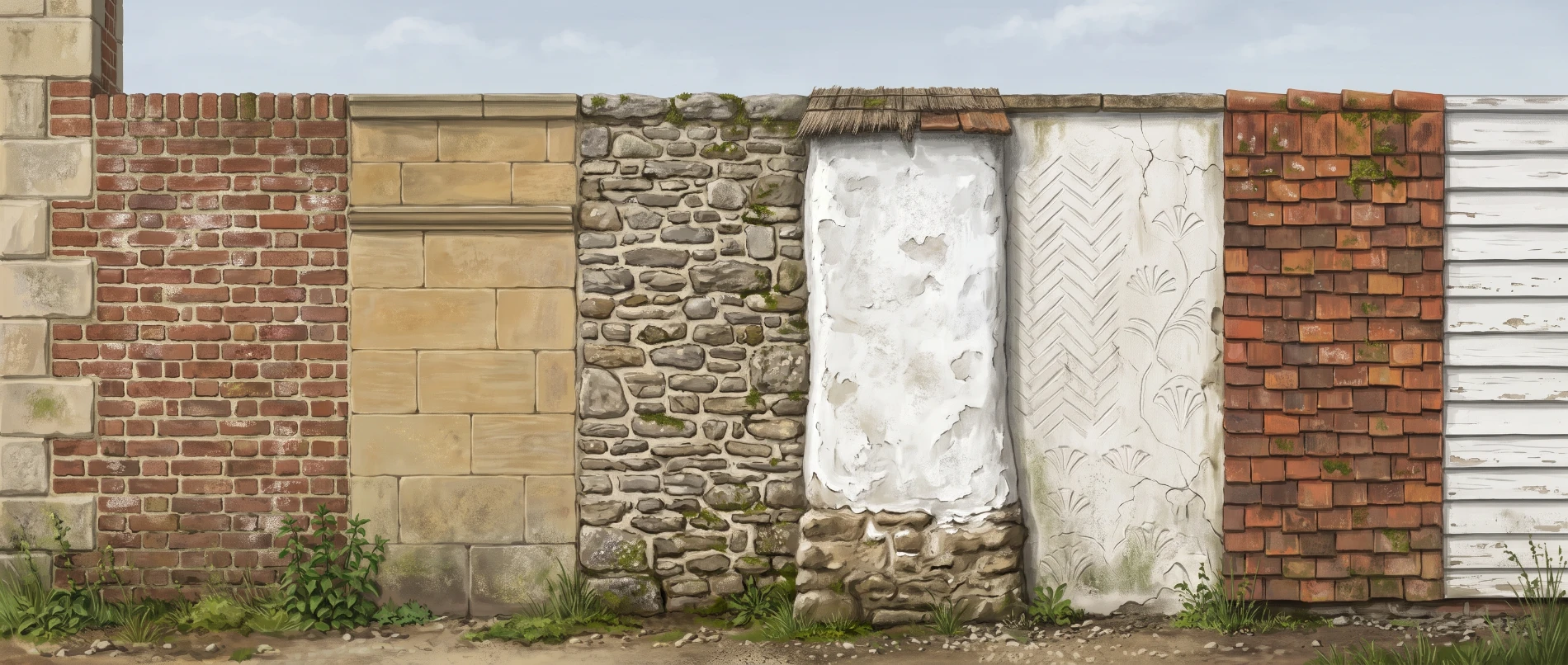
This page covers 23 terms. For every term in the glossary, see the full architectural glossary.
Brick and mortar
Brick bond
The pattern in which bricks are laid so that the joints in one course do not line up with those below. English bond has alternate courses of headers and stretchers, and Flemish bond alternates them in every course.
How to spot it: Look at how the brick ends show. Alternating long and short faces in each row is Flemish bond.
Gauged brickwork
Fine brickwork made from bricks cut or rubbed to exact sizes so they fit with very thin joints, often used for arches over windows.
How to spot it: Look above windows for very fine, tight joints in arches or flat arches of smooth red brick.
Lime mortar
Mortar made from lime and sand, softer and more flexible than cement mortar. It lets walls breathe and is the right choice for repairing old buildings.
How to spot it: Look for soft, pale, slightly rough mortar that sits back from the brick face.
Party wall
A wall shared between two properties, such as the wall between two terraced or semi-detached houses. Work on it may be covered by the Party Wall etc. Act 1996.
How to spot it: In a terrace or semi, this is the wall you share with your neighbour.
Stone walling
Ashlar
Stone cut into smooth, squared blocks and laid in neat, regular courses with very fine joints. It was the most expensive way to build a wall and was used for the fronts of grand buildings.
How to spot it: Look for smooth, squared stone blocks with very fine joints and even courses.
Rubble
Rough, undressed or roughly shaped stone used to build walls, often laid in courses or at random and held with mortar.
How to spot it: Look for irregular stones laid with wide mortar joints.
Rustication
Masonry with deeply cut joints or a rough face, used at ground level to give a base a strong look.
How to spot it: Look at the ground floor of a grand house for deep grooves between large stone blocks.
Flushwork
Decoration made by setting cut flint into patterns that sit flush with stone, found on churches and some East Anglian houses.
How to spot it: Look for patterns of dark flint set into pale stone, often on churches.
See in full glossary Norfolk and Suffolk flint and pargeting
Earth and timber infill
Cob
A walling material made from clay-rich earth, straw and sometimes gravel, built up in layers without formwork. It needs a good roof overhang and a dry base.
How to spot it: Look for thick, rounded, usually whitewashed walls on a stone base, with deep window reveals.
See in full glossary Full guide Devon cob and thatch house Chalk and clay lump
Wattle and daub
An infill for timber frames made of woven sticks (wattle) coated with a mix of clay, dung and straw (daub), usually finished with limewash.
How to spot it: Look at the infill panels between timber posts. Plaster over woven sticks, often rippled.
Renders and claddings
Render
A coat of mortar or plaster applied to the outside of a wall. Lime render is breathable, and cement render can trap damp.
How to spot it: Look for a smooth or textured coat covering the brick or stone beneath.
Stucco
A smooth lime or cement render, usually painted, used to imitate stone on Regency and early Victorian houses.
How to spot it: Look for smooth, painted, stone-like render on Regency and early Victorian terraces.
Roughcast
A rough render with small stones or gravel mixed in, thrown on to the wall. Pebbledash is a similar finish with stones thrown on afterwards.
How to spot it: Look for a rough, pebbly render, usually painted or white.
Harling
A rough, lime-based render thrown on to a wall, traditional in Scotland. It is similar to roughcast.
How to spot it: Look for rough, lime-based render on Scottish buildings, often painted in soft colours.
Pargeting
Decorative plasterwork on the outside of a timber-framed house, with patterns pressed or carved into wet lime plaster.
How to spot it: Look for raised or incised patterns in plaster on a timber-framed wall.
See in full glossary Full guide Norfolk and Suffolk flint and pargeting
Tile hanging
A wall covering of clay tiles hung on battens, to protect timber-framed or brick walls from rain. It is common in Kent and Sussex.
How to spot it: Look for walls covered in overlapping clay tiles, common in Kent and Sussex.
See in full glossary Full guide Sussex and Weald tile-hung house
Mathematical tile
A clay tile hung on a wall and shaped so that it looks like brick, with a flat front and a hidden overlap. It is found in Sussex and Kent.
How to spot it: Look for tile-hung walls that look like brick, with flat faces and thin joints.
Weatherboarding
Overlapping horizontal timber boards fixed to the outside of a wall to shed water, common in Kent, Sussex and Essex.
How to spot it: Look for overlapping horizontal boards, often painted white or black.
See in full glossary Full guide Kentish weatherboard and oast
Wall details
Quoin
A stone or brick at the corner of a building, often larger or a different colour from the walls, to emphasise or strengthen the corner.
How to spot it: Look at the corners of the building for larger blocks in alternating sizes.
Lintel
A beam over a door or window opening that carries the wall above. It can be timber, stone, brick or steel.
How to spot it: Look above windows and doors for a beam, flat arch or stone block across the opening.
String course
A horizontal band of stone or brick projecting slightly from a wall, marking a floor level or dividing the wall visually.
How to spot it: Look for a thin horizontal band of brick or stone that runs along the wall at floor level.
Plinth
The lowest part of a wall, often projecting slightly or built of stronger material, to protect it from splashing and damp.
How to spot it: Look at the foot of the wall for a slightly thicker, often darker, base.
Buttress
A block of masonry built against a wall to resist sideways thrust. Buttresses are most often seen on churches and large Gothic buildings.
How to spot it: Look for a stepped block of masonry built out from the wall.
Easily confused wall terms
- Render, stucco, roughcast and harling: all are coatings. Stucco is smooth, roughcast is thrown on with stones, and harling is the Scottish lime version.
- Ashlar and rubble: ashlar is neat, squared and fine-jointed, and rubble is rough and irregular.
- Cob and clay lump: cob is built up wet in layers, and clay lump is made of dried blocks. See our chalk and clay lump page.
- Tile hanging and weatherboarding: both are claddings, one with clay tiles and one with timber boards.
Comparison guides
Frequently asked questions
What is Flemish bond?
A brick pattern where each row alternates long faces (stretchers) and short faces (headers). It is common in Georgian brickwork.
What is the difference between ashlar and rubble?
Ashlar is smooth, squared stone with fine joints. Rubble is rough, irregular stone.
What is cob?
A walling material of clay-rich earth, straw and gravel built up in layers, found mainly in Devon and the South West.
What is the difference between render and stucco?
Render is any coat applied to a wall. Stucco is a smooth, painted render designed to look like stone.
What is pargeting?
Decorative patterns pressed or carved into plaster on the outside of a timber-framed building.