A pitched roof is made of a few repeating parts: the ridge at the top, the eaves at the bottom, the verge at the gable end, and hips and valleys where slopes meet. Features such as dormers, chimney stacks and finials sit on top of that basic shape.
Roof shape and covering are two of the quickest clues to a house's age and region. Use this page to name what you can see, and the style guides to see where each feature appears.
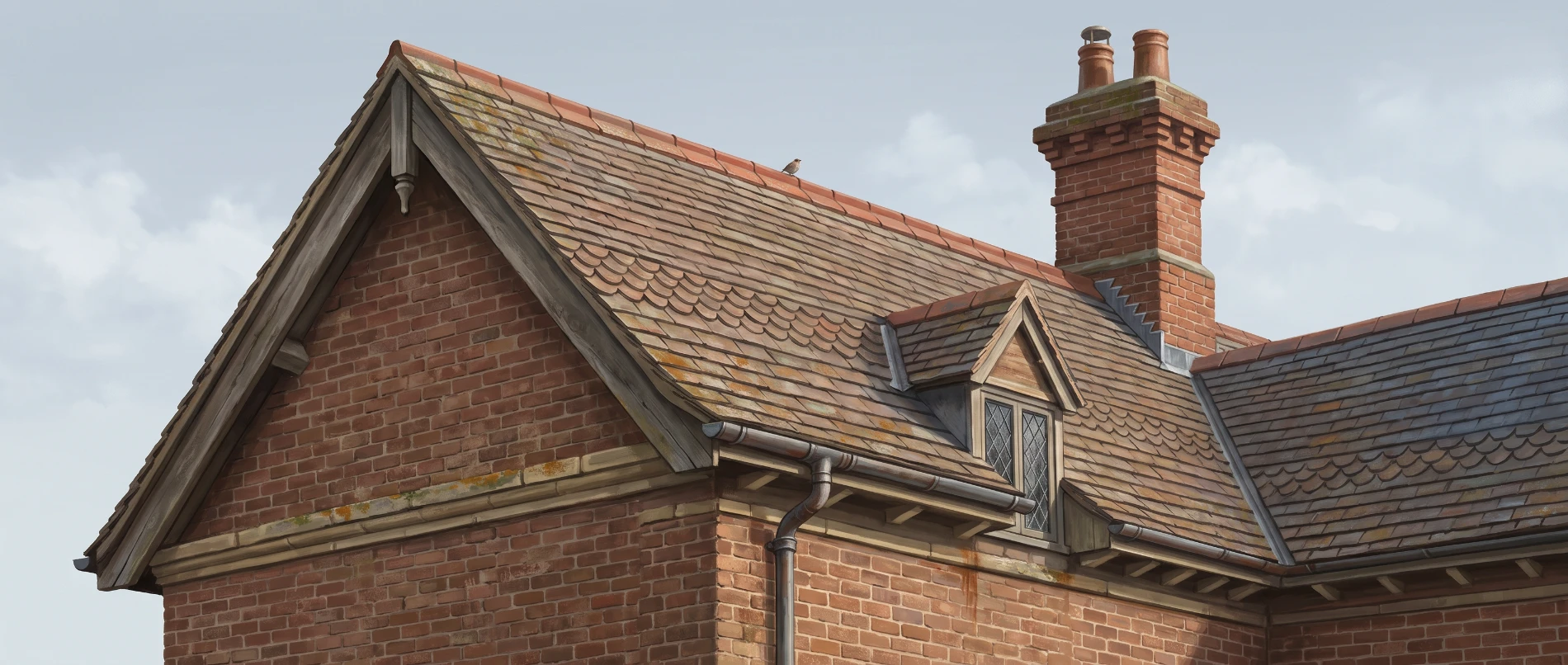
This page covers 25 terms. For every term in the glossary, see the full architectural glossary.
Roof shapes
Gable
The triangular part of the end wall of a building under a pitched roof. A gable can face the street or be set at right angles.
How to spot it: Look at the end walls. A triangular wall rising to a point under the roof is a gable.
Hipped roof
A roof that slopes down on all sides, with no gable. The sloping edge where two slopes meet is called the hip.
How to spot it: Walk round the house. If the roof slopes down on every side with no triangular end wall, it is hipped.
Mansard
A roof with two slopes on each of its four sides, the lower slope steep and the upper one shallow. It gives a full extra storey in the roof space.
How to spot it: Look for a steep lower slope, often with dormers, under a flatter upper slope on all four sides.
Gambrel roof
A roof with two slopes on each side, the lower steeper than the upper. It gives more headroom in the attic. A mansard roof is a similar idea on all four sides.
How to spot it: Look at the gable end. A shape like a barn roof, with two different slopes on each side, is a gambrel.
Cat-slide
A long roof slope that continues down past the normal eaves line to cover a lean-to extension at the back or side of a house.
How to spot it: Look at the back or side of the house for a roof that sweeps down much lower than the main eaves.
Dutch gable
A gable with curved sides topped by a pediment or a scroll. It came to England in the 17th century from the Low Countries.
How to spot it: Look for a curved, scrolled outline to the gable, usually topped by a small pediment.
Crow-stepped gable
A gable whose sloping sides are cut into a series of steps. It is common in Scotland and parts of eastern England.
How to spot it: Look for a gable edge cut into square steps, like a staircase.
Edges and junctions
Ridge
The horizontal line along the top of a pitched roof, where two slopes meet, usually covered by ridge tiles.
How to spot it: Look along the very top of the roof for a line of rounded or angled ridge tiles.
Eaves
The lower edge of a roof where it overhangs the wall. Deep eaves protect the wall from rain.
How to spot it: Look where the roof meets the wall. The part that overhangs is the eaves.
Verge
The edge of a roof at a gable end, where the roof overhangs the wall, often finished with a bargeboard or neat tile edge.
How to spot it: Look at the sloping edge of a gable end, where the roof overhangs the wall.
Valley
The internal angle where two roof slopes meet, which collects rainwater and channels it to the gutter.
How to spot it: Look for a V-shaped channel where two roof slopes meet at an inside corner.
Soffit
The underside of the eaves, or of any overhanging part such as an arch or a cornice.
How to spot it: Look up at the underside of the eaves overhang from the ground.
Fascia
A board fixed along the ends of the rafters under the edge of the roof, which usually carries the guttering.
How to spot it: Look for the board along the lower edge of the roof that the gutter is fixed to.
Parapet
A low wall along the edge of a roof, terrace or balcony. It hides the roof slope and can include a gutter behind.
How to spot it: Look for a low wall that stands above the roof edge and hides the slope from the street.
Coping
The top course of a wall or parapet, usually stone or brick, shaped to shed water away from the wall below.
How to spot it: Look at the very top of a parapet or garden wall for a capping of stone, brick or tile.
Flashing
A strip of lead, zinc or other metal that keeps water out at the join between a roof and a wall, chimney or other feature.
How to spot it: Look for a strip of lead or metal sealing the join between the roof and a chimney, wall or dormer.
Features on the roof
Dormer
A window that stands upright in a small structure projecting from a sloping roof. Dormers can have flat, gabled, hipped or curved roofs.
How to spot it: Look for a window that stands upright out of the roof slope, with its own little roof.
Chimney stack
The brick or stone structure that carries one or more flues above the roof. A chimney pot is the clay or metal pipe on top that helps draw smoke away.
How to spot it: Look for the tall brick or stone block rising through the roof, with pots on top.
Finial
A decorative ornament at the top of a gable, pinnacle or roof. It can be carved from stone or timber, or made of metal.
How to spot it: Look at the point of a gable or spire for a small carved or cast ornament.
Bargeboard
A board fixed along the sloping edge of a gable to cover the ends of the roof timbers. Victorian examples are often carved, pierced or have a decorative pendant at the point.
How to spot it: Look at the edge of a gable for a board, often carved or pierced, that hides the roof timbers.
Cupola
A small dome or turret on a roof, sometimes used as a lookout or to let light and air into the building below.
How to spot it: Look for a small dome or turret perched on the ridge or at the top of a roof.
Roof coverings
Thatch
A roof covering of dried plant stems such as water reed, wheat straw or sedge, laid in a thick layer on a timber frame.
How to spot it: Look for a thick, soft-edged roof of straw or reed, often with a patterned ridge and curved eaves.
Pantile
A clay roof tile with an S-shaped curve, so that each tile overlaps the next. It is common on the east coast of England and Scotland.
How to spot it: Look for wave-like rows of S-shaped clay tiles, usually orange or red-brown.
Stone slate
A thin slab of limestone or sandstone used as a roof covering, laid in diminishing courses with the largest at the eaves. Cotswold and Pennine roofs are traditional examples.
How to spot it: Look for thick, uneven slabs of stone, getting smaller towards the ridge.
Fish-scale tile
A small clay tile with a rounded end, laid in rows to look like scales. It is often used in bands or patterns in Victorian roofs and tile-hung walls.
How to spot it: Look for bands of small round-ended tiles that make a scale pattern.
Easily confused roof terms
- Eaves, fascia and soffit: the eaves are the overhang, the fascia is the board on the front edge, and the soffit is the underside.
- Gable and verge: the gable is the triangular wall, and the verge is the edge of the roof above it.
- Hip and valley: a hip is an outward corner where two slopes meet, and a valley is an inward corner.
- Mansard and gambrel: a mansard has two slopes on all four sides, and a gambrel has them only on two sides, with gable ends.
Comparison guides
Frequently asked questions
What is the difference between a hip and a valley?
A hip is the outward-sloping corner where two roof slopes meet, and a valley is the inward corner that collects and carries rainwater away.
What is the ridge of a roof?
It is the horizontal line along the top where two slopes meet, usually covered with ridge tiles.
What is the difference between a gable roof and a hipped roof?
A gable roof has triangular end walls, and a hipped roof slopes down on all four sides.
What is the part of the roof that overhangs the wall called?
The eaves. The underside of the overhang is the soffit, and the board along its edge is the fascia.
What is a dormer window?
A window set upright in its own small structure that projects from a sloping roof.