The two main opening types are the sash, which slides up and down, and the casement, which is hinged at the side. Features such as mullions, transoms and glazing bars describe how the glass is divided, and bay, bow and oriel windows describe how the window sits in the wall.
Windows are one of the best clues to a building's age. Use this page to name what you see, and the style guides to see where each type appears.
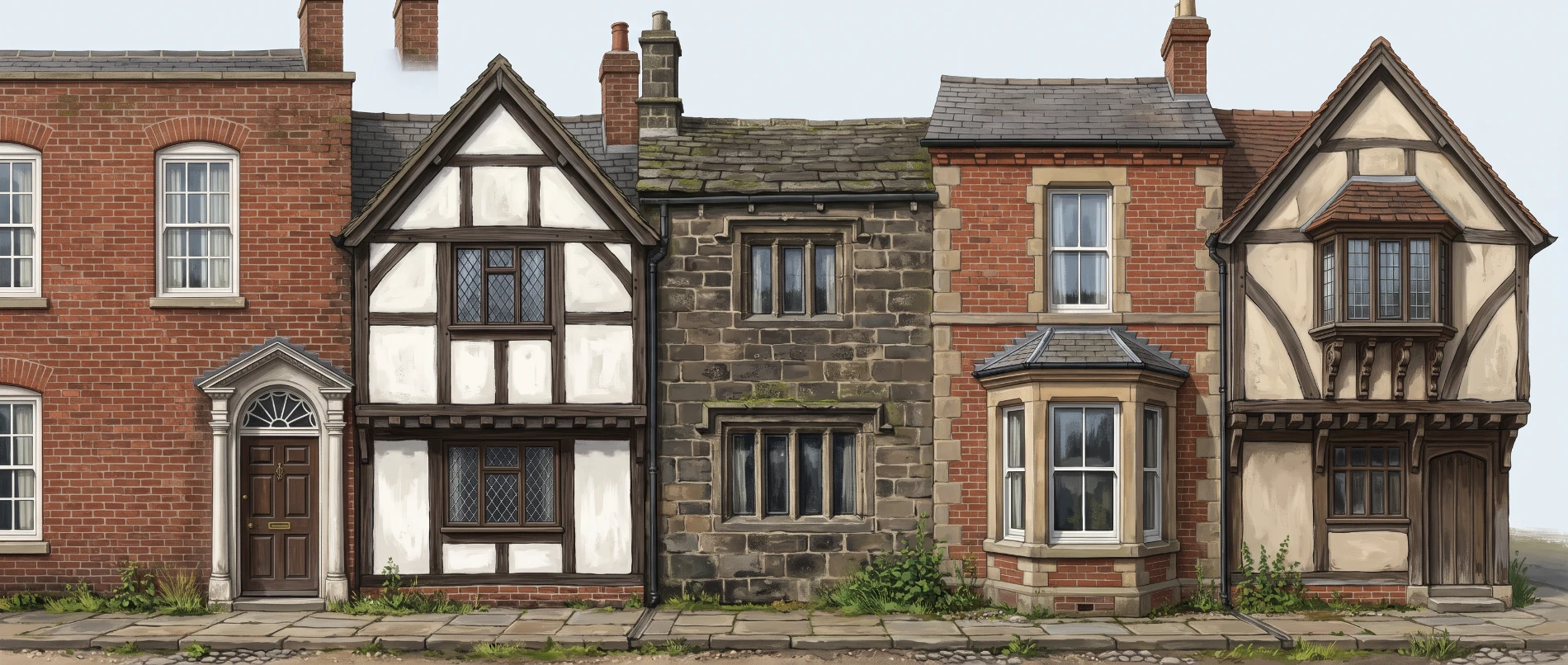
This page covers 16 terms. For every term in the glossary, see the full architectural glossary.
Opening types
Sash window
A window with one or two panels that slide up and down in grooves, usually balanced by weights. It arrived in the late 17th century and became the standard Georgian window.
How to spot it: Look for two panels in a box frame, one sliding over the other, with no hinges.
See in full glossary Full guide Queen Anne house Georgian townhouse and terrace
Casement window
A window hinged at the side so that it opens outwards or inwards like a door. It is the older of the two main window types and was used throughout the Tudor and Stuart periods.
How to spot it: Look for hinges on one side and a stay or handle on the other.
Projecting windows
Bay window
A window that projects from the wall in a canted (angled) or square plan and often runs up more than one storey. A bow window is the curved version.
How to spot it: Look for a window that sticks out from the wall and has angled or square sides.
Canted
Having angled sides rather than curved or square ones. A canted bay has a flat front and two angled sides.
How to spot it: Look at the plan of a bay. If the sides are angled instead of curved or square, it is canted.
Oriel window
A bay window that sticks out from an upper floor and is carried on corbels or brackets rather than reaching the ground.
How to spot it: Look for a projecting window on an upper floor, held up by brackets and not reaching the ground.
Shapes and special windows
Palladian window
A tall central window with a round top flanked by two narrower, shorter ones. It is also called a Venetian window.
How to spot it: Look for a tall arched centre window with a smaller flat-topped window on each side.
Venetian window
Another name for a Palladian window, a tall arched centre window with a narrower window on each side.
How to spot it: The same as a Palladian window. Look for a tall arched centre light with lower side lights.
Lancet
A tall, narrow window with a pointed top, typical of early Gothic buildings and the Gothic Revival.
How to spot it: Look for a tall, thin window with a pointed top.
Fanlight
A window above a door, usually semicircular or rectangular, to let light into the hall. Georgian fanlights often have delicate patterns of glazing bars.
How to spot it: Look above the front door for a semicircular or rectangular window.
See in full glossary Full guide Georgian townhouse and terrace
Dividing the glass
Mullion
A vertical bar of stone, timber or metal that divides a window into separate lights. A horizontal bar is a transom.
How to spot it: Look for vertical bars of stone or timber that divide a wide window into separate lights.
See in full glossary Full guide Peak District gritstone house
Transom
A horizontal bar across a window or above a door. A window with a transom above the door is a transom light.
How to spot it: Look for a horizontal bar across a window, or above a door.
Glazing bar
A thin strip of timber that divides the panes in a window. Georgian windows have slender bars, and Victorian windows often have fewer, bigger panes.
How to spot it: Look for the thin timber strips that divide a sash window into small panes.
Leaded light
A small pane of glass held in a lead strip called a came. Panes can be diamond-shaped or rectangular, and are fixed in a metal or timber frame.
How to spot it: Look for small panes held in dark lead strips, often diamond-shaped.
Surrounds and layout
Reveal
The side of an opening, between the outer face of the wall and the window or door frame.
How to spot it: Look at the side of the window opening, between the outer wall face and the frame.
Hood mould
A projecting moulding over a window or door, shaped to throw rainwater away from the opening. It is also called a drip mould or label mould.
How to spot it: Look for a projecting moulding over a window that throws rain away from the opening.
Fenestration
The pattern, size and arrangement of windows on a building. A well-ordered fenestration was important in classical design.
How to spot it: Look at the whole front of the building: the pattern and arrangement of windows is its fenestration.
Easily confused window terms
- Sash and casement: a sash slides up and down in a frame, and a casement is hinged like a door.
- Mullion and transom: a mullion is vertical, and a transom is horizontal.
- Bay, bow and oriel: a bay has angled or square sides and usually reaches the ground, a bow is curved, and an oriel is held up on brackets on an upper floor.
- Palladian and Venetian: these are two names for the same three-part window.
Comparison guides
Frequently asked questions
What is the difference between a sash and a casement window?
A sash window has panels that slide up and down. A casement window is hinged at the side and opens like a door.
What is a mullion?
A vertical bar, usually of stone or timber, that divides a window into separate lights.
What is the difference between a bay window and an oriel window?
A bay window usually starts at ground level, while an oriel window projects from an upper floor and is held on brackets or corbels.
What is a Palladian window?
A three-part window with a tall arched centre light and a shorter side light on each side. It is also called a Venetian window.
What is a fanlight?
A window above a door that lets light into the hall.