Gravel Stabilisation Calculator
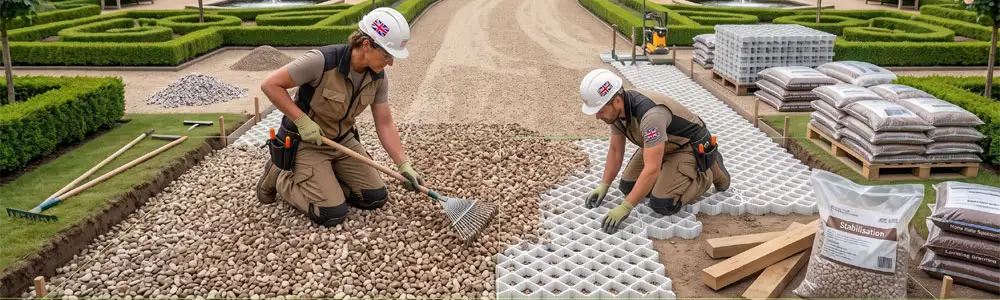
Grid panels, gravel fill, membrane, edging, pegs, and sub-base - everything you need for a stable gravel surface.
Panel m²:
-
Fill to grid depth or slightly proud (3-5 mm above). Typical grids: 30-50 mm depth.
Geotextile membrane under the grid. Add 10% for overlaps.
Gravel edging restraint to contain the grid. Calculated from total perimeter.
Typically 1 peg per 0.5 m² - holds grid flat during fill.
Areas
Your areas
Area name
Length (m)
Width (m)
Job Costing (optional)
Pro featurePopulate cost fields with current UK market prices. Sign in or upgrade to access.
Results
Total Area
-
m²
Grid panels
-
panels
Gravel to order
-
tonnes
Perimeter
-
linear m
Area Breakdown
| Area | Dimensions | Area (m²) | Panels | Gravel (t) | Perimeter (m) |
|---|
🚫 Estimate waste & skip size for this project →
Doing this as a homeowner?
Who do you actually need to hire for this?
Not sure what some of these terms mean?
Browse all →
Frequently Asked Questions
How many gravel stabilisation grid panels do I need?
Divide area by the area of one panel. A typical panel is 600 x 400 mm (0.24 m²). A 30 m² driveway: 30 ÷ 0.24 = 125 panels + 5-10% cutting waste. Gravel infill: approximately 20-25 kg/m² for a 50 mm grid depth using 10-20 mm aggregate.
What gravel should I use to fill stabilisation grids?
Use angular or crushed stone (10-20 mm) - not smooth rounded pea gravel. Angular stone locks together and resists displacement. Popular: crushed granite, limestone, or flint. Decorative coloured gravels also work. Avoid stones over 20 mm - they sit proud of the grid and become a trip hazard.
What sub-base do I need under a gravel grid?
Pedestrian path: 50-100 mm compacted MOT Type 1 or Type 3 + geotextile membrane. Car driveway: 150 mm Type 1. Heavy vehicles: 200 mm Type 1. Lay a weed membrane over the sub-base (under the grids) to prevent weed growth from below without blocking drainage.
Is a gravel grid driveway classed as a permeable surface?
Yes - gravel grids are permeable surfaces so paving a front garden with them does not require planning permission regardless of area, under the 2008 GPDO. Solid impermeable surfaces (concrete, tarmac) require permission for front gardens over 5 m². Gravel grids are also SuDS-compliant.
Can gravel grids be driven on by cars?
Most standard grids are rated for domestic vehicles (up to 3.5 tonnes per axle). Heavy-duty grids are available for HGV/commercial use. Check the manufacturer's load rating. For car use: a 50 mm grid on 150 mm Type 1 sub-base is standard. A thinner grid or inadequate sub-base causes flex and gravel migration.
How do I prevent gravel from spreading or migrating?
Gravel grids are the best solution - cells hold aggregate in place under traffic. At the perimeter: use a solid edging (timber, metal, or concrete kerb) to contain the grids. Fill gravel to the top of the grid for a stable flush surface. Do not overfill - gravel proud of the grid is unstable and will spread. Rake level periodically.

Grid Selection Guide
| Grid depth | Best for |
|---|---|
| 30 mm | Light foot traffic, garden paths |
| 40 mm | Standard driveways, parking (most popular) |
| 50 mm | Heavy vehicles, commercial use |
| 60 mm | HGV access, lorry parking |
Load-bearing capacity varies by manufacturer - check the spec sheet. Most 40 mm grids are rated for cars and light vans (3.5 t axle).
Gravel Choice
- 10 mm pea gravel: Most popular - rolls easily into cells. Best visual finish.
- 14 mm shingle: Good for driveways, slightly larger. Less tendency to scatter.
- 20 mm shingle: For heavy-use areas - stays put better under tyres.
- Slate chippings: Decorative - use for garden features and paths.
- Crushed limestone: Compacts into cells - very stable, less scatter.
Fill grids 3-5 mm proud - gravel settles over the first few weeks.
Installation Tips
- Compact sub-base thoroughly with a wacker plate before laying membrane
- Overlap membrane joins by at least 150 mm and fold up at edges
- Lock panels together before pegging - avoid gaps between panels
- Peg at every corner and mid-span on edges, 1 peg per 0.5 m² elsewhere
- Start filling from one end - use a rake or back of a shovel
- Compact gravel gently once filled - avoid heavy vibration
- For driveways: 6% minimum fall away from buildings for drainage
Reviews
★★★★★Did you find this calculator useful? We would love to hear what you think - your feedback helps us improve.
Trade Terms
Not sure what a term means? Our plain-English glossary covers 200+ building and trade terms.
Trade Terms Dictionary