A single-storey house extension typically costs about £1,800 to £3,000 per square metre to build in the UK, with £2,400 a common midpoint. A 20 m² extension is therefore roughly £36,000 to £60,000 before fees, fit-out and contingency.
London and the South East run higher (often 20 to 35 percent more), and double-storey extensions usually cost less per square metre than single-storey ones.
Extension cost estimator
The estimator uses indicative rates from the sources below and does not replace a quote. It excludes VAT on professional fees, land costs and any unusual groundwork such as poor soil, trees or drains that need diverting.
Typical cost per square metre
| Specification | Single storey | Double storey (per m² of total floor space) |
|---|---|---|
| Basic | About £1,800 to £2,200 per m² | About £1,550 to £1,900 per m² |
| Standard | About £2,200 to £2,800 per m² | About £1,900 to £2,400 per m² |
| High | About £2,800 to £3,500 per m² | About £2,400 to £3,000 per m² |
Total build cost for the same footprint
A 20 m² footprint: single storey is 20 m² of new floor space, double storey is 40 m² (the same again upstairs). Build only, before fees, fit-out and contingency.
A double storey costs less per square metre, but you are building twice the floor space, so the total is higher. These are build costs only, before fees, kitchens, bathrooms and contingency. Published price guides vary, and some use low rates that exclude VAT or finishes, so a wide range is the honest answer.
House extension cost by size
Most people search for the cost of an extension of a particular size. This table applies the single-storey rates above to common sizes, for a build in the middle of the UK range, so adjust for your region.
| Floor area | Basic | Standard | High |
|---|---|---|---|
| 10 m² | £18,000 to £22,000 | £22,000 to £28,000 | £28,000 to £35,000 |
| 15 m² | £27,000 to £33,000 | £33,000 to £42,000 | £42,000 to £52,500 |
| 20 m² | £36,000 to £44,000 | £44,000 to £56,000 | £56,000 to £70,000 |
| 30 m² | £54,000 to £66,000 | £66,000 to £84,000 | £84,000 to £105,000 |
| 40 m² | £72,000 to £88,000 | £88,000 to £112,000 | £112,000 to £140,000 |
As a guide, 10 m² is roughly a utility room or small study, 20 m² a good-sized kitchen extension, and 30 to 40 m² a large kitchen-diner or two rooms. Use the estimator above to see the effect of region, extras, fees and contingency.
Does VAT apply to an extension?
Yes. Building an extension to an existing home is normally charged at the standard 20 percent VAT rate, unlike a new-build home, which can be zero-rated. Many builders are VAT registered, but small firms below the threshold may not charge it, so always check whether a quote includes VAT. Our price ranges are broad enough to cover both situations, but compare quotes on the same basis.
What pushes the cost up or down
Where the money typically goes
A rough guide to how the build cost splits. Your own quote will differ.
- Foundations and groundwork
- Walls, floor and roof structure
- Windows and external doors
- Electrics, plumbing and heating
- Plastering, flooring and decoration
- Location: London and the South East are typically 20 to 35 percent above the national figure, and parts of the North and Scotland are lower.
- Single or double storey: a second storey shares the foundations and roof, so the cost per square metre falls, though the total is higher.
- Size: small extensions cost more per square metre because kitchens, bathrooms and fixed costs are spread over less floor area.
- Ground conditions: clay, trees and drains near the footprint can mean deeper or specialist foundations.
- Structural work: removing a load-bearing wall needs a steel beam and calculations from a structural engineer.
- Glazing and roof: large glass doors and roof lanterns can add thousands.
- Builder demand: busy periods and tight local supply raise quotes.
Costs people forget
| Item | Typical allowance |
|---|---|
| Architect or designer and structural engineer | Often 8 to 15 percent of the build cost together |
| Planning application (if needed) | Fee set nationally and revised periodically, check the Planning Portal |
| Building regulations (building control) | Several hundred pounds, varying by council or approved inspector |
| Party wall surveyor (if shared walls) | Commonly £1,000 to £3,000 or more per neighbour |
| Kitchen and bathroom fit-out | See the estimator extras above |
| Decoration, flooring and landscaping | Often overlooked, allow for it |
| Contingency | 10 to 15 percent of the build cost |
Planning permission may not be needed for smaller rear extensions, but building regulations approval almost always is. Check with the permitted development checker and see our house extension planning guide. If you share a wall, search the glossary for the Party Wall Act.
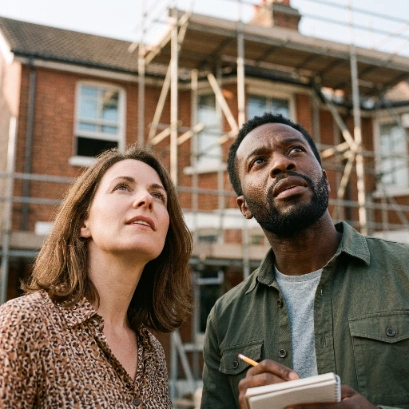
Before you ask for quotes
Decide what you want the new space to do, sketch the layout and note the finishes you like. Builders can only price accurately when they are all pricing the same thing.
Ask each one for an itemised quote, and compare them line by line, not just the total.
Cutting the cost without cutting corners
- Keep the footprint simple: fewer corners and a plain roof shape are cheaper to build.
- Build up rather than out where foundations are expensive.
- Get at least three itemised quotes and compare like for like.
- Fix the design and specification before work starts, because changes mid-build are the main cause of overspend.
- Buy materials yourself only if you can manage the ordering. Use our brick and foundation calculators to check quantities.
Sources and further reading
- Checkatrade: house extension cost guide Typical per square metre ranges
- Federation of Master Builders Trade body advice on hiring builders and pricing
- Homebuilding & Renovating Extension cost and budgeting guides
- Planning Portal: extensions Planning and building regulations basics
External links open in a new tab. Costs combine several published price guides, which differ. Last checked November 2026.
Frequently asked questions
How much does a house extension cost per square metre in the UK?
A single-storey extension typically costs about 1,800 to 3,000 pounds per square metre for the build, with around 2,400 pounds a common midpoint. Double-storey extensions usually cost less per square metre because the foundations and roof are shared. London and the South East cost more.
How much does a 20 square metre single-storey extension cost?
At 1,800 to 3,000 pounds per square metre the build is roughly 36,000 to 60,000 pounds before fees, kitchen or bathroom fit-out, and contingency.
Do I need planning permission for an extension?
Many single-storey rear extensions are permitted development in England, subject to size and other limits, but building regulations approval is almost always needed. Check with your council or our permitted development checker.
What extra costs should I budget for?
Professional fees, planning and building control fees, party wall costs, kitchen or bathroom fit-out, decoration and landscaping, and a contingency of around 10 to 15 percent.
How much does a 30 square metre extension cost?
A 30 square metre single-storey extension of standard specification typically costs about 66,000 to 84,000 pounds for the build, before fees, fit-out and contingency.
How much does a double-storey extension cost?
A double-storey extension costs less per square metre than a single-storey one, about 1,900 to 2,400 pounds at standard specification, but you are building twice the floor space. A 20 square metre footprint with the same again upstairs (40 square metres) is about 76,000 to 96,000 pounds.
Is VAT charged on a house extension?
Extensions to an existing home are normally charged at the standard 20 percent VAT rate, unlike new-build homes, which can be zero-rated. Builders who are not VAT registered do not charge it, so check whether each quote includes VAT.
Is it cheaper to extend or move?
Extending is often cheaper than moving once stamp duty, agent and legal fees and removal costs are counted, but it depends on your local market and the size of extension.