A Gothic Revival house is a house built in the 19th century in the manner of medieval architecture, with steep roofs, tall gables, pointed-arch windows, carved bargeboards and often bands of coloured brick. It is heavier and more serious than the playful Georgian Gothick.
The style was championed by Augustus Pugin, then by architects such as George Gilbert Scott and William Butterfield. It was used most for churches and public buildings, but it shaped many Victorian rectories, villas and country houses too.
c. 1830-1900
The band starts in the late Georgian period and runs through the Victorian period. Periods are drawn at equal width, so the line is not to scale.
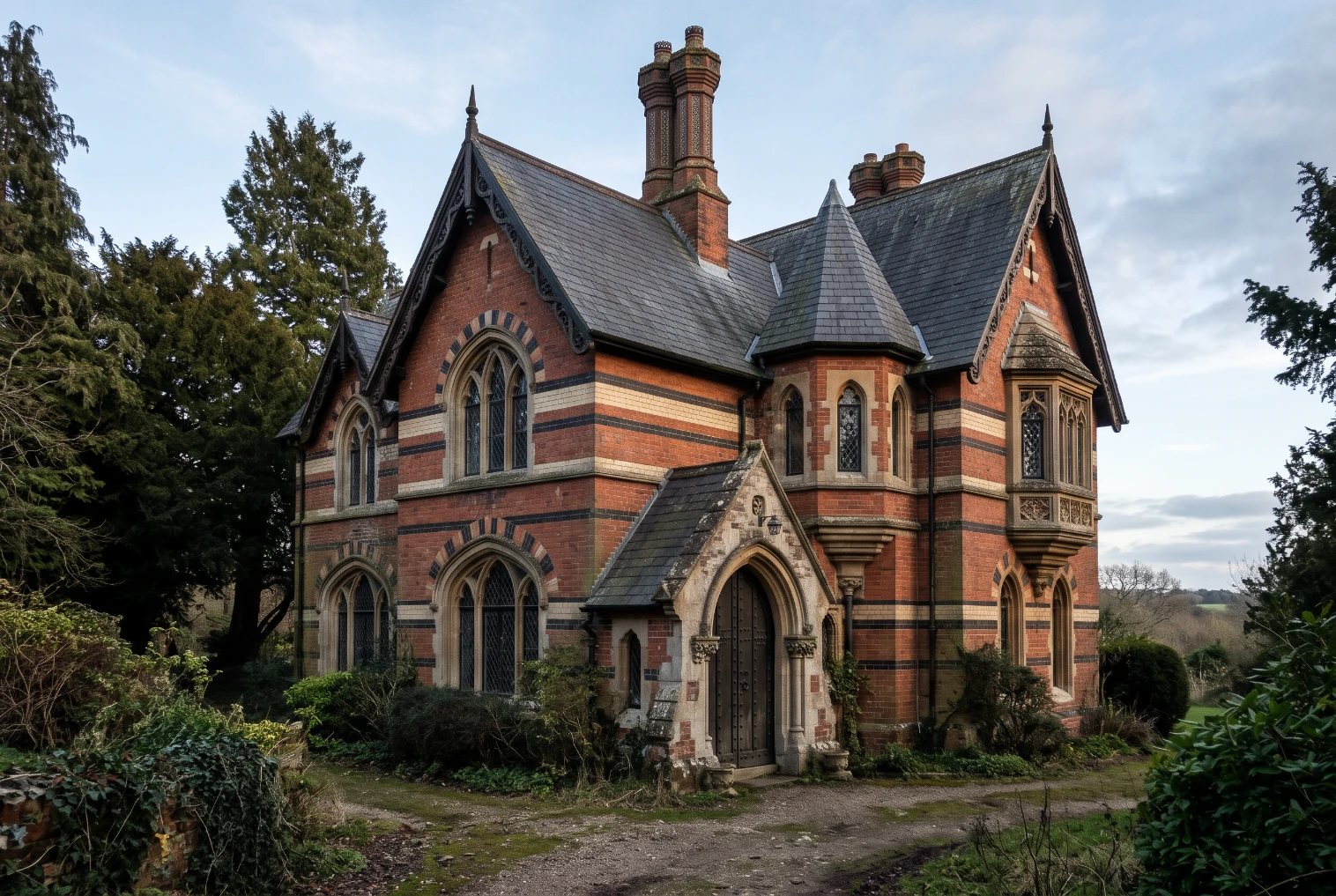
How to recognise it
| Feature | What to look for |
|---|---|
| Roof | Steeply pitched slate or tile roofs, often with patterned bands, with prominent gables and tall chimney stacks. |
| Windows | Pointed or two-centred arches, often with stone mullions and tracery, and sometimes an oriel or a projecting bay. |
| Walls | Red or yellow brick with stone dressings, often with bands or patterns in contrasting brick, called polychrome brickwork. |
| Gables | Steep gables with carved timber bargeboards, finials and sometimes a small attic window. |
| Doorway | A pointed-arch porch or doorway with carved stone, and a heavy timber door with decorative hinges. |
| Plan | Irregular and asymmetrical, planned from the inside out, not to a formal front. |
| Detail | Stained glass, carved stone and tiled floors in the better houses. |
Not sure what a term means? See our guides to bay, bow and oriel windows and hipped, gable and mansard roofs, or browse the full architectural glossary.
Where and when they were built
Gothic Revival grew from an earlier taste for the picturesque and developed into a serious movement. Pugin argued that Gothic was the right Christian style, and later Ruskin praised honest craftsmanship and colour, which encouraged the coloured brick patterns seen on many houses from the 1850s.
The Historic England entry for Wykeham House in Oxford, listed Grade II and dated 1866, describes a High Victorian Gothic house with an asymmetrical gable. The Historic England listing guide on suburban and country houses covers how Victorian houses in this and other revival styles are assessed.
Gothic Revival, Georgian Gothick or Old English?
- Gothic Revival: about 1830 to 1900. Serious, steep and asymmetrical, with heavy detail and often coloured brick.
- Georgian Gothick: earlier and lighter, with pointed windows on a symmetrical house. See our Georgian Gothick page.
- Old English revival: based on timber-framed houses, with half-timbering and leaded casements. See our Old English revival page.
- Victorian villa: the common brick house, with some Gothic ornament. See our Victorian villa page.
Many ordinary Victorian houses borrow a Gothic window or a steep gable, so a true Gothic Revival house is one where the whole design follows the style.
What to check when buying one
- Roof and gables: steep roofs with many valleys and gables have many places for leaks. Check the lead, valleys and the barge boards for rot.
- Coloured brickwork: patterned brick is vulnerable to hard repointing and cleaning. Repair with matching bricks and lime mortar.
- Stone and tracery: carved stone weathers and can crack where iron cramps rust. Look at window heads and porches.
- Stained glass and joinery: original glass and doors are valuable and often protected. Avoid removing them.
- Chimneys: tall stacks are exposed to weather. Check pots, flaunching and the brick at the top.
- Choose the right survey: use a surveyor who knows solid-wall Victorian buildings. See our home survey guide.
- Listed status and conservation areas: some Victorian houses are listed and many lie in conservation areas, where windows, roofs and fronts may be controlled. See our listed buildings guide.
Sources and further reading
- Historic England: Wykeham House, Oxford A Grade II High Victorian Gothic house of 1866
- Historic England: Domestic 3, Suburban and Country Houses Listing selection guide covering Victorian and later houses
- Historic England: the National Heritage List for England Check whether a building is listed
External links open in a new tab. Last checked November 2026.
Frequently asked questions
What is a Gothic Revival house?
A 19th-century house built in the manner of medieval architecture, with steep roofs, gables, pointed windows and often coloured brickwork.
What is the difference between Gothic and Gothick?
Gothick, with a k, is the lighter, decorative 18th-century style. Gothic Revival is the more serious, archaeological Victorian movement.
What is polychrome brickwork?
Brickwork that uses contrasting colours, such as red, yellow and black bricks, laid in bands and patterns.
Who started Gothic Revival?
It grew from the 18th-century picturesque, and was driven in the 19th century by Augustus Pugin and later architects such as George Gilbert Scott and William Butterfield.
Are Gothic Revival houses listed?
Many are, especially the better-designed ones, and many lie in conservation areas. Check the National Heritage List for England.