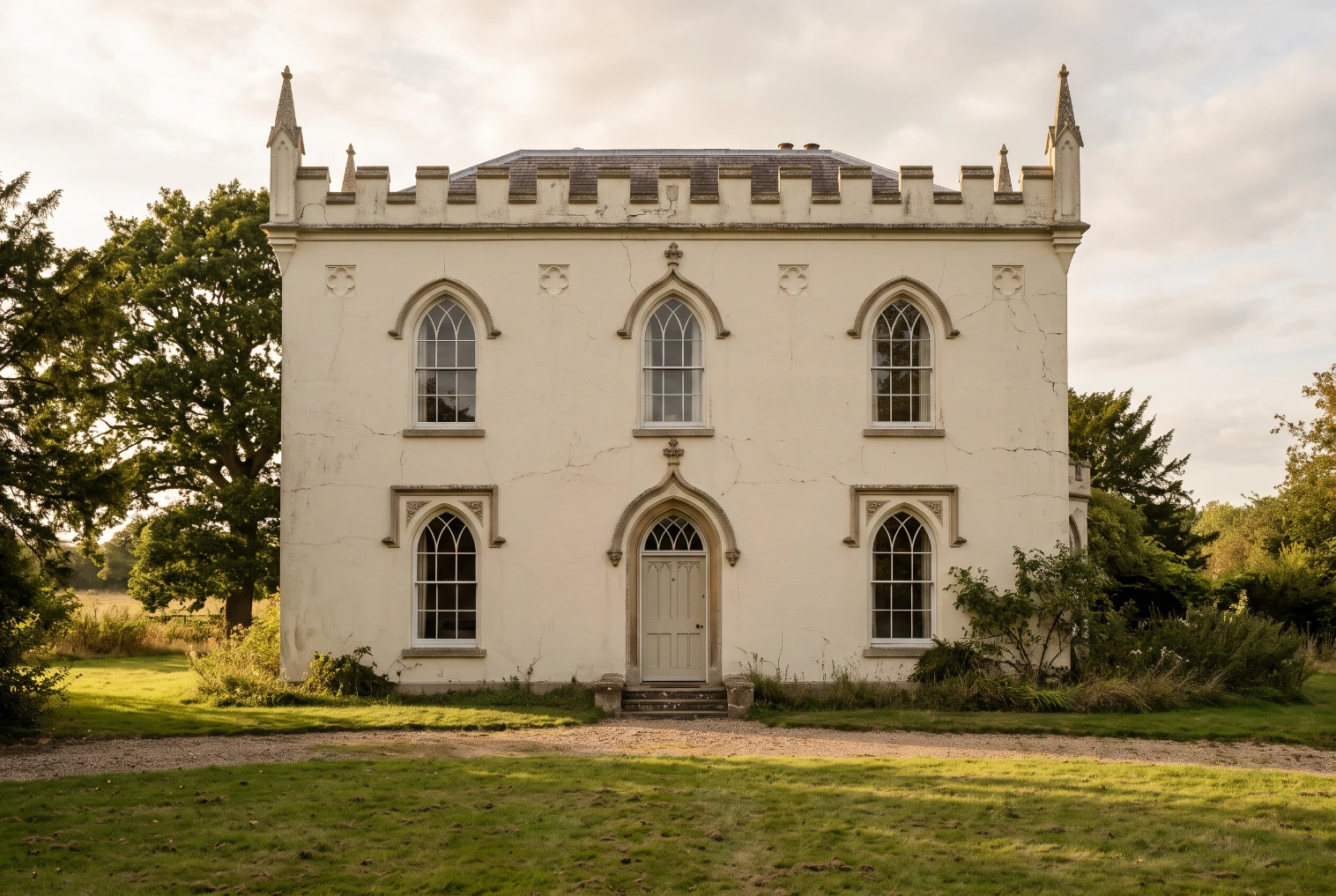
A Georgian Gothick house is an 18th-century house dressed up with medieval-looking details such as pointed arches, ogee windows, battlements and pinnacles. The spelling Gothick, with a k, marks the playful 18th-century style and sets it apart from the serious Victorian Gothic Revival.
It was made fashionable from the 1740s, most famously by Horace Walpole at Strawberry Hill. Gothick houses are usually still symmetrical and Georgian in shape, with the Gothic features added as decoration, often in pale stucco.
c. 1740-1800
The band sits in the middle of the Georgian period. Periods are drawn at equal width, so the line is not to scale.
How to recognise it
| Feature | What to look for |
|---|---|
| Windows | Pointed or ogee-headed windows, often sash windows with Gothic-shaped heads and thin intersecting glazing bars, sometimes with coloured glass. |
| Parapet | Battlements and small pinnacles along the roofline, which are decorative rather than defensive. |
| Walls | Painted or limewashed stucco, in pale cream, white or stone colours, or brick and flint. |
| Doorway | A pointed or ogee arch over the front door, sometimes with a porch of thin shafts. |
| Ornament | Quatrefoils, cusped panels, label mouldings above windows and finials. |
| Plan | Usually symmetrical or a regular Georgian plan, with Gothic dress added, though a few are deliberately irregular. |
| Interiors | Plaster fan vaults, pointed arches and Gothic fireplaces in the principal rooms. |
Not sure what a term means? See our guides to sash and casement windows and render, stucco, roughcast and pebbledash, or browse the full architectural glossary.
Where and when they were built
Gothick appeared in the 1740s as a light-hearted alternative to Palladian formality. Strawberry Hill at Twickenham, which Horace Walpole developed between 1749 and 1776, is the best-known example. Historic England describes its ogee and cinquefoil windows, bay and oriel windows and battlemented parapets with pinnacles.
Gothick features were also added to older houses, to rectories, lodges, cottages and garden buildings. Many are small. The Georgian taste for Gothic was about atmosphere and romance, and it led, later, to the more serious Gothic Revival of the Victorian period.
Gothick, Gothic Revival or medieval?
- Medieval Gothic: built in the Middle Ages, with real structural pointed arches.
- Georgian Gothick: about 1740 to 1800. Decorative pointed arches, battlements and pinnacles on a Georgian house.
- Gothic Revival: a more serious, archaeological style from about 1830 to 1900, with steep roofs and coloured brickwork.
- Strawberry Hill Gothic: another name for the early Gothick of Walpole's house and its followers.
A good test is the plan. If a symmetrical Georgian house has pointed windows added, it is probably Gothick. If the whole building is irregular, steep and heavily detailed, it is probably Victorian.
What to check when buying one
- Stucco and render: old stucco cracks and lets water in. Repair with lime and breathable paint, not cement or masonry paint.
- Pointed windows: unusual window shapes make repair and replacement difficult. Keep original timber glazing bars and have repairs made to match.
- Battlements and pinnacles: thin parapets and pinnacles loosen with age and frost. Check for movement and open joints.
- Timber and plaster details: decorative tracery and interior plaster vaults can rot or crack. Look for old leaks.
- Damp: see our damp and mould guide before choosing repair methods.
- Choose the right survey: use a surveyor with experience of older buildings. See our home survey guide.
- Listed status: most surviving Georgian houses are listed or in a conservation area, and most alterations need consent. See our listed buildings guide.
Sources and further reading
- Historic England: Strawberry Hill, Twickenham A Grade I house with ogee windows and battlements
- Historic England: Strawberry Hill park and garden Horace Walpole's remodelled house and grounds
- Historic England: the National Heritage List for England Check whether a building is listed
External links open in a new tab. Last checked November 2026.
Frequently asked questions
What does Gothick mean?
Gothick is the spelling used for the playful 18th-century revival of medieval Gothic styles, as distinct from the more serious Victorian Gothic Revival.
What is Strawberry Hill Gothic?
The style of Horace Walpole's house at Twickenham, which he remodelled between 1749 and 1776 with pointed windows, battlements and pinnacles. It inspired many later Gothick houses.
Are Gothick houses medieval?
No. They are 18th-century houses decorated with medieval-style details. Some were built on older sites or added to older buildings.
How is Gothick different from Gothic Revival?
Gothick is lighter, more decorative and usually still Georgian in plan. Gothic Revival is more serious and archaeological, with steep roofs and heavier detail.
Are Gothick houses listed?
Most surviving ones are, including many small lodges and cottages. Check the National Heritage List for England before planning work.