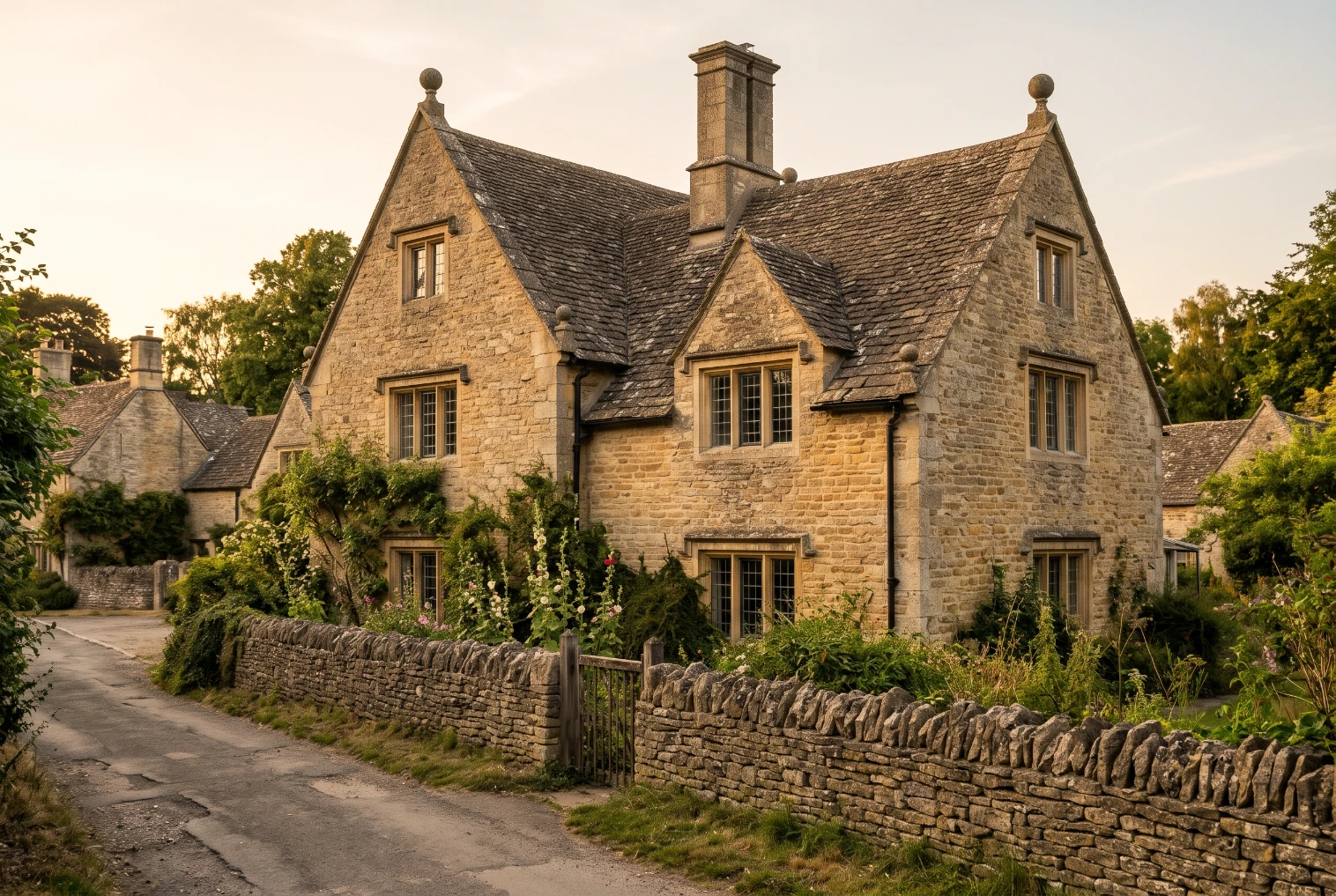
A Cotswold stone house is a house built from the honey-coloured limestone of the Cotswold hills in Gloucestershire, Oxfordshire and nearby counties. It typically has steep gables, stone-mullioned windows and a roof of stone slates.
The tradition grew with the wool trade, which paid for many of the best houses from the 16th and 17th centuries. Local stone was used for walls, roofs, boundary walls and even paving, which is why villages look so harmonious.
c. 1550-1850
Regional building traditions have no single start date, so the band shows the main period of building. Periods are drawn at equal width, so the line is not to scale.
How to recognise it
| Feature | What to look for |
|---|---|
| Walls | Oolitic limestone, from golden yellow to cream and grey, laid in coursed rubble or fine ashlar on better houses. |
| Roof | Steeply pitched stone slates, graded from large at the eaves to small at the ridge. |
| Gables | Prominent gables, often with kneelers (shaped end stones) and sometimes ball finials. |
| Windows | Stone-mullioned windows with drip moulds, or hood mouldings, over them. |
| Chimneys | Tall stone stacks at the gable ends or on the ridge. |
| Walls and setting | Dry stone walls and stone-paved paths, so that houses and landscape match. |
Not sure what a term means? See our guides to hipped, gable and mansard roofs and eaves, fascia, soffit and verge, or browse the full architectural glossary.
Where and when they were built
Cotswold building thrived on the wealth of the medieval and Tudor wool trade. Local masons used the nearby stone for farmhouses, manor houses, cottages and the wool churches, and the style continued in simpler form through the 18th century.
The Historic England guide to vernacular houses explains how regional materials gave different parts of the country their own building styles. The Cotswolds is among the best-known examples, where the local oolitic limestone gave the buildings both their colour and their form.
Cotswold stone, Yorkshire Dales stone or Peak District gritstone?
- Cotswold stone: warm, honey-coloured limestone with steep stone-slate roofs and a refined look.
- Yorkshire Dales stone: greyer, plainer and heavier. See our Yorkshire Dales stone house page.
- Peak District gritstone: darker and harder. See our Peak District gritstone page.
- Jacobean house: the grander national style that many Cotswold manors resemble. See our Jacobean house page.
Newer houses in Cotswold stone are common in the area, so check whether the stone and the roof are original.
What to check when buying one
- Stone slate roof: old stone slates are heavy and costly to repair. Check the roof timbers, the pegs and the lead flashings.
- Pointing and stone repairs: use lime mortar and matching stone. Cement mortar can damage soft limestone.
- Damp: solid limestone walls without a damp-proof course need breathable repairs. See our damp and mould guide.
- Stone supply and cost: matching stone and skilled masons are expensive. Allow for this in your budget.
- Planning controls: much of the area is within the Cotswolds National Landscape, where design is closely controlled.
- Choose the right survey: use a surveyor with experience of traditional buildings. See our home survey guide.
- Listed status and conservation areas: many surviving traditional houses are listed or lie in conservation areas, and most changes need consent. See our listed buildings guide.
Sources and further reading
- Historic England: Domestic 1, Vernacular Houses Listing selection guide covering traditional regional houses
- Historic England: the National Heritage List for England Check whether a building is listed
External links open in a new tab. Last checked November 2026.
Frequently asked questions
What is Cotswold stone?
A honey-coloured oolitic limestone quarried in the Cotswolds, and used for walls, roofs and boundary walls.
Why are Cotswold houses so yellow?
The limestone contains iron compounds that give it a warm yellow or golden colour.
What are stone slates?
Thin slabs of split limestone used as roof tiles, often laid in diminishing courses.
Can I use modern stone to extend a Cotswold house?
Usually yes, but the stone should match the existing in colour and texture. Planning authorities often insist on this.
Are Cotswold stone houses listed?
Many are, and most villages are conservation areas. Check the National Heritage List for England.