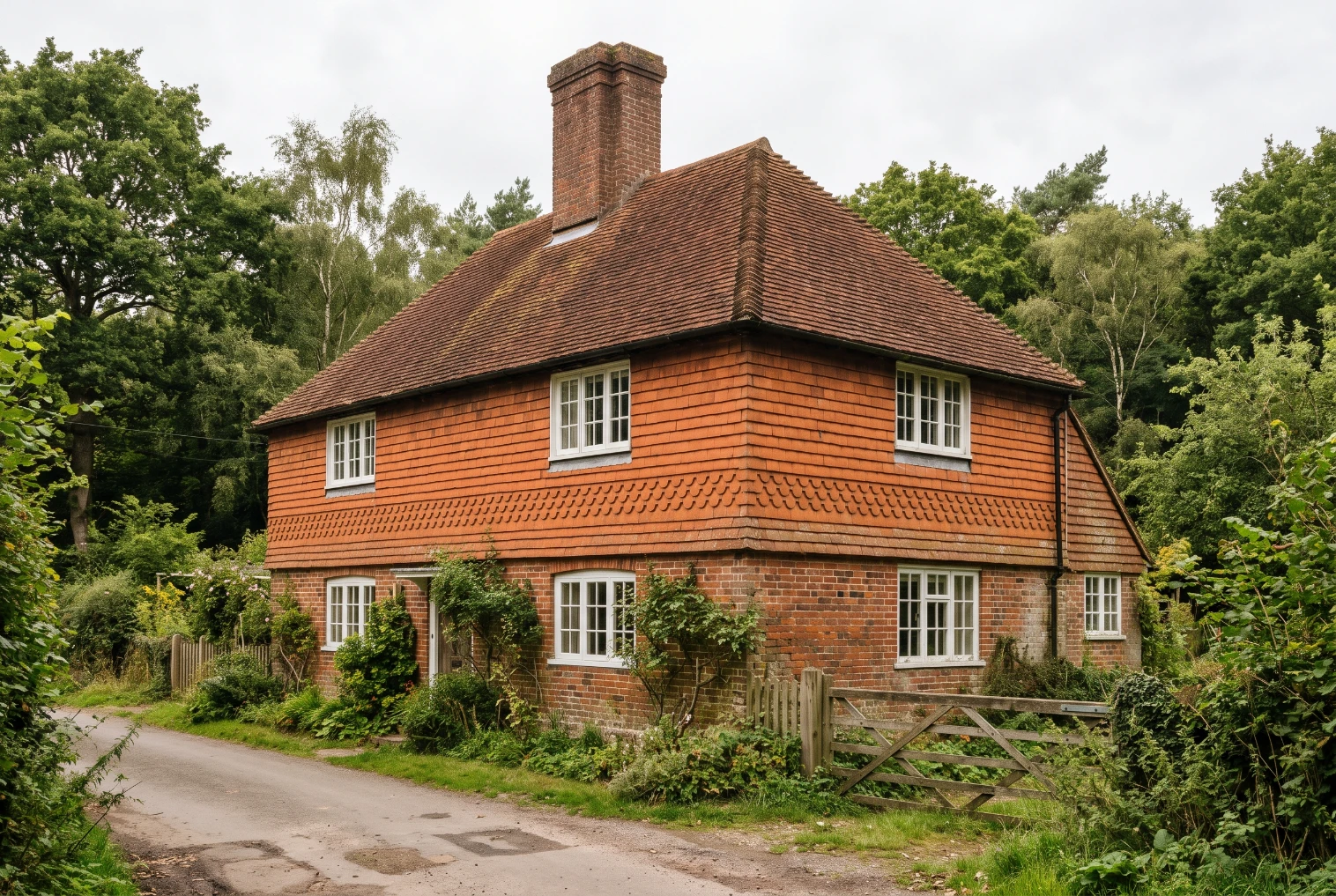
A tile-hung house is a house with its upper walls covered in rows of clay tiles hung on battens, often over a timber frame or brick wall. It is a hallmark of the Weald, in Sussex, Surrey and Kent, where clay and woodland provided the materials.
Tile hanging keeps out wind-driven rain and gives timber frames weather protection. Some tiles are plain, some have curved ends in a fish-scale pattern, and in places such as Lewes, so-called mathematical tiles were made to look like brick.
c. 1700-1900
Regional building traditions have no single start date, so the band shows the main period of building. Periods are drawn at equal width, so the line is not to scale.
How to recognise it
| Feature | What to look for |
|---|---|
| Tile hanging | Rows of clay tiles hung on wooden battens, often in orange-red, with bands of decorative curved tiles. |
| Walls | Brick or timber frame below and tile hanging on the upper floor, or sometimes the whole front. |
| Roof | A steep clay-tile roof, often with hips and a tall chimney. |
| Windows | Casement or sash windows in painted timber. |
| Mathematical tiles | In some places, tiles that imitate brick, used to give a flat brick-like face. |
| Setting | Villages in the Weald with woodland, hedges and winding lanes. |
Not sure what a term means? See our guides to sash and casement windows and timber frame terms, or browse the full architectural glossary.
Where and when they were built
The Weald's clay was ideal for tile making, and its woods supplied timber. Tile hanging became popular from the 17th and 18th centuries, and was revived by Victorian architects such as Richard Norman Shaw as part of the Old English style.
The Historic England guide to vernacular houses covers regional building materials and how they give local character. Tile hanging is one of the most recognisable features of south-east England.
Tile-hung, weatherboard or Old English revival?
- Sussex and Weald tile-hung: tiles hung on the wall, usually on older and traditional houses.
- Kentish weatherboard and oast: boards instead of tiles. See our Kentish weatherboard page.
- Old English and Tudorbethan revival: a Victorian style that used tile hanging with half-timbering. See our Old English revival page.
- Wealden hall house: the medieval timber-framed type found in the same area. See our Wealden hall house page.
Many modern houses in the area use tile hanging as a decoration, so check the age of the tiles and the wall behind.
What to check when buying one
- Slipped tiles and fixings: old tiles are held by nibs and nails that rust. Check for slipped or missing tiles.
- Battens and timbers: water getting behind the tiles rots the battens and timber frame. Check the lower edge and corners.
- Roof and chimneys: check the tile roof, ridges and chimney flashings. See our roof tile calculator.
- Hand-made tiles: matching old tiles is expensive. Allow for repairs with reclaimed tiles.
- Damp: see our damp and mould guide.
- Choose the right survey: use a surveyor with experience of traditional buildings. See our home survey guide.
- Listed status and conservation areas: many surviving traditional houses are listed or lie in conservation areas, and most changes need consent. See our listed buildings guide.
Sources and further reading
- Historic England: Domestic 1, Vernacular Houses Listing selection guide covering traditional regional houses
- Historic England: the National Heritage List for England Check whether a building is listed
External links open in a new tab. Last checked November 2026.
Frequently asked questions
What is tile hanging?
A way of covering an outside wall with rows of clay tiles fixed to timber battens, to keep out the weather.
What are mathematical tiles?
Special tiles made to look like brick, hung on a wall so that the front looks like brickwork.
Why is tile hanging common in the Weald?
Local clay for tiles and local timber for frames made it a natural choice.
Does tile hanging need maintenance?
Yes. Slipped tiles, rusted fixings and decayed battens need regular repair.
Are tile-hung houses listed?
Many older ones are, and many villages are conservation areas. Check the National Heritage List for England.