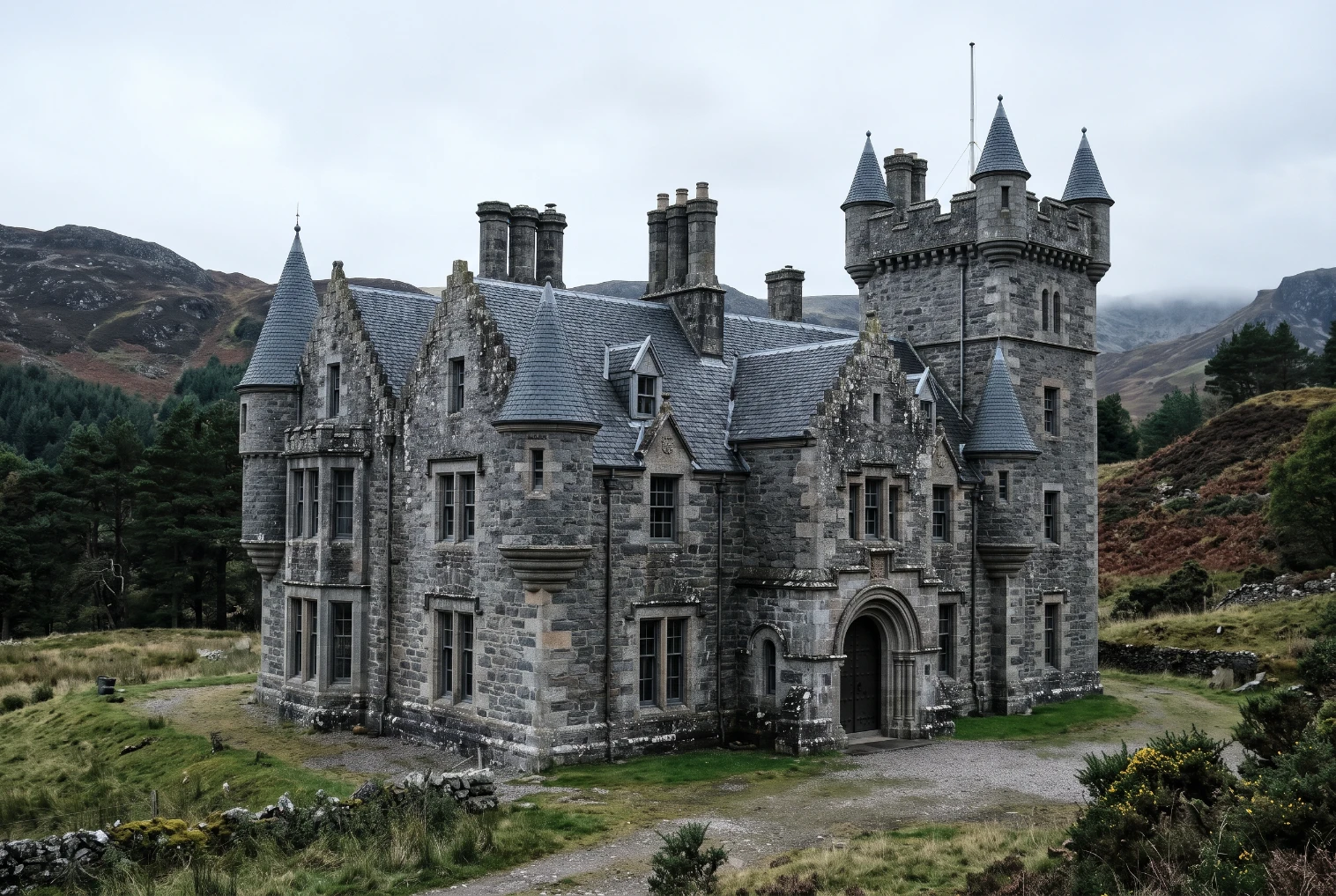
A Scots Baronial house is a house built from about 1830 to 1900 in the style of Scottish tower houses and castles, with corbelled turrets, crow-stepped gables, tall chimneys and a strong, rugged look. It is most often found in Scotland.
The style was made popular by Sir Walter Scott, who built Abbotsford, and by Queen Victoria and Prince Albert, who had Balmoral rebuilt in the 1850s. Architects such as David Bryce and William Burn used it for country houses, hotels and public buildings.
c. 1830-1900
The band starts in the late Georgian period and runs through the Victorian period. Periods are drawn at equal width, so the line is not to scale.
How to recognise it
| Feature | What to look for |
|---|---|
| Walls | Local stone, often granite or sandstone, in rugged rubble or dressed blocks. |
| Turrets | Small round turrets projecting from corners on corbels, topped with conical roofs. |
| Gables | Crow-stepped gables, with the edge cut into small steps. |
| Tower | A tower, often with a battlemented parapet, as the main feature or the entrance. |
| Windows | Small, deep-set windows, often with pedimented dormers and stone mullions. |
| Roof | Steep slate roofs with tall, plain or decorated chimneys. |
| Doorway | A round-arched doorway with a heavy studded door, sometimes with a coat of arms. |
Not sure what a term means? See our guides to hipped, gable and mansard roofs and ashlar and rubble stone, or browse the full architectural glossary.
Where and when they were built
Scots Baronial borrowed from the fortified tower houses of 16th and 17th-century Scotland. The Victorians wanted a romantic and national style, and the result was a mixture of real history and picturesque invention.
The Historic Environment Scotland record for Overtoun House near Dumbarton, built in 1860 to 1863 and designed by James Smith, shows crow-stepped gables and corbelled angle turrets. The style also appears in England and Wales, usually on country houses and hotels.
Scots Baronial, Gothic Revival or Jacobean?
- Scots Baronial: about 1830 to 1900. Turrets, crow-stepped gables and tower-house detail.
- Gothic Revival: based on English medieval churches and houses. See our Gothic Revival page.
- Jacobean: an English 17th-century style. See our Jacobean house page.
- Scottish tower house: the 16th and 17th-century originals that the Victorians copied.
Many Baronial houses combine older fabric with Victorian additions, so ask which parts are original.
What to check when buying one
- Stone and pointing: rubble stone needs lime mortar. Hard cement repair can damage the stone.
- Turrets and parapets: corbelled turrets and battlements are exposed and can leak at the lead and masonry joints.
- Roof: steep slate roofs and many valleys need regular checks. Look at the chimneys.
- Heating and size: thick walls and large rooms are costly to heat. Ask about running costs.
- Damp: solid stone walls need breathable repairs. See our damp and mould guide.
- Choose the right survey: use a surveyor who knows solid-wall Victorian buildings. See our home survey guide.
- Listed status and conservation areas: some Victorian houses are listed and many lie in conservation areas, where windows, roofs and fronts may be controlled. See our listed buildings guide.
Sources and further reading
- Historic Environment Scotland: Overtoun House A Scots Baronial house of 1860 to 1863 with crow-stepped gables and corbelled turrets
- Historic England: the National Heritage List for England For buildings in England
External links open in a new tab. Last checked November 2026.
Frequently asked questions
What is Scots Baronial?
A 19th-century style that revives the look of Scottish castles and tower houses, with turrets, crow-stepped gables and tall chimneys.
What is a crow-stepped gable?
A gable whose sloping edge is cut into small steps, a feature of Scottish and Flemish buildings.
Who made Scots Baronial popular?
Sir Walter Scott, through Abbotsford, and Queen Victoria, through the rebuilding of Balmoral, encouraged the style.
Is Scots Baronial found only in Scotland?
Mostly, but it was also used in England and Wales for country houses and hotels.
Are Scots Baronial houses listed?
Many are. In Scotland, listing is handled by Historic Environment Scotland, so check the national register for the country.