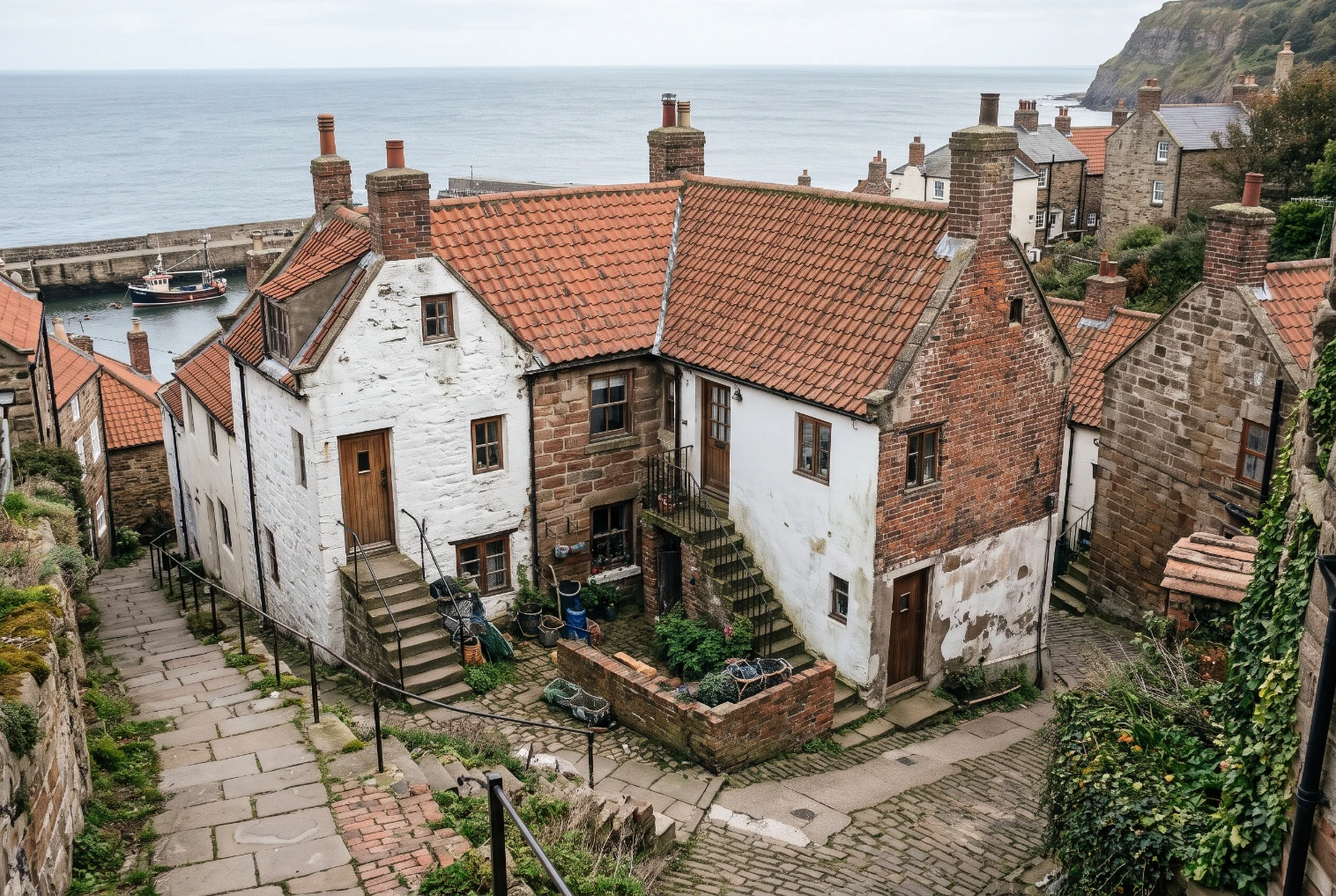
Fishermens cottages are small, tightly packed houses built in harbour villages, usually in stone or brick, with a pantile or slate roof and whitewashed or colourful walls. Many stand gable-end to the sea, to shelter from storms.
They are found around the coast, in places such as Cornish harbour towns, Yorkshire villages like Staithes and Robin Hood's Bay, Norfolk, and east and north-east Scotland. Many are now holiday homes and second homes.
c. 1700-1900
Regional building traditions have no single start date, so the band shows the main period of building. Periods are drawn at equal width, so the line is not to scale.
How to recognise it
| Feature | What to look for |
|---|---|
| Layout | Cottages packed along narrow lanes and steps, often facing different ways to dodge the wind. |
| Walls | Stone or brick, often rendered, whitewashed or painted. |
| Roof | Red pantiles in the east, slate in the west, with small stone chimneys. |
| Windows | Small windows set in thick walls, often with timber shutters. |
| Plan | Two rooms down and one or two up, sometimes with a net loft or store. |
| Detail | Stone steps, shared yards and sheds for gear. |
Not sure what a term means? See our guides to render, stucco, roughcast and pebbledash and parts of a roof, or browse the full architectural glossary.
Where and when they were built
Fishing villages grew where there was a safe landing and a steep shore, so houses often climb the hillside or crowd along the harbour. Gaps between the cottages were narrow, to keep the wind out.
The Historic England guide to vernacular houses covers regional traditions in coastal and fishing communities. Many harbour villages are conservation areas with tight planning controls.
Fishermens, coastguard or Cornish granite?
- Fishermens cottages: small, individual homes in harbour villages.
- Coastguard cottages: matching rows for coastguard staff. See our coastguard cottages page.
- Cornish granite house: a granite farmhouse or village house. See our Cornish granite house page.
- Orkney and Shetland stone houses: island houses by the sea. See our Orkney and Shetland page.
Many fishermens cottages have been joined, extended or restored, so check the layout and the history.
What to check when buying one
- Flood and coastal risk: cottages near the harbour may flood. Check flood risk, sea defences and insurance.
- Salt and damp: salt air and spray damage walls, windows and roofs. See our damp and mould guide.
- Access and parking: steep lanes and steps limit access, deliveries and parking.
- Holiday let and second homes: some villages limit second homes or holiday use. Ask about local planning rules.
- Small rooms and layout: rooms are small and stairs steep. Check that the layout suits you.
- Choose the right survey: use a surveyor with experience of traditional buildings. See our home survey guide.
- Listed status and conservation areas: many surviving traditional houses are listed or lie in conservation areas, and most changes need consent. See our listed buildings guide.
Sources and further reading
- Historic England: Domestic 1, Vernacular Houses Listing selection guide covering traditional regional houses
- Historic England: the National Heritage List for England Check whether a building is listed
External links open in a new tab. Last checked November 2026.
Frequently asked questions
What is a fishermens cottage?
A small house in a fishing village, often of stone or brick, with a pantile or slate roof.
Why are they gable-end to the sea?
It reduces the wind and spray that hit the long walls and roof.
What are pantiles?
Curved clay roof tiles with an S-shape, common on the east coast of England and Scotland.
Are fishermens cottages expensive to maintain?
They can be, because of salt, damp and difficult access for builders.
Are fishermens cottages listed?
Many are, and most fishing villages are conservation areas. Check the National Heritage List for England.