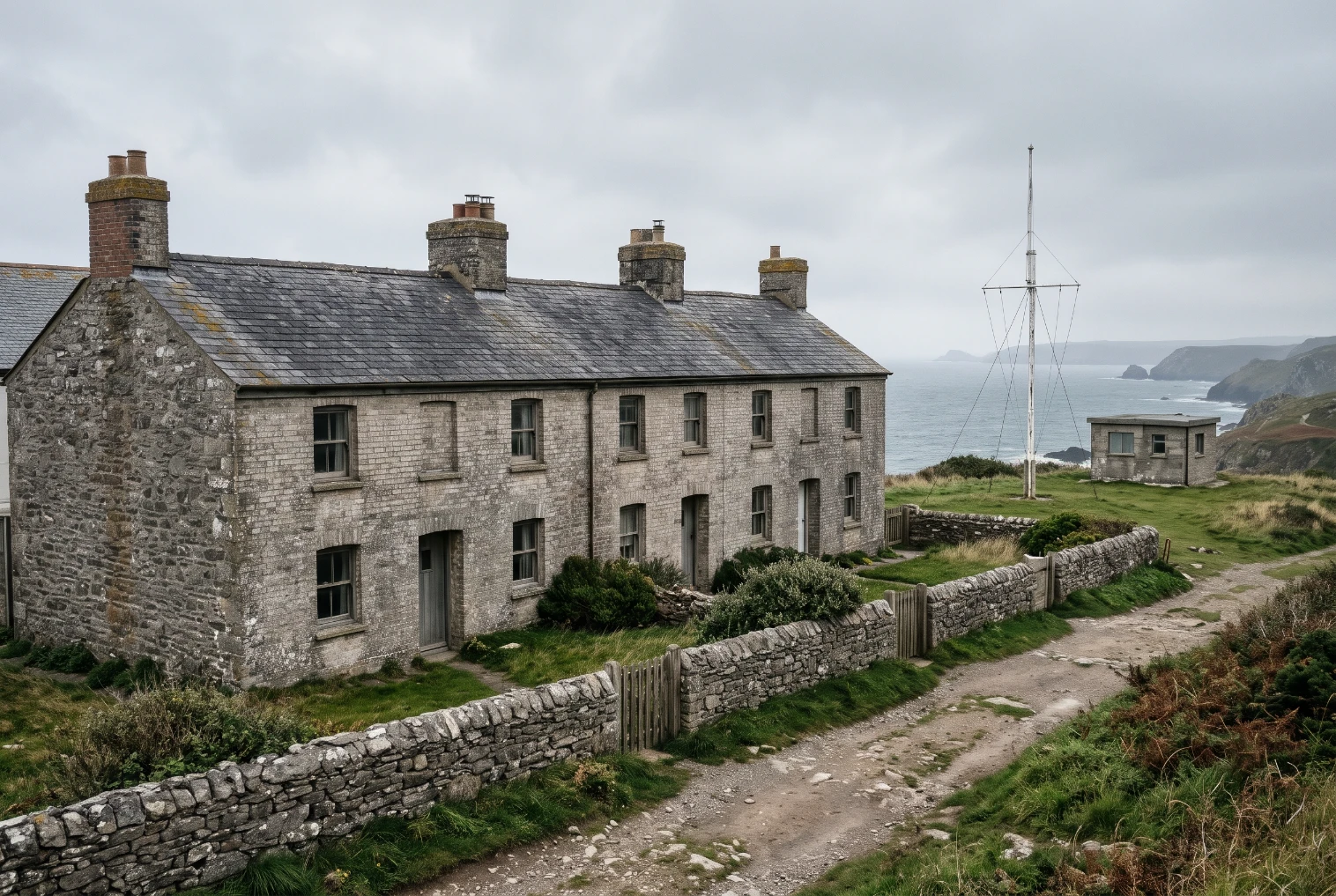
Coastguard cottages are rows of plain, matching houses built on the coast for coastguard staff and their families, usually in brick or stone with a slate roof. They often stand on headlands, near a lookout, and keep to a simple, uniform pattern.
The Coastguard service was organised in 1822 to stop smuggling and help with rescues. Cottages were built along the coast of England and Wales, and many now serve as private homes or holiday cottages.
c. 1822-1920
Regional building traditions have no single start date, so the band shows the main period of building. Periods are drawn at equal width, so the line is not to scale.
How to recognise it
| Feature | What to look for |
|---|---|
| Form | A plain terrace of identical two-storey houses, sometimes with a larger house for the officer. |
| Walls | Brick or local stone, with little ornament. |
| Roof | Slate, with a chimney at each party wall. |
| Windows | Small sash or casement windows in a regular pattern. |
| Garden | A small front garden, and sometimes a flagstaff or lookout nearby. |
| Setting | On headlands and coastal paths, near coves and harbours. |
Not sure what a term means? See our guides to sash and casement windows and parts of a roof, or browse the full architectural glossary.
Where and when they were built
The Coastguard was set up to prevent smuggling and later took on a role in rescues and defence. Its housing followed a standard pattern so staff could be moved easily from one station to another.
The Historic England guide to vernacular houses covers regional traditions, and coastguard cottages fall at the planned end of the scale. Many are now in conservation areas or National Landscapes.
Coastguard cottages, estate cottages or railway cottages?
- Coastguard cottages: standard matching rows built for the coastguard service.
- Tied farm cottages and estate cottages: rows built by landowners. See our estate cottages page.
- Railway cottages: standard rows built by railway companies. See our railway cottages page.
- Fishermens cottages: unplanned harbour cottages. See our fishermens cottages page.
Many rows have been painted in different colours or extended, so look at the roofline and chimneys for the original pattern.
What to check when buying one
- Exposure: exposed headland sites suffer wind and salt. Check roofs, windows and render.
- Cliff erosion and flood risk: check for coastal erosion and flood risk, and what that means for insurance.
- Damp: see our damp and mould guide.
- Services: some sites have private drainage or water. Check what applies.
- Planning controls: many sites lie in National Landscapes or heritage coasts with strict planning rules.
- Choose the right survey: use a surveyor with experience of traditional buildings. See our home survey guide.
- Listed status and conservation areas: many surviving traditional houses are listed or lie in conservation areas, and most changes need consent. See our listed buildings guide.
Sources and further reading
- Historic England: Domestic 1, Vernacular Houses Listing selection guide covering traditional regional houses
- Historic England: the National Heritage List for England Check whether a building is listed
External links open in a new tab. Last checked November 2026.
Frequently asked questions
What are coastguard cottages?
Rows of matching houses built for coastguard staff, usually in plain brick or stone.
When was the Coastguard founded?
The Coast Guard service was organised in 1822, partly to combat smuggling.
Why are they on headlands?
They sit close to lookouts and have a clear view of the sea.
Are coastguard cottages the same everywhere?
No. Their design varies with local materials, but their layout and plainness are similar.
Are coastguard cottages listed?
Some are, and many lie in conservation areas. Check the National Heritage List for England.