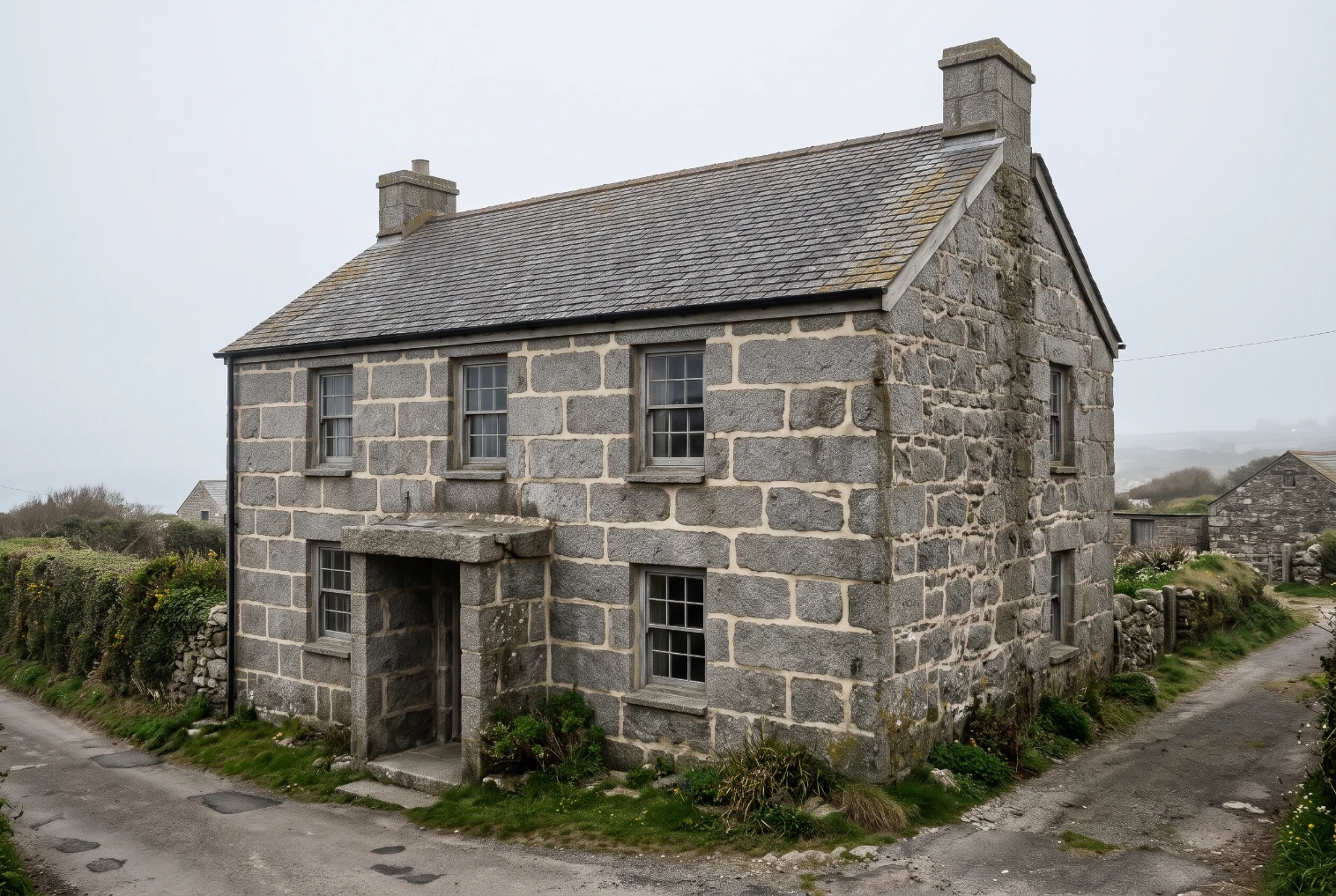
A Cornish granite house is a house built from the hard granite of Cornwall, with thick walls, small deep-set windows and a roof of local slate. It is built for exposure to Atlantic weather and often stands in granite-walled fields.
Granite is very hard to cut, so builders used large roughly squared blocks, often gathered as loose moorstone. Houses are plain, strong and low, with simple chimneys at the gables and little decoration.
c. 1600-1900
Regional building traditions have no single start date, so the band shows the main period of building. Periods are drawn at equal width, so the line is not to scale.
How to recognise it
| Feature | What to look for |
|---|---|
| Walls | Large blocks of grey granite, roughly squared or rubble, with wide mortar joints. |
| Thickness | Very thick walls, often 600mm or more, which gave shelter from wind and rain. |
| Roof | Slate, often from Delabole, with a plain ridge and simple eaves. |
| Windows | Small, deep-set openings with granite lintels and sills. |
| Chimneys | Plain granite chimney stacks at the gable ends. |
| Setting | Granite hedges, called Cornish hedges, and farm buildings in matching stone. |
Not sure what a term means? See our guides to hipped, gable and mansard roofs and eaves, fascia, soffit and verge, or browse the full architectural glossary.
Where and when they were built
Cornwall's granite upland provided building stone for houses, barns, bridges and engine houses. Wealth from tin, copper and farming led to more substantial houses, but the style stayed plain and practical.
The Historic England guide to vernacular houses notes how regional building materials shaped local traditions. In Cornwall the hardness of the granite limited ornament, and many houses are known for their simple, strong form.
Cornish granite, Cornish tin miners cottages or Devon cob?
- Cornish granite house: a larger farmhouse or village house in granite, with thick walls and a slate roof.
- Cornish tin miners cottages: smaller cottages built near the mines. See our Cornish tin miners cottages page.
- Devon cob and thatch: earth walls and thatch next door in Devon. See our Devon cob and thatch page.
- Peak District gritstone: another hard, plain northern stone. See our Peak District gritstone page.
Many Cornish houses are rendered or painted, so you may need to look at the thickness of the walls and the windows to tell what is underneath.
What to check when buying one
- Damp and exposure: granite is hard but the joints let moisture through. Check the pointing and the wall bases.
- Slate roof: check for slipped or broken slates and the condition of the roof timbers. Salt air speeds up corrosion of fixings.
- Wall movement: granite blocks with poor mortar can move. Check for bulging walls and cracks.
- Energy and heating: thick walls store heat but are hard to insulate without risk to the stone. Seek specialist advice.
- Flood and coastal risk: many houses are near the coast or in valleys. Check flood risk and insurance.
- Choose the right survey: use a surveyor with experience of traditional buildings. See our home survey guide.
- Listed status and conservation areas: many surviving traditional houses are listed or lie in conservation areas, and most changes need consent. See our listed buildings guide.
Sources and further reading
- Historic England: Domestic 1, Vernacular Houses Listing selection guide covering traditional regional houses
- Historic England: the National Heritage List for England Check whether a building is listed
External links open in a new tab. Last checked November 2026.
Frequently asked questions
What is a Cornish granite house?
A traditional Cornish house built from local granite, with thick walls, small windows and a slate roof.
Why are Cornish windows so small?
Small windows reduced heat loss and resisted wind and rain, and granite is hard to cut into large openings.
What is a Cornish hedge?
A stone and earth bank, faced in local stone, used as a field boundary.
Do granite houses have damp problems?
They can, especially where the pointing is cement or where ground levels are raised. Breathable lime repairs help.
Are Cornish granite houses listed?
Many are, and many villages are conservation areas. Check the National Heritage List for England.