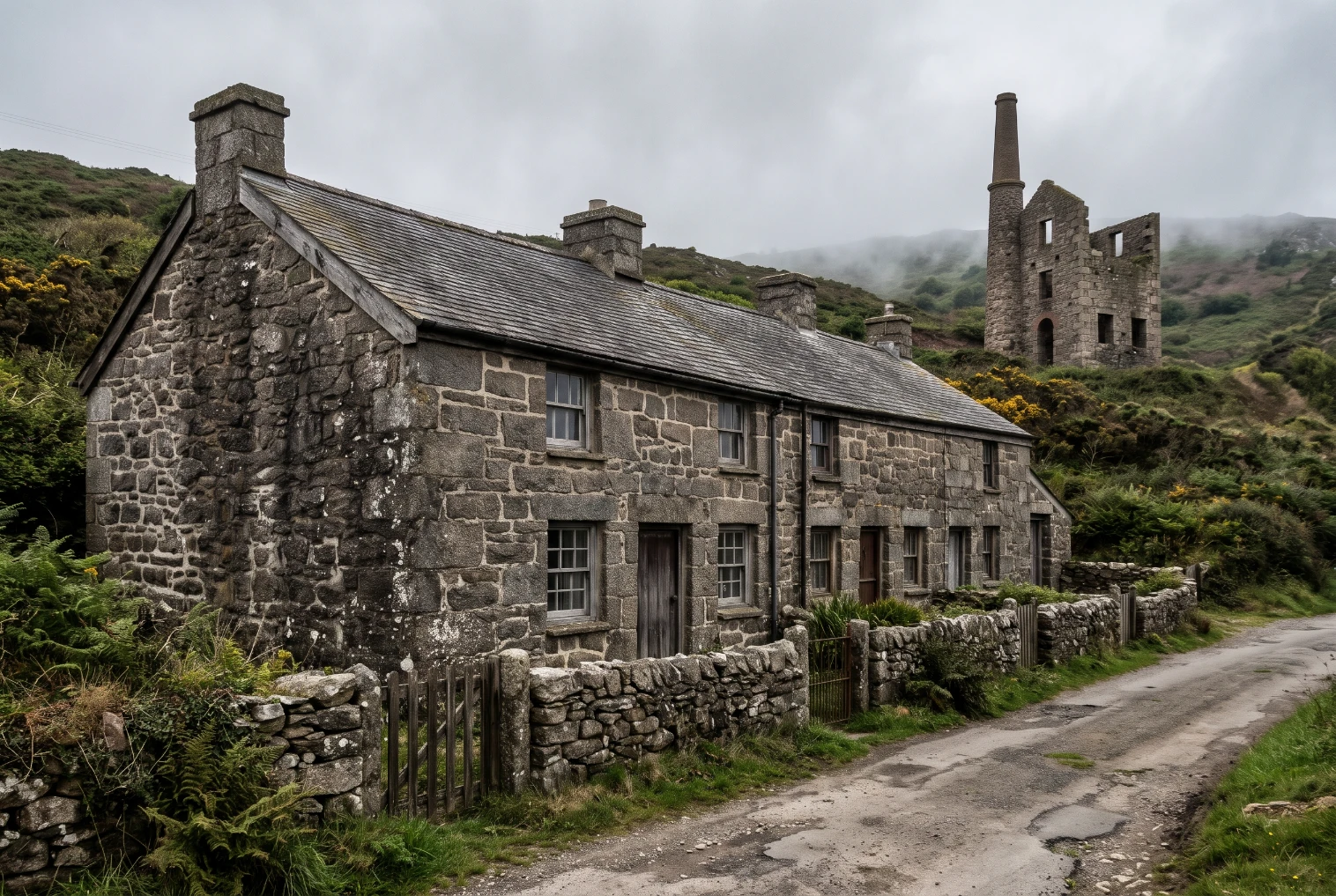
Cornish tin miners cottages are small, simple cottages built for miners and their families in the mining districts of Cornwall, usually in granite or local stone with a slate roof, and often with a small plot of land for growing food.
Many were built by the miners themselves on leased land, in scattered groups near the mines rather than in company rows. The landscape of engine houses and cottages is part of the Cornwall and West Devon Mining Landscape World Heritage Site.
c. 1750-1900
Regional building traditions have no single start date, so the band shows the main period of building. Periods are drawn at equal width, so the line is not to scale.
How to recognise it
| Feature | What to look for |
|---|---|
| Form | Small one or two-storey cottages, in rows or in small groups, often irregular. |
| Walls | Local granite or killas stone, sometimes with render. |
| Roof | Slate, or earlier thatch, with a plain stone chimney. |
| Plan | Two rooms downstairs, a loft or small bedroom upstairs. |
| Plot | A small garden or smallholding, used to grow vegetables and keep a pig or hens. |
| Setting | Close to mine workings, engine houses and chapels, often on hillsides. |
Not sure what a term means? See our guides to render, stucco, roughcast and pebbledash and parts of a roof, or browse the full architectural glossary.
Where and when they were built
Cornwall's tin and copper mines grew fast in the 18th and 19th centuries, and the workforce lived in cottages that spread across the countryside. Many miners also held a small plot of land.
The Historic England guide to vernacular houses covers how regional materials and ways of life shaped traditional houses. In Cornwall, the mining villages show how stone housing grew up beside industry.
Tin miners cottage, Cornish granite house or colliery row?
- Cornish tin miners cottages: small cottages built for miners in Cornwall.
- Cornish granite house: a larger farmhouse or village house. See our Cornish granite house page.
- Miners cottages and colliery rows: coalfield rows built by companies. See our colliery rows page.
- Fishermens cottages: another Cornish tradition on the coast. See our fishermens cottages page.
Many tin miners cottages have been extended or merged, so the original small cottage may be only part of the building.
What to check when buying one
- Old mine workings: ask about shafts, adits and subsidence. A mining search is wise in Cornwall.
- Radon: parts of Cornwall have high radon levels in the ground. Ask about radon testing.
- Granite walls and damp: thick granite walls need breathable repairs. See our damp and mould guide.
- Small plots and boundaries: check boundaries, access and rights of way carefully.
- World Heritage controls: some areas have extra planning controls because of the mining landscape.
- Choose the right survey: use a surveyor with experience of traditional buildings. See our home survey guide.
- Listed status and conservation areas: many surviving traditional houses are listed or lie in conservation areas, and most changes need consent. See our listed buildings guide.
Sources and further reading
- Historic England: Domestic 1, Vernacular Houses Listing selection guide covering traditional regional houses
- Historic England: the National Heritage List for England Check whether a building is listed
External links open in a new tab. Last checked November 2026.
Frequently asked questions
What is a tin miners cottage?
A small cottage built for a Cornish tin miner and family, usually of granite, with a slate roof and a small plot of land.
Why are they scattered?
Many miners built their own cottages on leased plots near the mines.
What is an engine house?
A stone building that housed a steam engine used to pump water from mines or lift ore.
Is there a mining landscape World Heritage Site?
Yes. The Cornwall and West Devon Mining Landscape was inscribed in 2006.
Are tin miners cottages listed?
Some are. Check the National Heritage List for England.