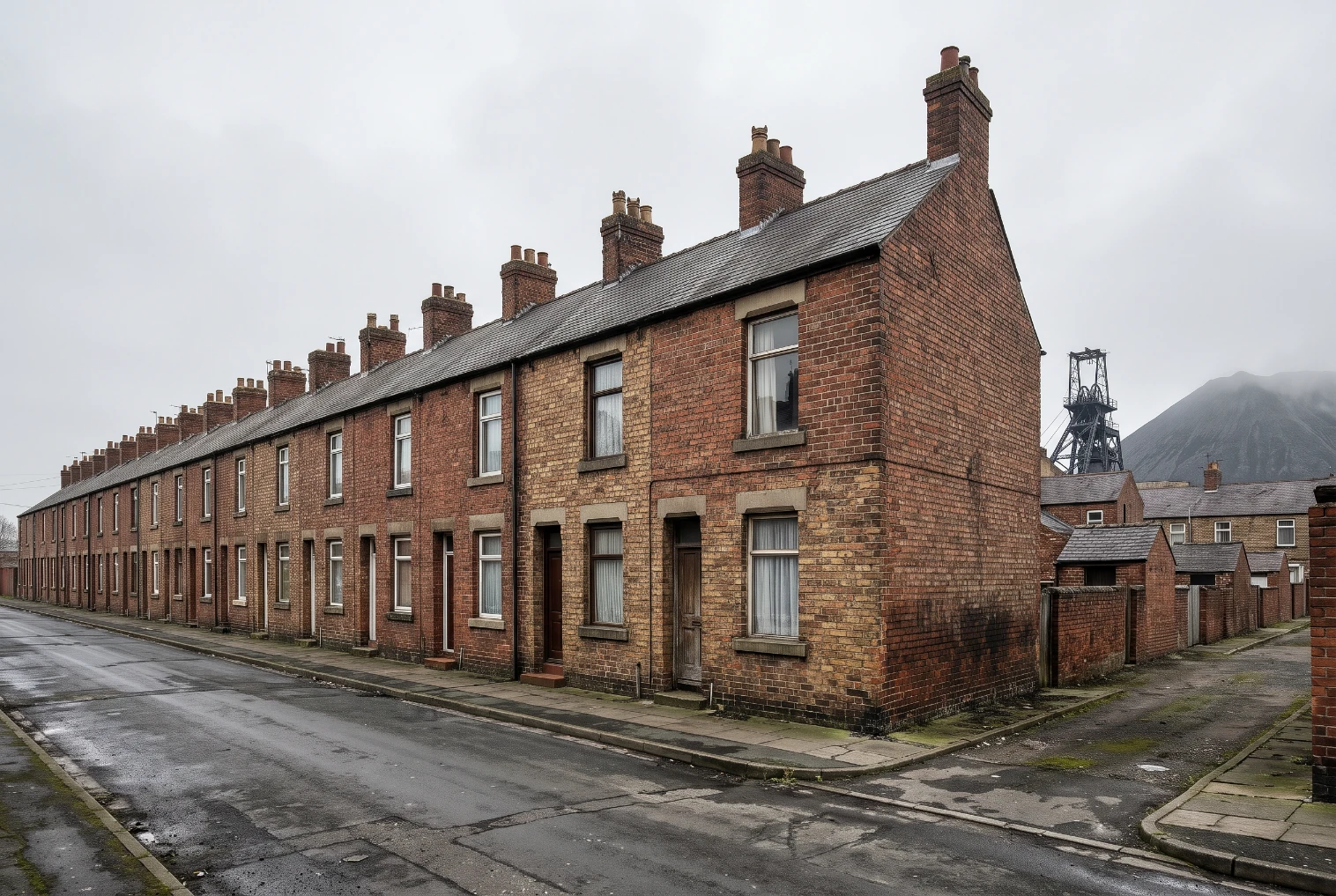
Miners cottages and colliery rows are rows of small terraced houses built by mining companies for their workers, usually in brick or stone, with a slate roof and a yard at the back. They were built next to pits in County Durham, South Wales, Yorkshire and other coalfields.
Colliery housing was often built in long, regular rows with shared yards, outside toilets and a coal house. After pits closed, many villages declined, and in County Durham some were planned for demolition under a policy of the 1950s.
c. 1840-1930
Regional building traditions have no single start date, so the band shows the main period of building. Periods are drawn at equal width, so the line is not to scale.
How to recognise it
| Feature | What to look for |
|---|---|
| Form | Long rows of identical two-storey, or sometimes single-storey, houses. |
| Walls | Local brick or stone, often plain with few decorations. |
| Roof | Slate, with a chimney on every house. |
| Plan | Two rooms down and two up, or a single room and a loft in the earliest ones. |
| Back yards | A shared back lane, outhouses, a coal house and, in older rows, an outside toilet. |
| Setting | Next to the colliery, with chapel, institute and shops nearby. |
Not sure what a term means? See our guides to parts of a roof and wall and brickwork terms, or browse the full architectural glossary.
Where and when they were built
Mining companies built houses to attract and keep workers, and often owned them. The rows were laid out in regular patterns, and the villages often grew into close communities.
The Historic England guidance on Georgian and Victorian terraced housing explains how terraces were built and altered, and much of it applies to colliery rows. Many have been altered with new windows, extensions and rendered fronts.
Colliery rows, Welsh valley terrace or mill-town terrace?
- Miners cottages and colliery rows: company housing in the coalfields.
- Welsh valley terrace: stepped hillside terraces in South Wales. See our Welsh valley terrace page.
- Back-to-back and mill-town terrace: northern industrial housing. See our mill-town terrace page.
- Victorian terrace: the more general English terrace. See our Victorian terrace page.
Many colliery rows have been demolished, so surviving examples are valued locally and in conservation areas.
What to check when buying one
- Mining subsidence: houses near old mine workings can suffer subsidence. Ask for a Coal Authority mining report. See our home survey guide.
- Solid walls and damp: most have solid walls and no cavity. See our damp and mould guide.
- Back yards and outhouses: check drainage, ownership and rights of way for shared yards and lanes.
- Roof and chimneys: check the slates and the shared chimney stacks.
- Extensions: check that extensions had consent and building regulations approval.
- Choose the right survey: use a surveyor with experience of traditional buildings. See our home survey guide.
- Listed status and conservation areas: many surviving traditional houses are listed or lie in conservation areas, and most changes need consent. See our listed buildings guide.
Sources and further reading
- Historic England: Conserving Georgian and Victorian Terraced Housing Guidance on terraced houses and how they were built
- Historic England: the National Heritage List for England Check whether a building is listed
External links open in a new tab. Last checked November 2026.
Frequently asked questions
What is a colliery row?
A row of terraced houses built by a mining company for its workers, usually close to the pit.
What was Category D?
A planning label used in County Durham in the 1950s for villages that were expected to decline, and which were sometimes marked for demolition.
Do I need a mining report?
In coalfield areas it is wise. The Coal Authority provides reports on past mining and subsidence risk.
Are colliery houses solid wall?
Most are, so damp control and insulation need care.
Are miners cottages listed?
A few good examples are, and some are in conservation areas. Check the National Heritage List for England.