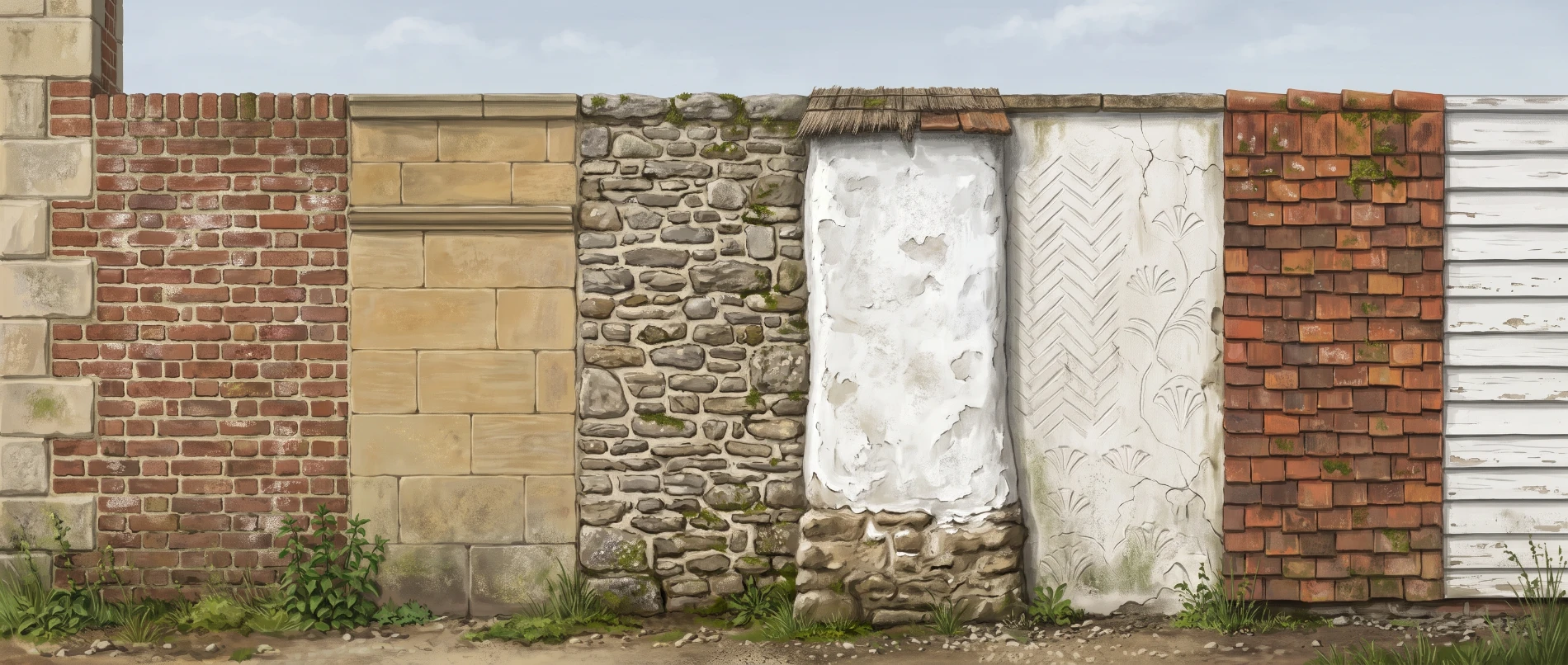
Tile hanging is a wall covering of clay tiles hung from timber battens, like roof tiles but fixed vertically. It protects a wall from rain and gives a warm, textured finish.
It is a traditional finish in Surrey, Sussex and Kent, and it is often used on the upper storey above brick. Plain tiles can be laid in patterns, using fish-scale and other shaped tiles.
How to spot it
- Tiles on the wall. Small clay tiles cover the upper wall in overlapping rows.
- Shaped tiles. Bands of fish-scale or other shaped tiles are used for pattern.
- Above brick. The ground floor is often brick, with tile hanging above.
- Colour variation. Handmade tiles vary in colour from orange to brown and grey.
Where you will see it
- Sussex and Weald tile-hung house: the classic tile-hung house.
- Kentish weatherboard and oast: tile hanging with weatherboard.
- Arts and Crafts house: tile hanging used as a decorative feature.
- Old English and Tudorbethan revival: tile-hung gables.
What to know about tile hanging
- Slipped and cracked tiles: Nails rust and tiles slip. Individual tiles can be re-hung or replaced.
- Battens and fixings: Rotten battens behind the tiles are the real problem, and they cannot be seen until some tiles are lifted.
- Matching tiles: Reclaimed or handmade tiles match old work much better than machine-made ones.
- Mathematical tiles: Some brick-faced walls are actually tiles shaped like bricks, hung to imitate brickwork.
For more definitions, see our wall materials and brickwork page and the architectural glossary.
Sources and further reading
- Historic England: Domestic 1, Vernacular Houses Listing guide covering traditional house types and materials
- Historic England: the National Heritage List for England Check whether a building is listed
External links open in a new tab. Last checked November 2026.
Frequently asked questions
What is the difference between tile hanging and roof tiling?
The tiles are the same type, but on a wall they are fixed vertically with nails and battens, and there is less overlap because water runs off more easily.
What are mathematical tiles?
They are tiles shaped to look like bricks and hung on a wall, so that a timber-framed building appears to be brick. They are found in Sussex and Kent.
Can tile hanging be repaired?
Yes. Slipped or broken tiles can be replaced one at a time, and battens can be renewed where needed.
Does tile hanging insulate a wall?
It adds little insulation on its own, but the air gap behind helps. Insulation can sometimes be added behind new battens.