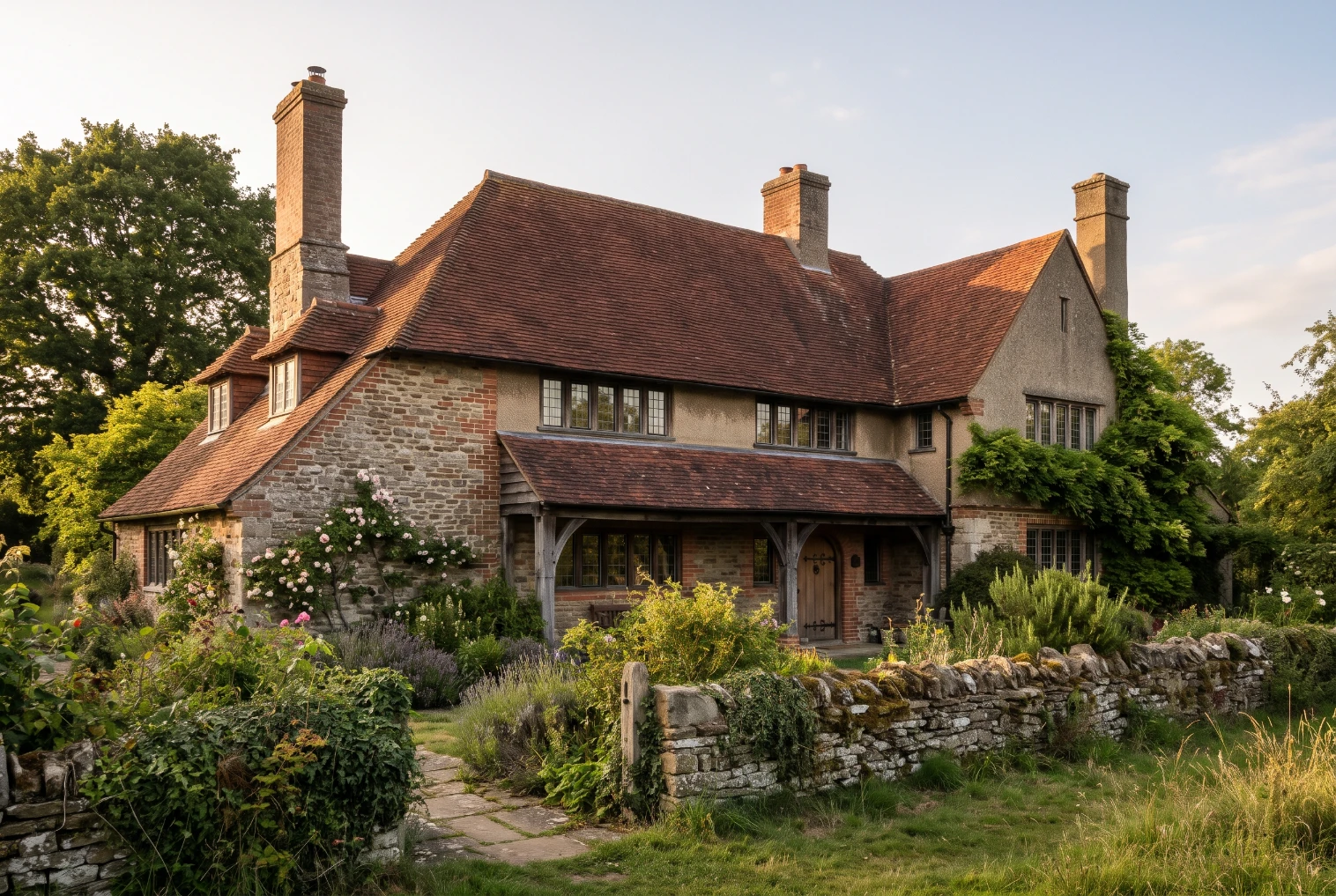
An Arts and Crafts house is a house built from about 1880 to 1920 that stresses good craftsmanship, local materials and a comfortable, informal plan, with big clay-tile roofs, tall chimneys, casement windows and often roughcast or local stone walls.
The movement grew from the ideas of William Morris and John Ruskin, who valued the handmade over the machine-made. Architects such as Philip Webb, C F A Voysey, Edwin Lutyens and M H Baillie Scott designed houses that looked both modern and rooted in tradition.
c. 1880-1920
The band starts in the later Victorian period and runs into the Edwardian period. Periods are drawn at equal width, so the line is not to scale.
How to recognise it
| Feature | What to look for |
|---|---|
| Materials | Local stone, brick or oak, with roughcast or limewashed render, chosen to suit the region. |
| Roof | Big clay-tile or stone-slate roofs, often swept down low, with tall plain chimneys. |
| Windows | Long bands of casement windows with leaded lights and timber or iron frames. |
| Plan | Informal and asymmetrical, planned from the inside out, with rooms arranged for use and light. |
| Joinery | Handmade oak doors, staircases and fittings, with visible pegs and joints. |
| Porch | A deep porch or entrance, often with a rounded timber door. |
| Garden | A house designed together with its garden, with terraces, walls and planting. |
Not sure what a term means? See our guides to sash and casement windows and render, stucco, roughcast and pebbledash, or browse the full architectural glossary.
Where and when they were built
The Arts and Crafts movement reacted against factory-made decoration and the heavy styles of the mid-Victorian period. Houses were meant to feel simple, comfortable and truthful to their materials, and varied from small cottages to large country houses.
The Historic England entry for Whitwood Terrace describes a terrace of 1904 by Voysey, and the entry for Daneshill House in Hampshire describes a house of 1903 by Lutyens in an Arts and Crafts style. The movement ran through both the Victorian and Edwardian periods.
Arts and Crafts, Old English or Edwardian?
- Arts and Crafts: about 1880 to 1920. Handcrafted, informal and tied to local materials.
- Old English revival: more openly historical, with half-timbering. See our Old English revival page.
- Queen Anne Revival: more formal, with red brick and white sashes. See our Queen Anne Revival page.
- Edwardian house: built from 1901 and often influenced by Arts and Crafts ideas.
The style overlaps with other revivals, so look for craftsmanship and local materials, not just the shape.
What to check when buying one
- Roofs: large tiled or slate roofs with low eaves need regular inspection. Check the timbers underneath.
- Handmade joinery: original oak doors, windows and stairs are valuable. Repair, do not replace.
- Roughcast and lime render: repair with matching lime-based materials, not cement, which traps moisture.
- Casement windows: long runs of casements and leaded lights can be fragile. Check frames and glazing.
- Gardens and walls: garden walls, terraces and outbuildings may be part of the original design and need care.
- Choose the right survey: use a surveyor who knows solid-wall Victorian buildings. See our home survey guide.
- Listed status and conservation areas: some Victorian houses are listed and many lie in conservation areas, where windows, roofs and fronts may be controlled. See our listed buildings guide.
Sources and further reading
- Historic England: Whitwood Terrace A terrace of 1904 by Voysey
- Historic England: Daneshill House A Grade II house of 1903 by Lutyens
- Historic England: the National Heritage List for England Check whether a building is listed
External links open in a new tab. Last checked November 2026.
Frequently asked questions
What is an Arts and Crafts house?
A house built from about 1880 to 1920 that emphasises handcraft, local materials and an informal plan, often with a big tiled roof and casement windows.
Who designed Arts and Crafts houses?
Notable architects include Philip Webb, C F A Voysey, Edwin Lutyens and M H Baillie Scott.
What is the link to William Morris?
Morris and John Ruskin inspired the movement by valuing the handmade, and Philip Webb designed Morris's Red House in the late 1850s.
Are Arts and Crafts houses Victorian or Edwardian?
Both. The movement began in the later Victorian period and continued through the Edwardian years.
Are Arts and Crafts houses listed?
Many are, especially those by well-known architects, and many lie in conservation areas. Check the National Heritage List for England.