A Queen Anne Revival house is a Victorian house built from about 1870 to 1900 in a mix of 17th and early 18th-century English and Dutch details, with warm red brick, white-painted sash windows, terracotta ornament and a lively, varied roofline.
The name is misleading. It refers to the style of the reign of Queen Anne, from 1702 to 1714, but the houses are Victorian and much freer in design. The look was popularised by Richard Norman Shaw, and was used on many large suburban houses and in estates such as Bedford Park in London.
c. 1870-1900
The band covers the later Victorian period. Periods are drawn at equal width, so the line is not to scale.
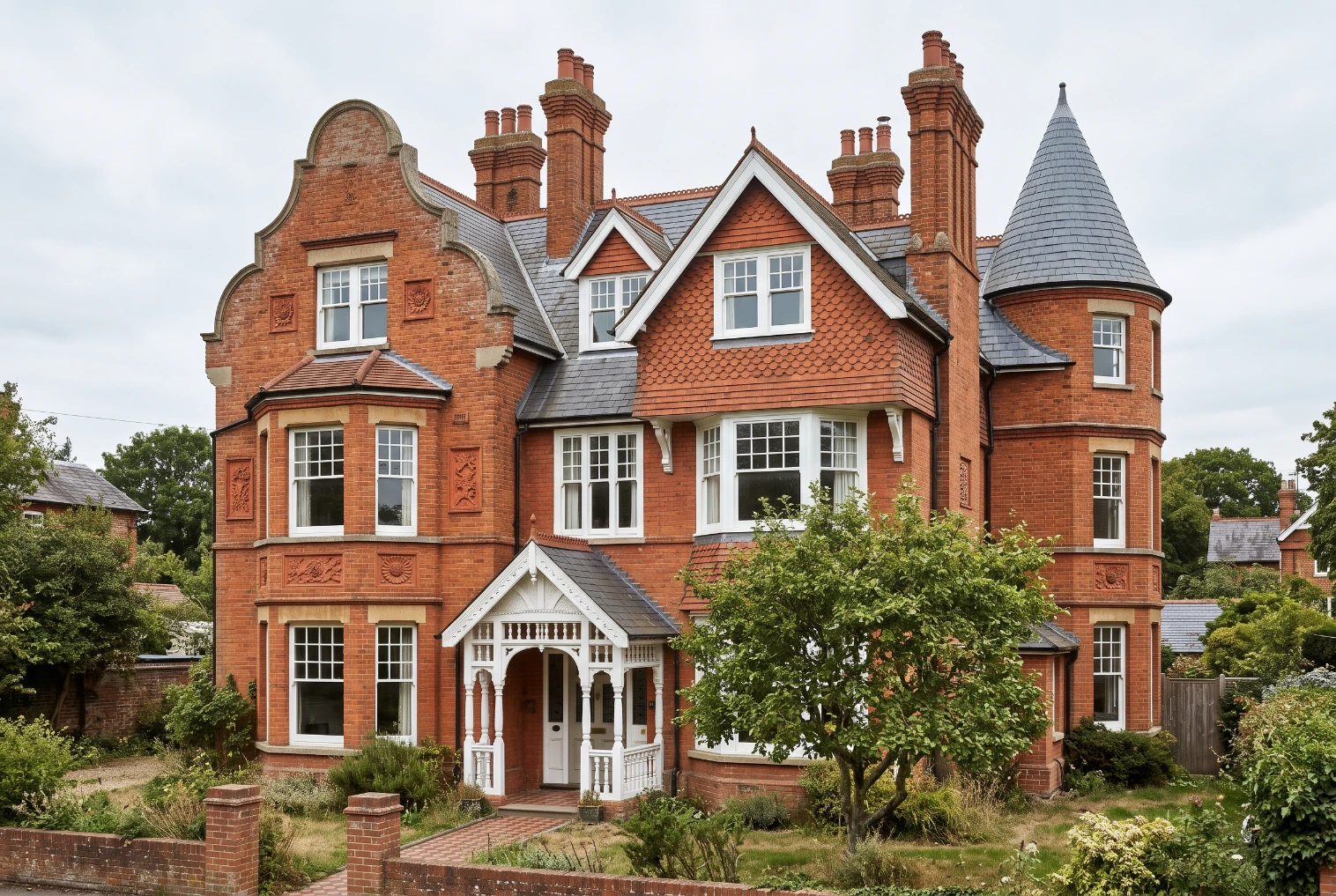
How to recognise it
| Feature | What to look for |
|---|---|
| Walls | Warm red brick, often with moulded or carved brick and terracotta panels, such as sunflower motifs. |
| Windows | White-painted sash windows, often with small panes in the upper sash and a single pane below. |
| Gables | Shaped Dutch gables and curved pediments, mixed with ordinary gables. |
| Roof | A varied roofline with tall clustered chimneys, dormers and sometimes a small turret. |
| Porch | A white-painted timber porch with turned posts or classical details. |
| Tile hanging | Upper walls often hung with tiles, as in Kent and Sussex houses. |
| Plan | Informal and asymmetrical, with rooms arranged for comfort and light. |
Not sure what a term means? See our guides to sash and casement windows and hipped, gable and mansard roofs, or browse the full architectural glossary.
Where and when they were built
Queen Anne Revival grew from the Old English style of the 1860s and mixed it with classical details. It was seen as friendlier and more domestic than Gothic, and became very popular for the new middle-class suburbs of the 1870s and 1880s.
The Historic England listing guide on suburban and country houses identifies Lowther Lodge in Kensington Gore, built by Norman Shaw in 1874 to 1875 and listed Grade II*, as the first prominent Queen Anne style building. The list entry for 196 Queen's Gate describes a Shaw house of 1875 in the same style.
Queen Anne Revival, Queen Anne or Old English?
- Queen Anne Revival: about 1870 to 1900. A Victorian house with red brick, white sashes, terracotta and varied rooflines.
- Queen Anne house: the original of 1702 to 1714. See our Queen Anne house page.
- Old English revival: half-timbered and more medieval in look. See our Old English revival page.
- Victorian villa: the more common brick house, with some of the same details. See our Victorian villa page.
In the United States, Queen Anne means a different, more ornate Victorian style, so check the date and country when searching.
What to check when buying one
- Terracotta and carved brick: look for cracking and loose pieces. Repair with matching materials.
- Painted sashes: white-painted timber sashes need regular repainting and can rot at the sills.
- Complex roofs: many valleys, dormers and chimneys mean more points where leaks can start.
- Tile hanging: check for missing tiles and rusted fixings, which let in water.
- Damp: solid walls and old chimneys cause damp. See our damp and mould guide.
- Choose the right survey: use a surveyor who knows solid-wall Victorian buildings. See our home survey guide.
- Listed status and conservation areas: some Victorian houses are listed and many lie in conservation areas, where windows, roofs and fronts may be controlled. See our listed buildings guide.
Sources and further reading
- Historic England: 196 Queen's Gate A house of 1875 by Richard Norman Shaw in the Queen Anne style
- Historic England: Domestic 3, Suburban and Country Houses Listing selection guide covering Victorian and later houses
- Historic England: the National Heritage List for England Check whether a building is listed
External links open in a new tab. Last checked November 2026.
Frequently asked questions
What is a Queen Anne Revival house?
A Victorian house built from about 1870 to 1900 in red brick with white sash windows, terracotta ornament and a varied roofline.
Is Queen Anne Revival the same as Queen Anne style?
No. Queen Anne style dates from 1702 to 1714, while Queen Anne Revival is a Victorian revival with a freer design.
Who created Queen Anne Revival?
It is closely linked with Richard Norman Shaw, and with architects such as Philip Webb and others of the same period.
What is a Dutch gable?
A shaped gable with curved sides, often topped with a pediment, borrowed from Dutch buildings.
Are Queen Anne Revival houses listed?
Some are, especially well-known examples, and many lie in conservation areas. Check the National Heritage List for England.