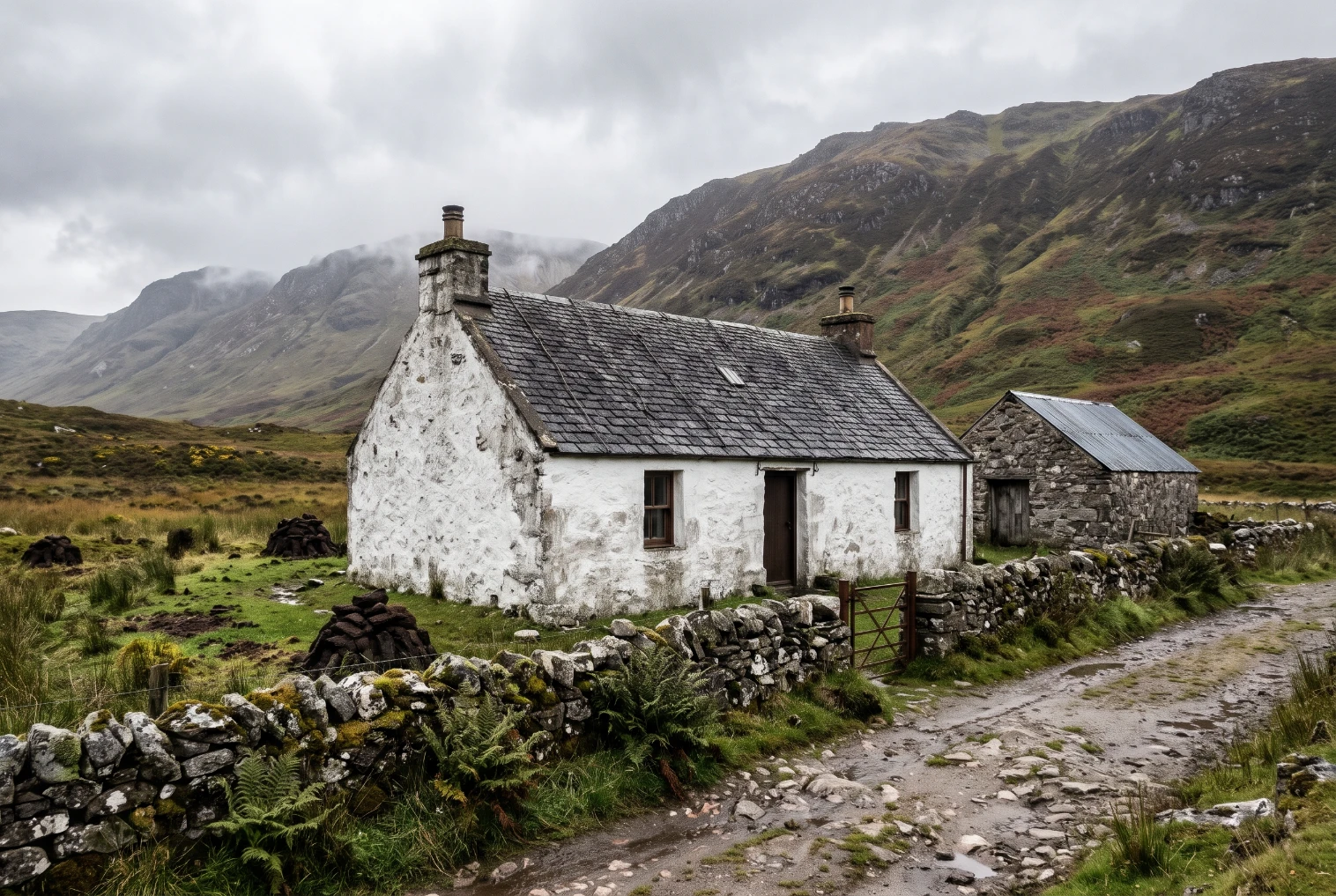
A Scottish croft house is a small stone house on a croft, a small farm held under crofting law, found in the Highlands and islands. It is low, with thick walls, small windows, a central door and a roof of slate, thatch or corrugated iron.
Crofts were established in the 19th century, and the Crofters Holdings (Scotland) Act of 1886 gave tenants security. Many croft houses are plain two-room cottages, sometimes with a loft, and many are now holiday homes or restored.
c. 1750-1940
Regional building traditions have no single start date, so the band shows the main period of building. Periods are drawn at equal width, so the line is not to scale.
How to recognise it
| Feature | What to look for |
|---|---|
| Form | A low, single-storey house or one and a half storeys, with a central door and a window each side. |
| Walls | Thick rubble stone, often whitewashed or harled with lime. |
| Roof | Slate, thatch tied with ropes, or later corrugated iron. |
| Chimneys | A chimney at each gable end, with hearths in the main rooms. |
| Windows | Small windows set into thick walls with deep reveals. |
| Outbuildings | A byre, barn or store close by, sometimes attached. |
Not sure what a term means? See our guides to hipped, gable and mansard roofs and render, stucco, roughcast and pebbledash, or browse the full architectural glossary.
Where and when they were built
Croft houses were designed to withstand wind, rain and cold. Many early houses had a central hearth and no chimney, while later cottages had gable chimneys and more rooms.
In Scotland, listing is handled by Historic Environment Scotland. Many surviving croft houses are listed, and crofting law has its own rules on ownership and use, which affect buying and selling.
Highland croft, Hebridean blackhouse or Orkney house?
- Scottish croft and Highland cottage: low stone cottage with gable chimneys, on the mainland and islands.
- Hebridean blackhouse: an earlier, thatched house with double walls and a central hearth. See our Hebridean blackhouse page.
- Orkney and Shetland stone houses: flagstone-roofed houses in the north. See our Orkney and Shetland page.
- Welsh longhouse and slate: a similar upland farmhouse tradition. See our Welsh longhouse page.
Many croft houses have been extended, so the original cottage may form only part of the building today.
What to check when buying one
- Croft tenancy and land: a croft house may come with croft land that is held under crofting law. Take legal advice on what you are buying.
- Roof: check slates, thatch or tin sheets, and the roof timbers.
- Damp and exposure: exposed sites suffer wind-driven rain. See our damp and mould guide.
- Services: many sites have private water, drainage and long tracks. Check costs and responsibility.
- Scottish home report: in Scotland, the seller provides a Home Report, so read it carefully.
- Choose the right survey: use a surveyor with experience of traditional buildings. See our home survey guide.
- Listed status and conservation areas: many surviving traditional houses are listed or lie in conservation areas, and most changes need consent. See our listed buildings guide.
Sources and further reading
- Historic Environment Scotland: Portal Check whether a building in Scotland is listed
External links open in a new tab. Last checked November 2026.
Frequently asked questions
What is a croft?
A small agricultural holding in the Highlands and islands, held under crofting law.
What is a croft house?
The house on a croft, usually a small stone cottage with thick walls and a slate or tin roof.
Can I buy a croft house?
Yes, but the croft land may be tenanted and subject to crofting rules, so get legal advice.
Why do croft houses have small windows?
To keep out wind and cold, and because large openings were hard to build in thick stone walls.
Are croft houses listed?
Many are. Check the Historic Environment Scotland portal.