Georgian vs Victorian vs Edwardian
What It Means for Your Renovation
The age of a house shapes almost every renovation decision: how it should be repaired, which materials are safe to use, what is likely to be hiding behind the plaster and how much it will cost. Georgian, Victorian and Edwardian houses share some traits but behave quite differently. This guide compares them so you can plan a renovation that works with the building rather than against it.
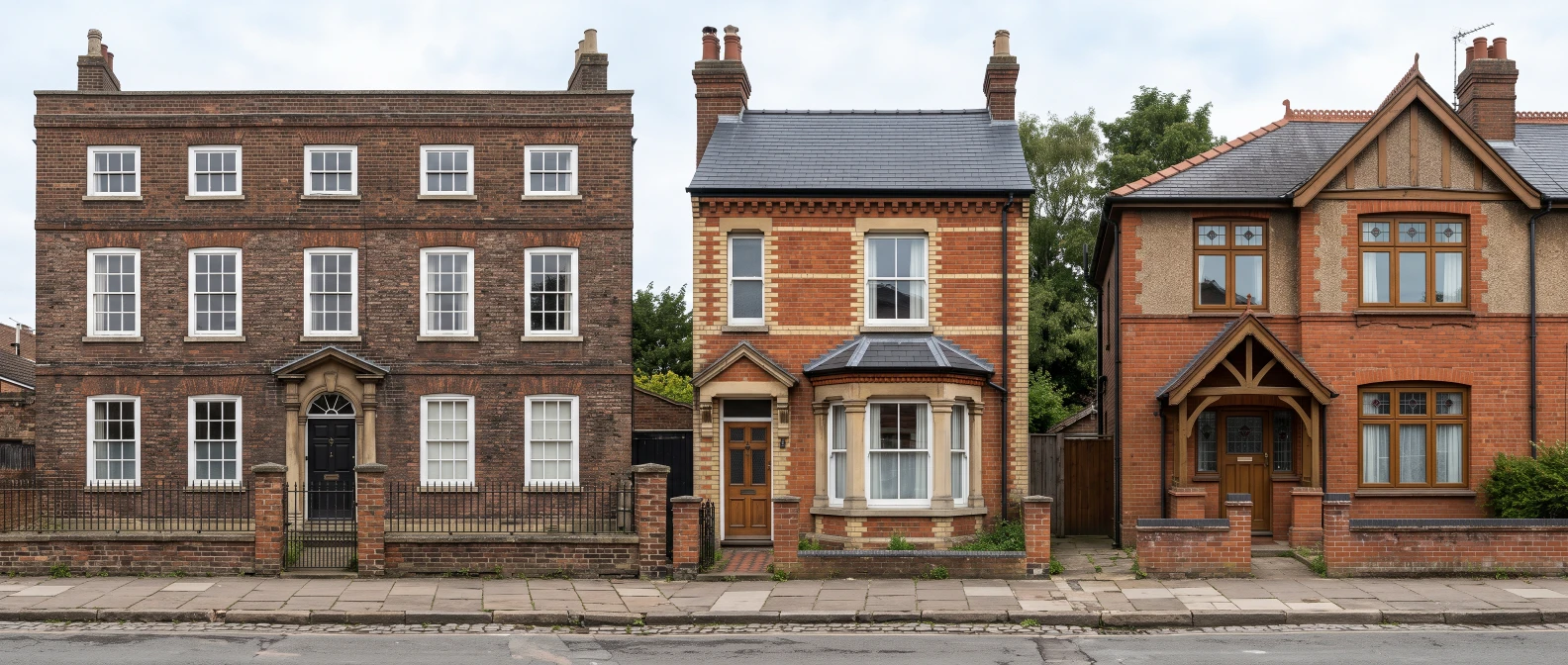
The Three Periods at a Glance
Dates overlap and regions vary, but these ranges are a useful guide:
| Period | Rough dates | Typical build | Typical renovation watch-points |
|---|---|---|---|
| Georgian (including Regency) | 1714 to 1837 | Solid brick or stone, lime mortar, timber floors, sash windows | Breathability, timber decay, thin or missing damp protection |
| Victorian | 1837 to 1901 | Solid brick, slate roofs, bay windows, often cramped plots | Rising and penetrating damp, failed damp-proof courses, roof and chimney repairs |
| Edwardian | 1901 to 1914 | Brick or render, larger rooms and windows, better ventilation | Timber windows and floors, ageing wiring and plumbing, early cavity walls rare |
Not sure which period your house belongs to? Start with our street-walk guide to identifying your house style, or read the individual guides to Georgian townhouses, Victorian terraces and Edwardian houses.
Walls and Damp
Houses of all three periods are mostly solid-walled - a single thickness of brick or stone with no cavity. Cavity walls only became common in the 1920s and 1930s. That matters because a solid wall is designed to absorb moisture and release it again, and it needs to be able to breathe.
- Georgian: usually built with lime mortar, which is soft and flexible. Repointing with hard cement mortar can trap moisture and damage the brick. Use lime-based repairs. See repointing.
- Victorian: damp is the classic problem. Many houses have, or had, a damp-proof course that can fail, and ground levels often rise over time and bridge it. Diagnose the cause before treating it: rising damp is less common than penetrating damp from gutters, roofs and pointing. Our damp and mould guide helps.
- Edwardian: usually better built and better ventilated, but solid walls still dominate. If you find a cavity wall, see what a cavity wall is and whether insulation is possible.
A rule that applies to all three: do not seal a solid wall with impermeable paint, cement render or non-breathable insulation without advice. It can drive moisture into the structure instead of out.
Windows and Doors
Original timber windows are one of the best features of older houses and are often repairable. Georgian houses typically have tall multi-pane sashes, Victorian houses have sashes with fewer and larger panes, and Edwardian houses mix sashes and casements. Our guides to sash windows and sash versus casement windows will help you identify what you have.
Repair is often cheaper than replacement, and secondary glazing can improve comfort without changing the look. If you do replace, check whether the house is listed or in a conservation area first - see is my house listed - because consent may be needed. For rough prices, see the new windows cost guide.
Roofs and Chimneys
Roofs are where age shows. Slate roofs, common from the Victorian period on, can last a long time but fixings fail before the slate itself does. Clay tiles are often found on Edwardian houses and suffer from frost damage and lost nibs. Georgian roofs may be hidden behind parapets, which means problems with gutters, lead and flashings that are easy to miss until water gets in.
Chimneys deserve a check: loose pointing, leaning stacks and failed flashing are all common. Before re-roofing, budget with the new roof cost guide and use the roof tile calculator or slate roofing calculator to estimate quantities.
Floors, Timber and Structure
Older houses typically have suspended timber floors with an underfloor void that needs ventilation. Blocked air bricks are a common cause of rot. Georgian structures can include original timber frames in partitions, and Victorian terraces often have shallow foundations and thin internal walls.
When removing walls, never assume a wall is non-structural. Get an engineer to check, and be aware of joist spans, chimney breasts and party walls. Open-plan changes are possible in all three periods but need proper support.
Insulation and Energy Efficiency
Older homes can be made much warmer without ruining them, but the order of work matters. A sensible sequence is:
- Fix moisture problems first - gutters, roofs, pointing and ground levels.
- Draught-proof and insulate the loft - the cheapest, safest wins.
- Treat floors and walls carefully - choose breathable materials, and take advice before fitting external or internal wall insulation on a solid wall. Use the insulation calculator to size materials.
- Upgrade heating last - once heat loss is reduced, you can size a heat pump or new boiler correctly. See available grants, including the Boiler Upgrade Scheme.
Surveys and Budget
Older houses are more likely to hide expensive surprises, so a good survey is worth the money. See our home surveys guide and survey checklist, and estimate the fee with the survey cost calculator.
As a rule of thumb, add a generous contingency to any renovation budget for an older house. Rewiring, roof repairs and damp treatment are common extras - see the cost of rewiring a house and the wider building costs hub for typical figures.
Which Period Is Easiest to Renovate?
There is no simple winner. Edwardian houses tend to have more generous rooms and better ventilation, which can make them easier to live in and update. Georgian houses are elegant but can be sensitive to the wrong materials, and are more likely to be listed. Victorian terraces are plentiful and often good value, but damp and cramped layouts are the usual trade-offs.
Whatever the period, the best renovations work with the building: repair rather than replace where you can, use breathable materials, and get advice before making irreversible changes.
Learn More About Your House Style
Browse detailed guides to Georgian, Victorian and Edwardian houses, and look up unfamiliar terms in the architectural glossary.
Architectural Styles Guide Damp and Mould Guide