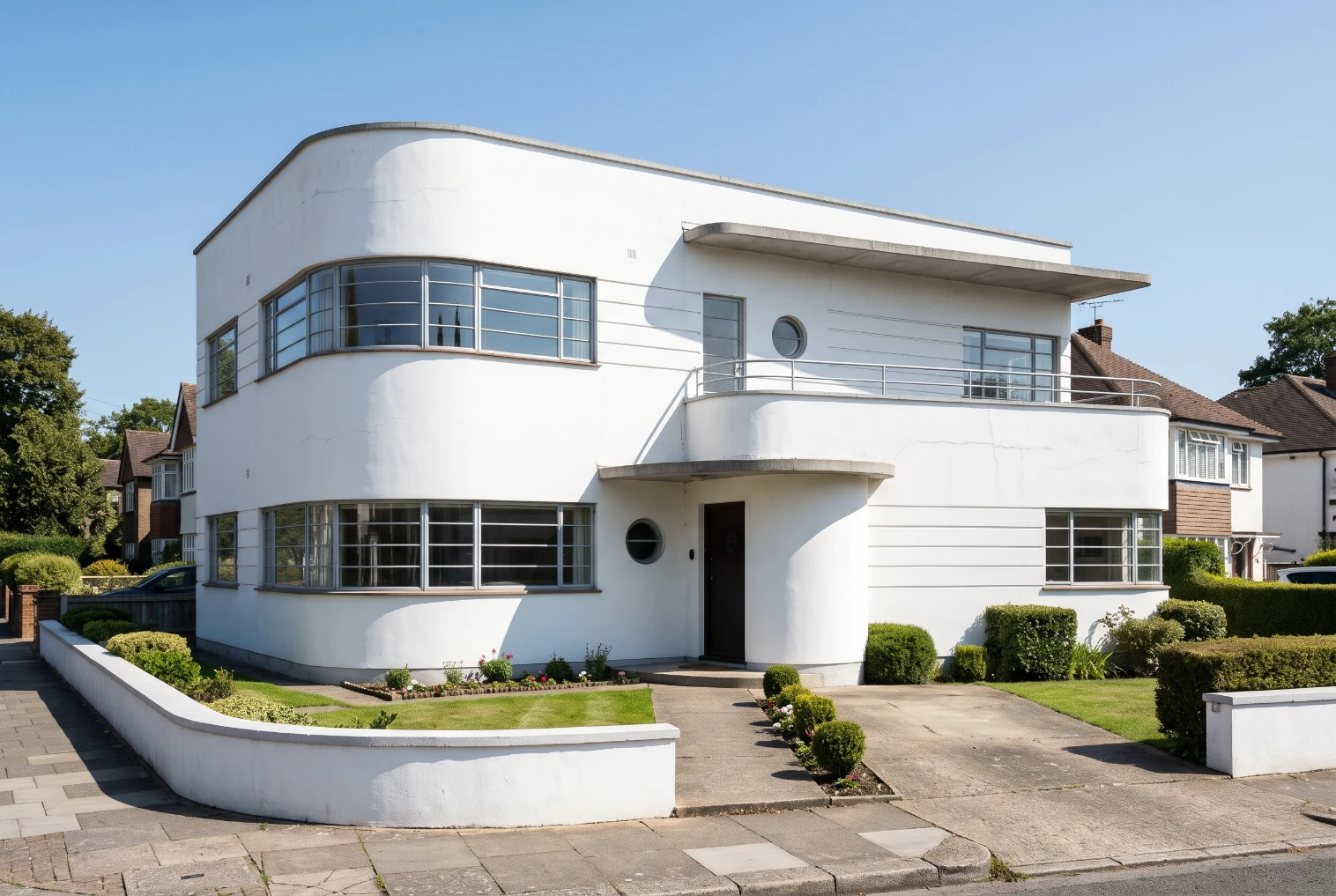
A Streamline Moderne house is a house of the 1930s with smooth rendered walls, rounded corners, a flat roof and long horizontal bands of windows, inspired by the look of ocean liners, aircraft and cars. It is a smoother and more flowing cousin of Art Deco.
The style is rare for houses in Britain and more common on cinemas, lidos, shops and flats. Houses in the style are often seaside villas or one-off houses for adventurous owners.
1930s
The band covers the 1930s, at the end of the interwar years. Periods are drawn at equal width, so the line is not to scale.
How to recognise it
| Feature | What to look for |
|---|---|
| Walls | Smooth white or pale render, often with thin horizontal lines or grooves. |
| Corners | Curved or rounded corners, often with windows that wrap around them. |
| Roof | A flat roof with a slim projecting edge, sometimes with a roof terrace and railings. |
| Windows | Long horizontal bands of metal-framed windows, sometimes with curved glass. |
| Ship details | Porthole windows, tubular railings and a canopy over the door. |
| Doorway | A rounded porch or flat canopy, often with a plain modern door. |
| Ornament | Very little, with the shape and the lines doing the work. |
Not sure what a term means? See our guides to render, stucco, roughcast and pebbledash and parts of a roof, or browse the full architectural glossary.
Where and when they were built
Streamline Moderne grew from Art Deco and from the idea of speed and efficiency. In Britain it appeared in seaside towns, on cinemas and in new suburbs in the 1930s.
Historic England has listed 26 Old Hall Road in Salford at Grade II, describing it as a glamorous 1930s streamlined Moderne house. The Historic England listing guide on modern houses and housing covers how this period is assessed.
Streamline Moderne, Art Deco or Early Modernism?
- Streamline Moderne: the 1930s. Smooth curves, flat roofs and horizontal glazing, like an ocean liner.
- Art Deco: more decorative and geometric. See our Art Deco house page.
- Early Modernism: more austere, with flat boxes and no curves. See our Early Modernism page.
- Interwar suburban semi: sometimes has a curved bay. See our interwar semi page.
The styles share many features, so look for curves and horizontal lines to identify Streamline Moderne.
What to check when buying one
- Flat roof: flat roofs from the 1930s often fail. Check for leaks, ponding and the condition of the edge.
- Curved render: curved render cracks and is hard to repair. Look for hairline cracks and patches.
- Metal windows: curved metal windows are hard to replace. Check for rust and failed glass.
- Concrete: if the house has a concrete frame or floors, check for carbonation and rusting steel.
- Condensation: see our damp and mould guide.
- Choose the right survey: a surveyor who knows 20th-century construction will spot the problems typical of the period. See our home survey guide.
- Listed status and conservation areas: most houses of this period are not listed, but some are, and many lie in conservation areas with controls on fronts and windows. See our listed buildings guide.
Sources and further reading
- Historic England: 26 Old Hall Road, Salford, listed Grade II A 1930s streamlined Moderne house
- Historic England: Domestic 4, Modern Houses and Housing Listing selection guide covering 20th-century houses and housing
- Historic England: the National Heritage List for England Check whether a building is listed
External links open in a new tab. Last checked November 2026.
Frequently asked questions
What is Streamline Moderne?
A 1930s style with smooth curves, flat roofs and horizontal bands of windows, inspired by ships, planes and cars.
How is it different from Art Deco?
Art Deco is more decorative and geometric, while Streamline Moderne is smoother, more curved and plainer.
Are there Streamline Moderne houses in Britain?
A few. Most examples are public and commercial buildings, but some houses survive.
What is a porthole window?
A small round window, copied from ships.
Are Streamline Moderne houses listed?
Some are, because they are rare. For example, 26 Old Hall Road in Salford is listed Grade II.