An Art Deco house is a house of about 1925 to 1940 in a modern, stylish manner, with smooth rendered walls, geometric detail, curved bays, stepped doorways and sunburst motifs. True Art Deco houses are rare in Britain, and most examples are flats, cinemas and public buildings.
The name comes from the 1925 Paris exhibition of decorative arts. On British houses it often appears as Deco touches on an otherwise ordinary design, such as a sunburst gate, a stepped porch, or metal windows with geometric glazing.
c. 1925-1940
The band covers the later interwar years. Periods are drawn at equal width, so the line is not to scale.
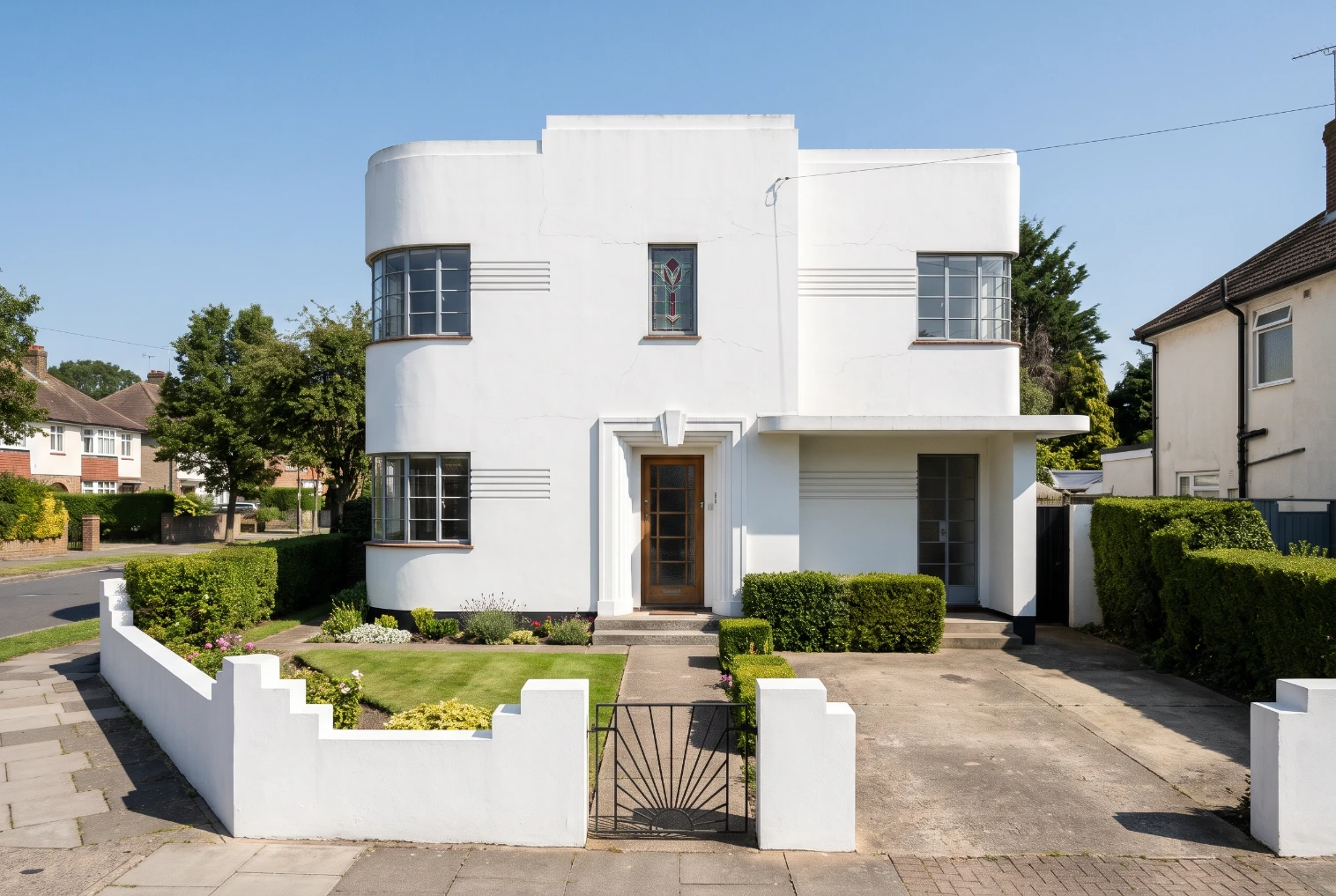
How to recognise it
| Feature | What to look for |
|---|---|
| Walls | Smooth white or cream render, sometimes with contrasting bands or tiles. |
| Roof | A flat roof or a low pitched roof hidden behind a stepped parapet. |
| Windows | Metal-framed windows, often curved or in horizontal bands, with geometric glazing patterns. |
| Doorway | A stepped or recessed door surround with geometric mouldings. |
| Glass | Stained glass with stylised sunbursts, fountains or geometric designs. |
| Ornament | Zigzags, chevrons, sunbursts and stepped forms, in ironwork, tiles and plaster. |
| Detail | Chrome, bakelite and coloured tiles used in interiors and fittings. |
Not sure what a term means? See our guides to render, stucco, roughcast and pebbledash and parts of a roof, or browse the full architectural glossary.
Where and when they were built
Art Deco was a decorative style more than a structural one, so it appears on many types of building. In houses it ranges from fully modern designs to ordinary semis with Deco details added to the porch, gate or windows.
The Historic England listing guide on modern houses and housing covers 20th-century houses and explains how interwar modern and decorative houses are assessed. Genuine Art Deco houses are rare, so each example is worth documenting.
Art Deco, Streamline Moderne or Early Modernism?
- Art Deco: about 1925 to 1940. Decorative, geometric and glamorous.
- Streamline Moderne: smoother and more curved, like a ship. See our Streamline Moderne page.
- Early Modernism: plainer, with no decoration. See our Early Modernism page.
- Interwar suburban semi: often borrows a few Deco details. See our interwar semi page.
The three styles overlap and a single house may mix them. Look for decoration to identify Art Deco, and for smooth curves to identify Streamline Moderne.
What to check when buying one
- Flat roofs: flat roofs from the 1930s have often been replaced or patched. Check for leaks and ponding.
- Metal windows: steel frames rust and distort. Check for corrosion and failed glazing.
- Render: smooth render cracks and can hide failing masonry or concrete. Look for hairline cracks and blown patches.
- Original details: stained glass, tiles and metalwork are valuable. Avoid removing them.
- Damp and condensation: see our damp and mould guide.
- Choose the right survey: a surveyor who knows 20th-century construction will spot the problems typical of the period. See our home survey guide.
- Listed status and conservation areas: most houses of this period are not listed, but some are, and many lie in conservation areas with controls on fronts and windows. See our listed buildings guide.
Sources and further reading
- Historic England: Domestic 4, Modern Houses and Housing Listing selection guide covering 20th-century houses and housing
- Historic England: the National Heritage List for England Check whether a building is listed
External links open in a new tab. Last checked November 2026.
Frequently asked questions
What is an Art Deco house?
A house of about 1925 to 1940 with geometric detail, smooth walls, curved corners and sunburst motifs.
Are there many Art Deco houses in Britain?
Few. Most Art Deco buildings in Britain are flats, cinemas, factories and public buildings. Many houses only have a few Deco details.
Where does the name come from?
From the 1925 Exposition Internationale des Arts Decoratifs et Industriels Modernes in Paris.
What is a sunburst motif?
A fan of rays radiating from a central point, often used on gates, windows and doors.
Are Art Deco houses listed?
Some are, because they are rare. Check the National Heritage List for England.