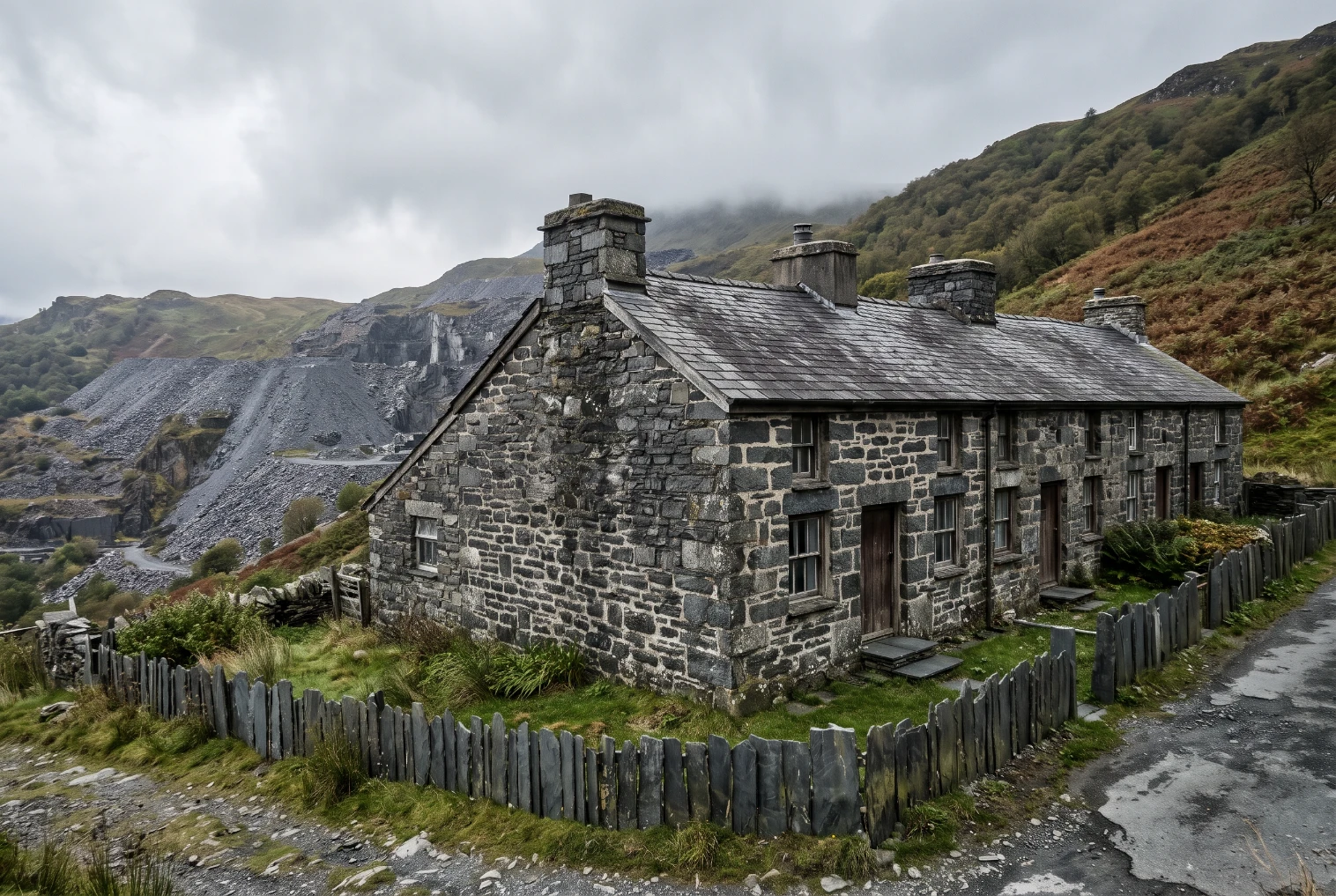
Quarrymens cottages are small stone and slate terraces built for quarry workers on hillsides above the quarries, mainly in North Wales and Cornwall. Walls are usually stone, roofs slate, and the steep sites give the terraces a stepped look.
The slate industry of North Wales boomed in the 19th century, and quarry villages such as Bethesda and Llanberis grew around the pits. The Slate Landscape of Northwest Wales is now a World Heritage Site.
c. 1800-1920
Regional building traditions have no single start date, so the band shows the main period of building. Periods are drawn at equal width, so the line is not to scale.
How to recognise it
| Feature | What to look for |
|---|---|
| Walls | Stone or slate rubble, often rendered, with thick walls and small windows. |
| Roof | Welsh slate in large slabs, with a chimney on each house. |
| Plan | A small cottage of two rooms and a loft, sometimes with a small plot or tyddyn. |
| Fences | Upright slate slabs used as fences and garden walls. |
| Details | Slate sills, lintels, steps and paths. |
| Setting | Steep hillsides above the quarry, with chapels and schools nearby. |
Not sure what a term means? See our guides to render, stucco, roughcast and pebbledash and ashlar and rubble stone, or browse the full architectural glossary.
Where and when they were built
The slate quarries employed thousands, and many quarrymen also kept a small piece of land. Houses and chapels were built from slate and stone close to the workings, and slate was used for almost everything.
The Slate Landscape of Northwest Wales was inscribed as a World Heritage Site in 2021. Buildings in Wales are listed by Cadw, which maintains the Welsh register.
Quarrymens cottages, valley terrace or Welsh longhouse?
- Quarrymens cottages: slate and stone terraces above quarries.
- Welsh valley terrace: stepped rows in the coalfield valleys. See our Welsh valley terrace page.
- Welsh longhouse and slate: a farmhouse type found in the same hills. See our Welsh longhouse page.
- Cornish tin miners cottages: mining homes in Cornwall. See our Cornish tin miners cottages page.
Quarry waste tips and old workings sit close to many cottages, so check the surroundings as well as the house.
What to check when buying one
- Slate roof: slate is long-lasting but the fixings fail. Check slates, ridge and flashings.
- Old quarry workings: ask about nearby quarries, spoil tips and ground stability.
- Damp and rainfall: North Wales is very wet. See our damp and mould guide.
- Steep sites: steep sites mean retaining walls, drainage and awkward access.
- Listing in Wales: listed buildings in Wales are protected by Cadw. Check the Welsh register.
- Choose the right survey: use a surveyor with experience of traditional buildings. See our home survey guide.
- Listed status and conservation areas: many surviving traditional houses are listed or lie in conservation areas, and most changes need consent. See our listed buildings guide.
Sources and further reading
- Cadw: Cof Cymru, National Historic Assets of Wales Check whether a building in Wales is listed
- Historic England: Domestic 1, Vernacular Houses Listing selection guide covering traditional regional houses
External links open in a new tab. Last checked November 2026.
Frequently asked questions
What is a quarrymens cottage?
A small house built for a slate or stone quarry worker, usually of stone and slate on a steep hillside.
Why is slate used for fences?
Slate was waste from the quarries and made strong, long-lasting fence posts and walls.
What is a tyddyn?
A small Welsh smallholding, which many quarrymen worked alongside their quarry jobs.
Is the slate landscape protected?
Yes. The Slate Landscape of Northwest Wales is a World Heritage Site.
Are quarrymens cottages listed?
Some are. Check the Cadw register.