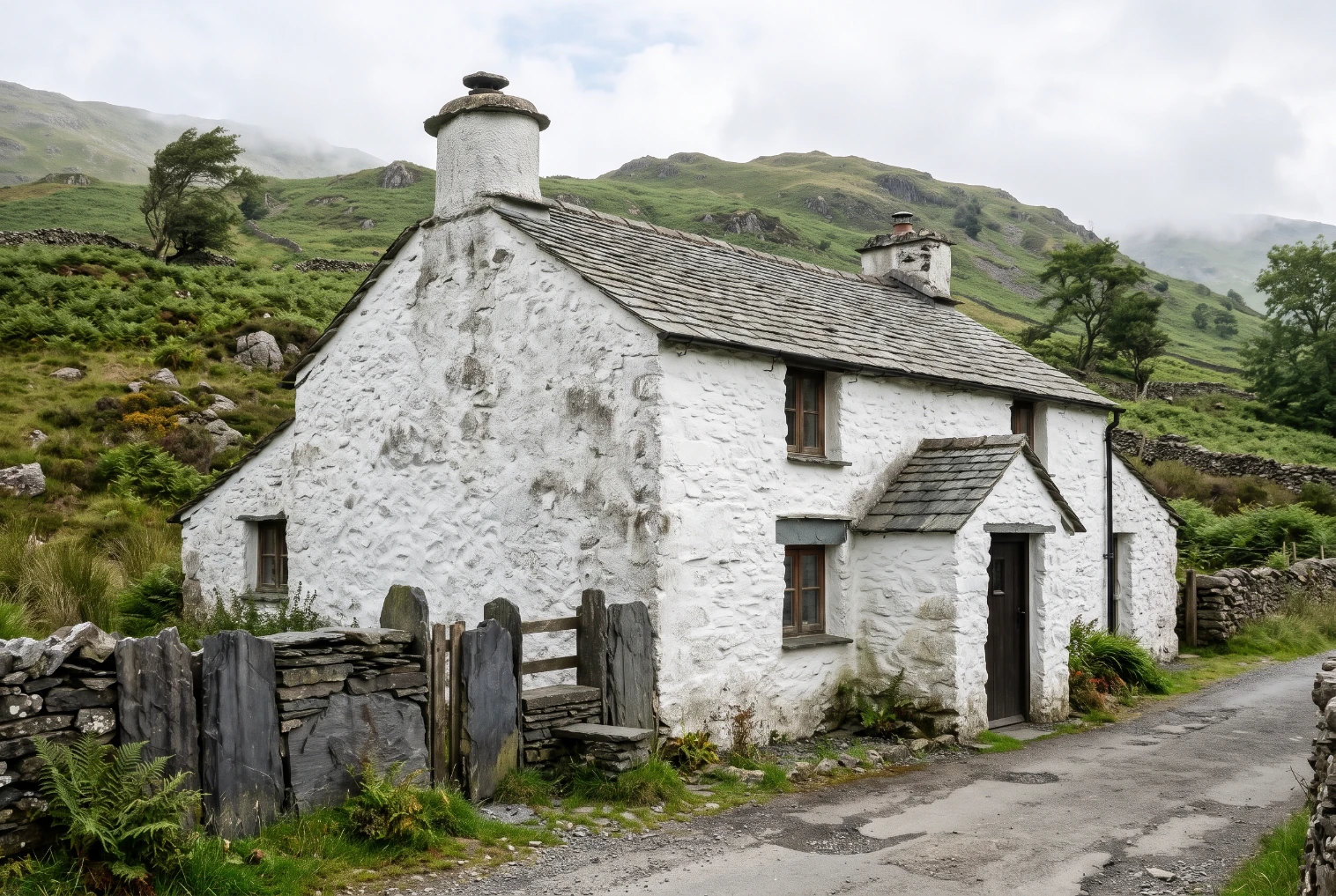
A Lake District slate house is a house built from local stone, with a roof of green or grey Lakeland slate, and often whitewashed or roughcast walls and tall round chimneys. It sits in the fells of Cumbria and is built to shed heavy rain.
Slate and stone were plentiful in the Lakes, so builders used them for walls, roofs, floors, fences and even bridges. Some farmhouses have a spinning gallery, a covered balcony at the upper level, which is typical of Cumbria.
c. 1600-1900
Regional building traditions have no single start date, so the band shows the main period of building. Periods are drawn at equal width, so the line is not to scale.
How to recognise it
| Feature | What to look for |
|---|---|
| Roof | Graded green or grey Lakeland slate, with a thick, uneven look. |
| Walls | Rough local stone, often roughcast and whitewashed, with thick walls. |
| Chimneys | Tall round chimneys with a slab cap, a feature of Cumbrian farmhouses. |
| Windows | Small windows with slate sills and plain lintels, sometimes with slate hanging on exposed walls. |
| Fences and walls | Slate slabs set upright as fences, and dry stone walls. |
| Farm buildings | Bank barns built into a slope with access to two levels, and sometimes spinning galleries. |
Not sure what a term means? See our guides to render, stucco, roughcast and pebbledash and parts of a roof, or browse the full architectural glossary.
Where and when they were built
The slate quarries of the central Lakes, such as at Honister, provided roofing across the region. Houses were plain, thick and low, to withstand heavy rain and wind on the fells.
The Historic England guide to vernacular houses covers regional traditions in the north-west. The round chimneys of Cumbria are one of the best-known regional features and are often visible on farmhouses and cottages.
Lake District slate, Dales stone or Welsh slate?
- Lake District slate: whitewashed stone and green slate with round chimneys.
- Yorkshire Dales stone: greyer and with stone-flag roofs. See our Yorkshire Dales stone house page.
- Welsh longhouse and slate: a similar use of slate in Wales. See our Welsh longhouse page.
- Border peel towers and bastle houses: fortified houses on the same border. See our bastle houses page.
Cumbria has many farmhouses that were once cruck-framed, so older timber structures may be hidden inside stone walls.
What to check when buying one
- Slate roof: check for slipped slates and rusted fixings. Slates are expensive to match.
- Roughcast and whitewash: repair with lime, not cement, and repaint with limewash.
- Damp and rainfall: the Lakes are very wet, so check gutters, drainage and the base of walls. See our damp and mould guide.
- Flood risk: many houses are in valleys and near rivers. Check flood risk and insurance.
- National Park and World Heritage rules: the Lake District is a National Park and World Heritage Site, so alterations are closely controlled.
- Choose the right survey: use a surveyor with experience of traditional buildings. See our home survey guide.
- Listed status and conservation areas: many surviving traditional houses are listed or lie in conservation areas, and most changes need consent. See our listed buildings guide.
Sources and further reading
- Historic England: Domestic 1, Vernacular Houses Listing selection guide covering traditional regional houses
- Historic England: the National Heritage List for England Check whether a building is listed
External links open in a new tab. Last checked November 2026.
Frequently asked questions
What is Lakeland slate?
A hard slate quarried in the Lake District, in shades of green and grey, used for roofs, walls and floors.
What is a Cumbrian round chimney?
A tall round chimney, usually built from stone and capped with a slab, found on older farmhouses in the county.
What is a spinning gallery?
A covered balcony on a farmhouse or barn, once used for drying wool and spinning.
Why are Lake District houses whitewashed?
Whitewash or limewash protected the walls and made them last longer.
Are Lake District houses listed?
Many are. Check the National Heritage List for England.