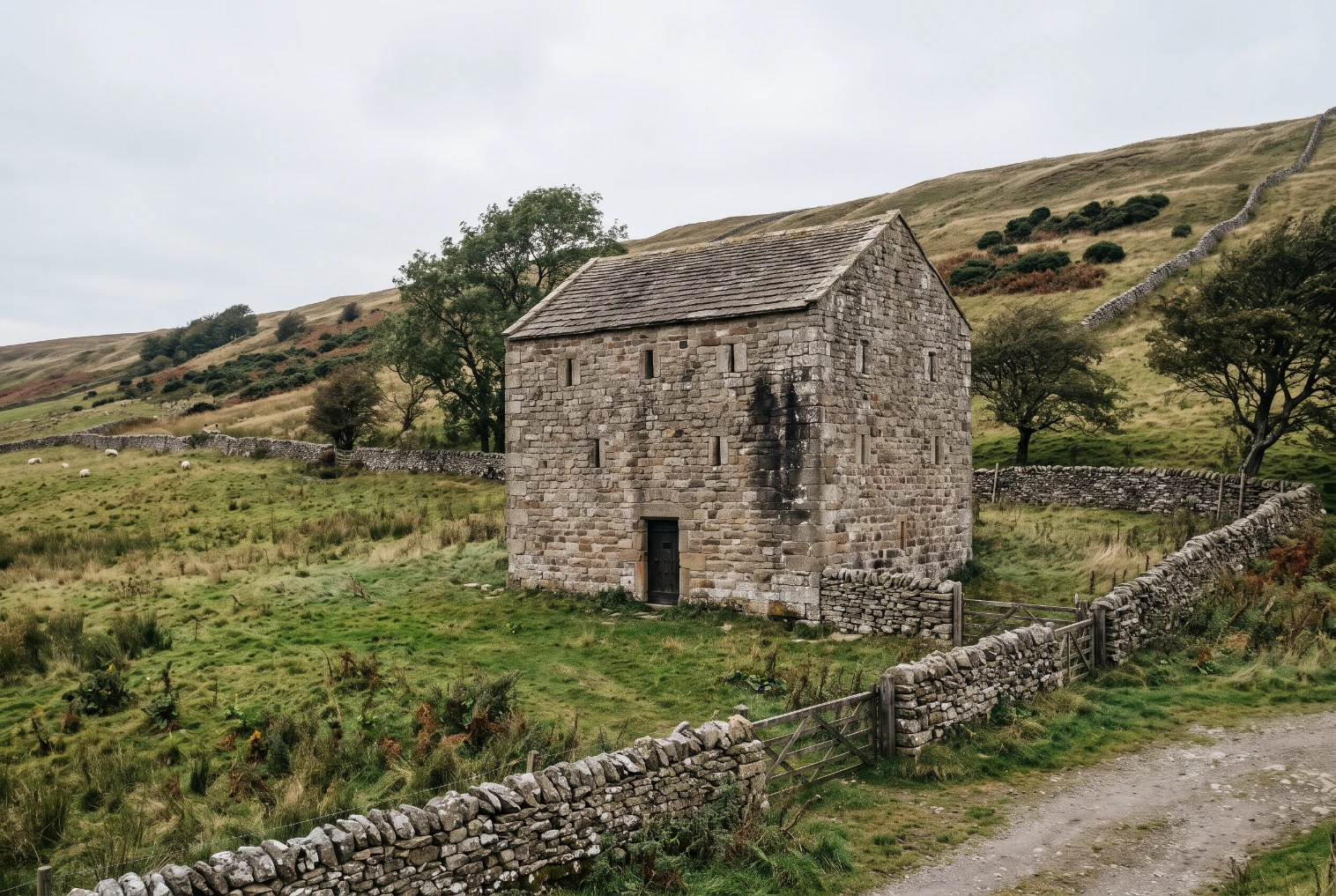
A bastle house is a fortified farmhouse of the English-Scottish border, with very thick stone walls, small slit windows, a ground floor for animals and an upper floor for the family. A peel tower is a small defended tower house built by landowners and clergy.
They were built mainly in the 16th and early 17th centuries, in the troubled years of border raiding, and most are in Northumberland and Cumbria. Historic England notes that fewer than 300 bastles are known to survive.
c. 1550-1700
Regional building traditions have no single start date, so the band shows the main period of building. Periods are drawn at equal width, so the line is not to scale.
How to recognise it
| Feature | What to look for |
|---|---|
| Walls | Very thick rubble stone walls, up to about 1.2 metres, with few openings. |
| Ground floor | A single low door, a vaulted or beamed ceiling, and small slit windows, used for animals. |
| Upper floor | The family's living space, reached by a ladder or an outside stair, with small windows. |
| Roof | Stone slabs or slate, and sometimes thatch in earlier times. |
| Datestone | A carved date or initials over the door, often of the early 17th century. |
| Setting | Isolated farms on hillsides in Northumberland and Cumbria. |
Not sure what a term means? See our guides to ashlar and rubble stone and parts of a roof, or browse the full architectural glossary.
Where and when they were built
Border reivers raided across the frontier, and farmers built strong houses to protect their families and cattle. After the union of the crowns in 1603 the Border grew peaceful, and many bastles were enlarged or converted into ordinary farmhouses and barns.
Historic England list entries describe several bastles in Northumberland. One near Whitlees in Elsdon has walls about 54 inches thick, Woodhouses Bastlehouse at Harbottle is listed Grade II* with a datestone of 1602, and Hole Bastle near Bellingham has a barrel-vaulted ground floor.
Bastle house, peel tower or Lake District farmhouse?
- Bastle house: a fortified farmhouse, usually two storeys with a ground floor for cattle.
- Peel tower: a taller tower house built for gentry or clergy, with more rooms.
- Lake District slate house: a more peaceful farmhouse tradition nearby. See our Lake District slate house page.
- Medieval hall house: the earlier hall type. See our medieval hall house page.
Many bastles have been altered over the centuries, with later windows, extensions and farm uses added.
What to check if you are buying one
- Listed status: bastles are often listed or scheduled, so work needs consent. See our listed buildings guide.
- Thick walls and damp: rubble walls need breathable lime repairs. See our damp and mould guide.
- Roof structure: check the roof timbers and the stone slabs or slates.
- Vaults and floors: vaulted ground floors may need specialist repair and care.
- Remote location: check access, services and winter conditions.
- Choose the right survey: use a surveyor with experience of traditional buildings. See our home survey guide.
- Listed status and conservation areas: many surviving traditional houses are listed or lie in conservation areas, and most changes need consent. See our listed buildings guide.
Sources and further reading
- Historic England: Bastle House near Whitlees, Elsdon A bastle with walls about 54 inches thick
- Historic England: Woodhouses Bastlehouse, Harbottle A Grade II* bastle with a datestone of 1602
- Historic England: Hole Bastle, Bellingham A bastle with a barrel-vaulted ground floor
- Historic England: the National Heritage List for England Check whether a building is listed
External links open in a new tab. Last checked November 2026.
Frequently asked questions
What is a bastle house?
A defended farmhouse of the English-Scottish border, with thick walls, a ground floor for animals and an upper floor for the family.
What is a peel tower?
A small fortified tower house, built by landowners or clergy in the Border area, for protection against raiders.
How many bastles survive?
Historic England notes that fewer than 300 are known to survive.
Who were the Border reivers?
Raiders on both sides of the English-Scottish border, active mainly from the 13th to the 17th centuries.
Are bastles listed?
Many are listed, and some are scheduled monuments. Check the National Heritage List for England.