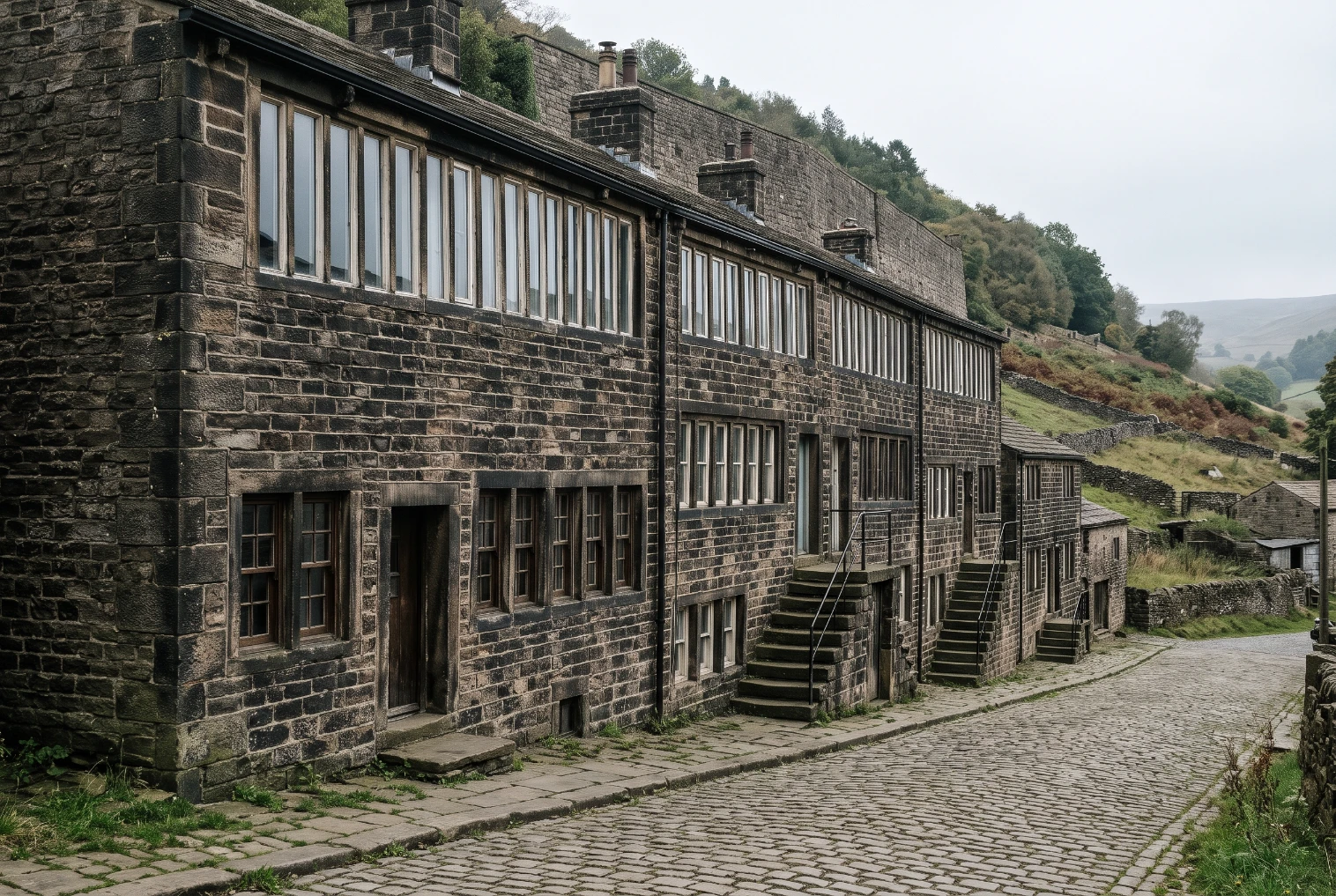
Weavers cottages are houses built for handloom weavers, with a long window of many lights, often in a continuous band, along the top floor to give light to the loom. They are found in the Pennines of Yorkshire and Lancashire and, in a smaller form, in the Cotswolds.
Weaving was a home industry before the factory, and the top floor was a workshop. The introduction of power looms in the early 19th century ended the trade, and many weavers cottages were converted to ordinary homes.
c. 1700-1850
Regional building traditions have no single start date, so the band shows the main period of building. Periods are drawn at equal width, so the line is not to scale.
How to recognise it
| Feature | What to look for |
|---|---|
| Top-floor windows | A long band of narrow lights, set in a continuous stone mullioned window, to light the loom. |
| Walls | Local stone, often gritstone in the Pennines, laid in neat courses. |
| Roof | Stone slates or flags, with a shallow pitch. |
| Plan | A living space on the ground floor, a bedroom, and a loom shop above, sometimes with a cellar. |
| Steps | External stone stairs in some terraces to reach the upper floors. |
| Setting | Hillside villages and hamlets, often near streams for washing and fulling. |
Not sure what a term means? See our guides to parts of a roof and wall and brickwork terms, or browse the full architectural glossary.
Where and when they were built
Before the factory, the textile trade was a family industry, and the weaver's home and workplace were one. Handloom shops were built wherever the cloth trade was strong.
The Historic England guide to vernacular houses covers regional traditions, including the stone terraces of the Pennines. The Historic England guidance on industrial buildings covers the factories that replaced them.
Weavers cottages, mill-town terrace or Peak gritstone?
- Weavers cottages: a home and workshop with long top-floor windows.
- Back-to-back and mill-town terrace: housing for factory workers, later. See our mill-town terrace page.
- Peak District gritstone: the stone used for many Pennine houses. See our Peak District gritstone page.
- Cotswold stone: a different stone tradition where weavers also worked. See our Cotswold stone house page.
Many long windows were later blocked or altered after weaving ended, so look at the stonework for the original opening.
What to check when buying one
- Long mullioned windows: stone mullions can crack or weather. Check the lintels, the frames and the glass.
- Stone roof: heavy stone slates need strong timbers. Check for sagging and slipped slabs.
- Damp and exposure: hillside sites are damp and exposed. See our damp and mould guide.
- Steps and access: stone steps and terraces can be uneven and steep.
- Listed status: many weavers terraces are listed. Check what consent is needed.
- Choose the right survey: use a surveyor with experience of traditional buildings. See our home survey guide.
- Listed status and conservation areas: many surviving traditional houses are listed or lie in conservation areas, and most changes need consent. See our listed buildings guide.
Sources and further reading
- Historic England: Domestic 1, Vernacular Houses Listing selection guide covering traditional regional houses
- Historic England: the National Heritage List for England Check whether a building is listed
External links open in a new tab. Last checked November 2026.
Frequently asked questions
What is a weavers cottage?
A house built for a handloom weaver, with a long band of windows on the top floor to light the loom.
Why are the windows so long?
Weaving needs good light, so the loom shop had a continuous band of narrow windows.
Where are weavers cottages found?
Mainly in the Pennines of Yorkshire and Lancashire, and also in parts of the Cotswolds and elsewhere.
What ended handloom weaving?
Power looms and factories in the early 19th century.
Are weavers cottages listed?
Many are. Check the National Heritage List for England.