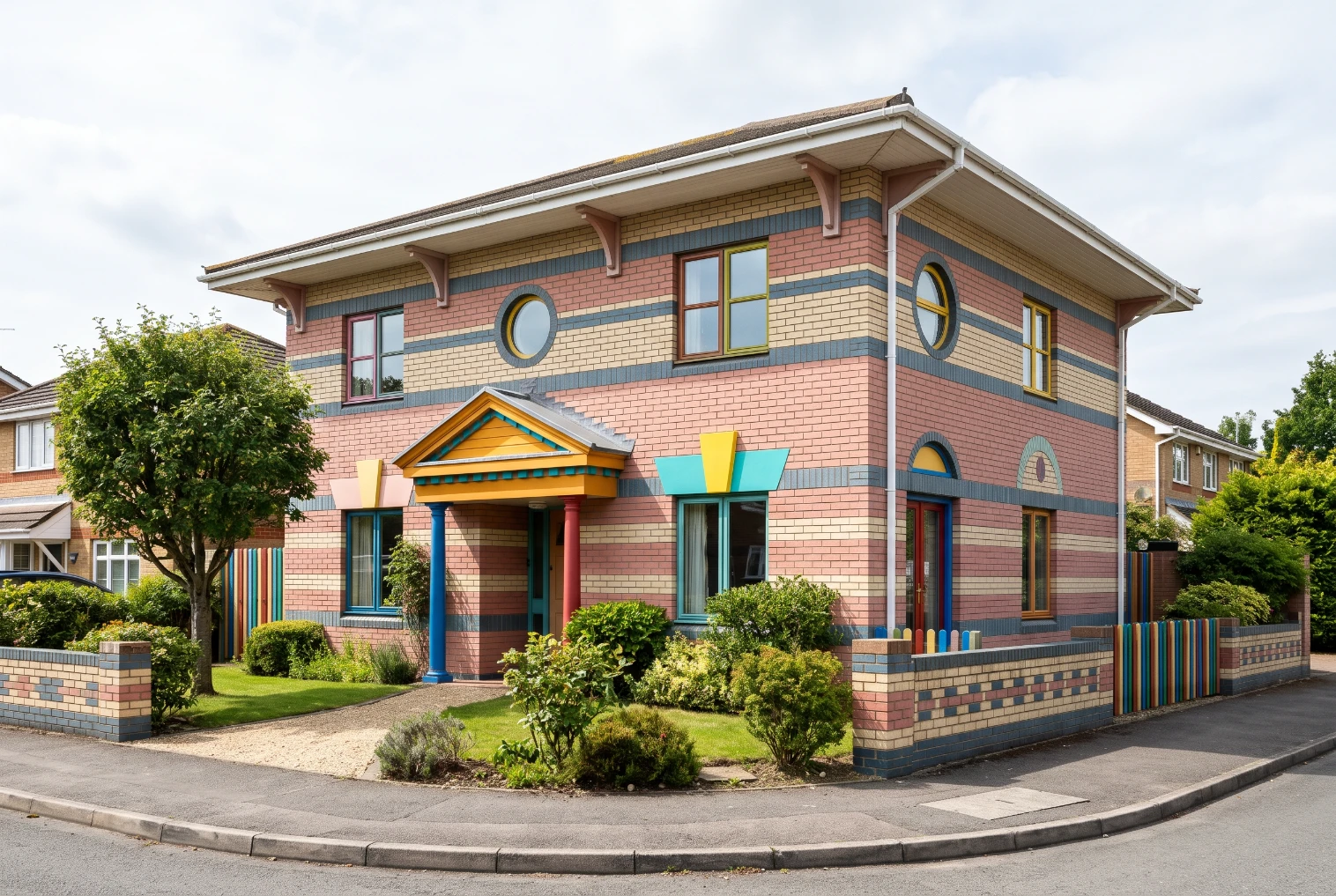
A Postmodern house is a house of about 1975 to 1995 that mixes modern construction with playful references to historic styles, such as small pediments, keystones, columns and arches, often in bright colours and used in an ironic or decorative way.
Postmodernism was a reaction against the plain, functional look of Modernism. In housing it appears most often on private and housing-association estates from the 1980s, with decorative brick, painted details and unusual shapes.
c. 1975-1995
The band starts at the end of the post-war period and runs into the modern period. Periods are drawn at equal width, so the line is not to scale.
How to recognise it
| Feature | What to look for |
|---|---|
| Historic references | Pediments, keystones, columns and arches used on a small scale, often as decoration, not structure. |
| Colour | Pink, cream, blue-grey and other bright or pastel colours, often in bands or panels. |
| Brickwork | Patterned or contrasting brick, often in horizontal stripes and with decorative lintels. |
| Shapes | Gabled or pitched roofs, round windows and playful curves on a simple box. |
| Windows | Windows in unusual shapes and positions, including round and arched ones. |
| Scale | Details sometimes made much larger or smaller than normal, for a witty effect. |
| Construction | Modern materials, usually brick or block with a tiled roof, built to modern regulations. |
Not sure what a term means? See our guides to hipped, gable and mansard roofs and classical architecture terms, or browse the full architectural glossary.
Where and when they were built
Postmodernism was influenced by architects such as Robert Venturi and James Stirling, and became popular in commercial and public buildings as well as housing. Many housing developments of the 1980s used its ideas in a mild form, with decorated brickwork and playful details.
Historic England has published an introduction to Post-Modern architecture, and listed No.1 Poultry in the City of London, designed by James Stirling and Michael Wilford and built in 1994 to 1998, at Grade II*. That building is commercial, not a house, but it shows how the style is now being protected.
Postmodern, Modernist or neo-vernacular?
- Postmodern: about 1975 to 1995. Playful, decorative and ironic, with historic references.
- Mid-century modern: plainer and more functional. See our mid-century modern house page.
- Neo-vernacular estate housing: copies local traditional forms more seriously. See our neo-vernacular page.
- Neo-Georgian: an earlier and more respectful revival. See our Neo-Georgian house page.
Postmodernism is a loose label, so many houses with some of these features are better described as late 20th-century speculative housing.
What to check when buying one
- Painted details: bright colours fade and peel. Check the paint on rendering, columns and applied features.
- Applied ornament: decorative features may be glued or fixed on thinly. Check for loose or missing pieces.
- Flat and shallow roofs: roofs with unusual shapes and flat sections may leak. Check the junctions.
- Insulation: houses of the 1980s often have thinner insulation than a new house. Check the energy performance certificate.
- Alterations: unusual features may have been removed or altered, so compare with the original design if you can.
- Choose the right survey: use a surveyor who understands the type of construction. See our home survey guide.
- Building regulations and warranties: ask for completion certificates, a structural warranty or architect's certificate, and energy performance information.
Sources and further reading
- Historic England: No.1 Poultry, London A Grade II* Postmodern building of 1994 to 1998 by James Stirling and Michael Wilford
- Historic England: Post-Modern Architecture An introduction to the style
- Historic England: the National Heritage List for England Check whether a building is listed
External links open in a new tab. Last checked November 2026.
Frequently asked questions
What is Postmodern architecture?
A style from about 1975 that reacted against Modernism by bringing back decoration, colour and references to historic styles, often in a playful way.
Are there many Postmodern houses?
Not many pure examples. Many 1980s houses use a few Postmodern details such as keystones, coloured brick and round windows.
How is Postmodern different from Modernist?
Modernist buildings avoid decoration, while Postmodern buildings bring it back, often with humour.
Are Postmodern buildings listed?
A few are. No.1 Poultry in London is listed Grade II*, and Historic England has been looking at more buildings from this period.
Are Postmodern houses well built?
They follow modern regulations, but the decorative details can be fragile. A survey will show their condition.