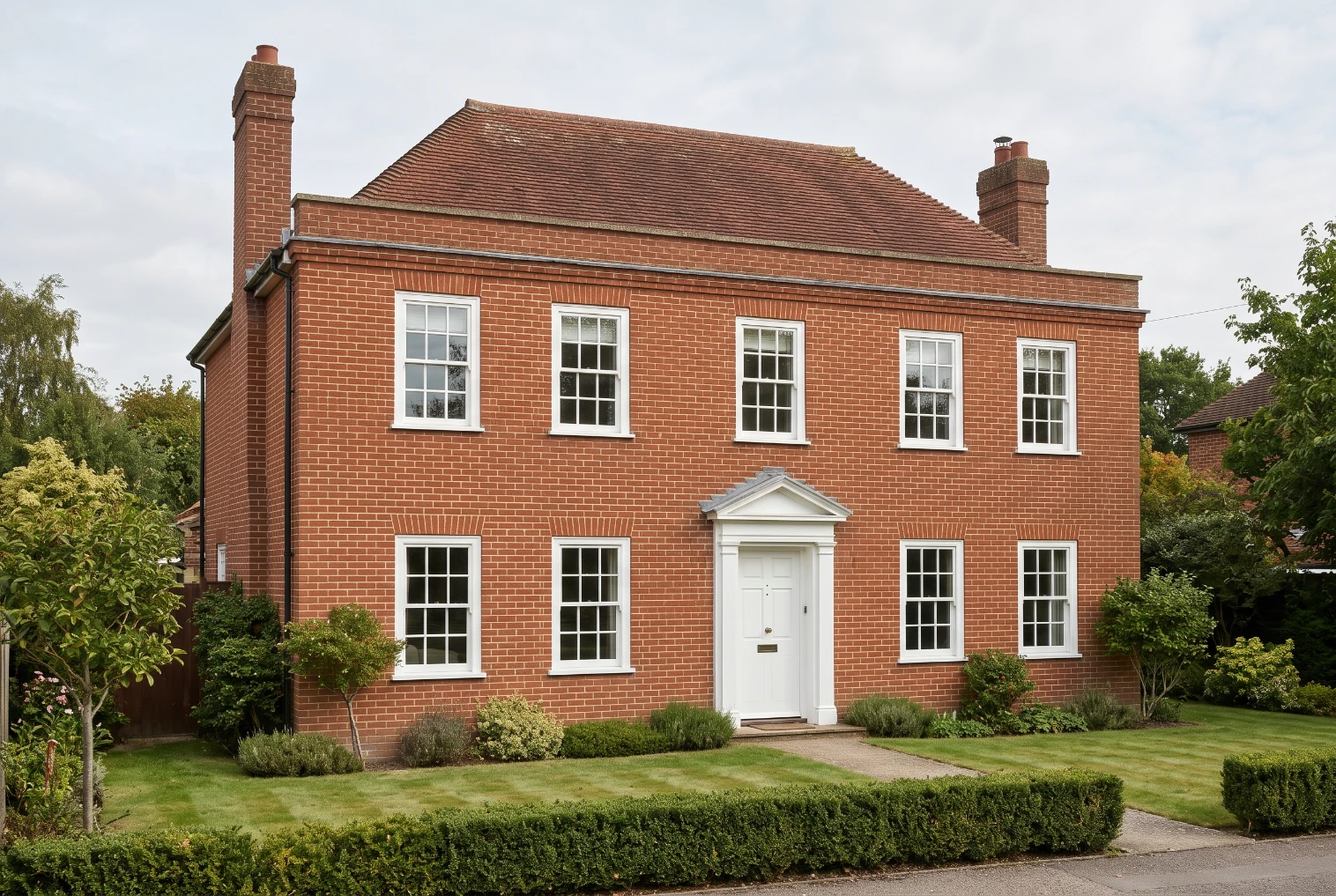
A Neo-Georgian house is a 20th-century house built to look like an 18th-century Georgian one, with a symmetrical front, sash windows with small panes, a central door with a pediment, and a hipped roof. It was built from about 1910 to 1960.
It was a popular, quiet and respectable style for houses, banks, schools, offices and town halls. Neo-Georgian houses are usually in machine-made brick with thinner details than a true Georgian house.
c. 1910-1960
The band starts in the Edwardian period and runs through the interwar years into the post-war period. Periods are drawn at equal width, so the line is not to scale.
How to recognise it
| Feature | What to look for |
|---|---|
| Symmetry | A balanced front with a central door and an equal number of windows on each side. |
| Walls | Regular, machine-made brick, often a warm red or orange, with pale mortar and neat joints. |
| Windows | White-painted timber sashes with small panes, often in a regular pattern. |
| Door | A central panelled door, often with a pediment, simple columns or a canopy. |
| Roof | A hipped tiled or slate roof with a simple cornice and tall chimneys at each end. |
| Detail | Brick quoins, string courses and a plain cornice, but thinner and more regular than the 18th-century originals. |
| Plan | A modern layout with a hall, reception rooms, kitchen and bathroom, hidden behind a Georgian front. |
Not sure what a term means? See our guides to hipped, gable and mansard roofs and classical architecture terms, or browse the full architectural glossary.
Where and when they were built
The Georgian revival grew in the early 20th century as a reaction against the busier Victorian and Edwardian styles. It became more popular between the wars, and continued after 1945 for some housing and public buildings.
The Historic England listing guide on suburban and country houses says that the neo-Georgian revival gained increasing dominance in the 20th century, and gives Ridgehanger in Ealing, a house of 1915, as an example of a well-proportioned and reticent neo-Georgian house.
Neo-Georgian or true Georgian?
- Neo-Georgian: about 1910 to 1960. Georgian proportions in regular, machine-made brick with modern services.
- Georgian townhouse and terrace: the original, with hand-made bricks, narrow bonds and original sashes. See our Georgian terrace page.
- Palladian: a grander 18th-century style. See our Palladian house page.
- Interwar semi: often has a few Georgian details. See our interwar semi page.
Look at the brick, the window glass and the joints. Real Georgian brick is irregular and hand-made, while Neo-Georgian brick is even and sharp.
What to check when buying one
- Wall construction: houses of the 1920s and 1930s may have early cavity walls, and wall ties of that date can corrode. Ask a surveyor to check.
- Sash windows: timber sashes may need repair or draught-proofing. Check the cords and sills.
- Roof: check tiles, flashings and chimneys. See our roof tile calculator.
- Brickwork: regular brick and neat pointing can hide cracks. Check for movement around windows and doors.
- Damp: see our damp and mould guide.
- Choose the right survey: a surveyor who knows 20th-century construction will spot the problems typical of the period. See our home survey guide.
- Listed status and conservation areas: most houses of this period are not listed, but some are, and many lie in conservation areas with controls on fronts and windows. See our listed buildings guide.
Sources and further reading
- Historic England: Domestic 3, Suburban and Country Houses Listing selection guide covering houses to the early 20th century
- Historic England: the National Heritage List for England Check whether a building is listed
External links open in a new tab. Last checked November 2026.
Frequently asked questions
What is a Neo-Georgian house?
A 20th-century house designed in the style of 18th-century Georgian houses, with a symmetrical front, sash windows and a pedimented door.
How can I tell Neo-Georgian from Georgian?
Neo-Georgian houses use regular, machine-made brick, thinner details and modern windows or services. True Georgian brick is uneven and hand-made.
When was Neo-Georgian popular?
Mainly from about 1910 to 1960, especially between the wars.
Why was it popular?
It looked respectable, quiet and well-proportioned, and suited banks, offices, schools and suburban houses.
Are Neo-Georgian houses listed?
Some are, especially work by well-known architects. Check the National Heritage List for England.