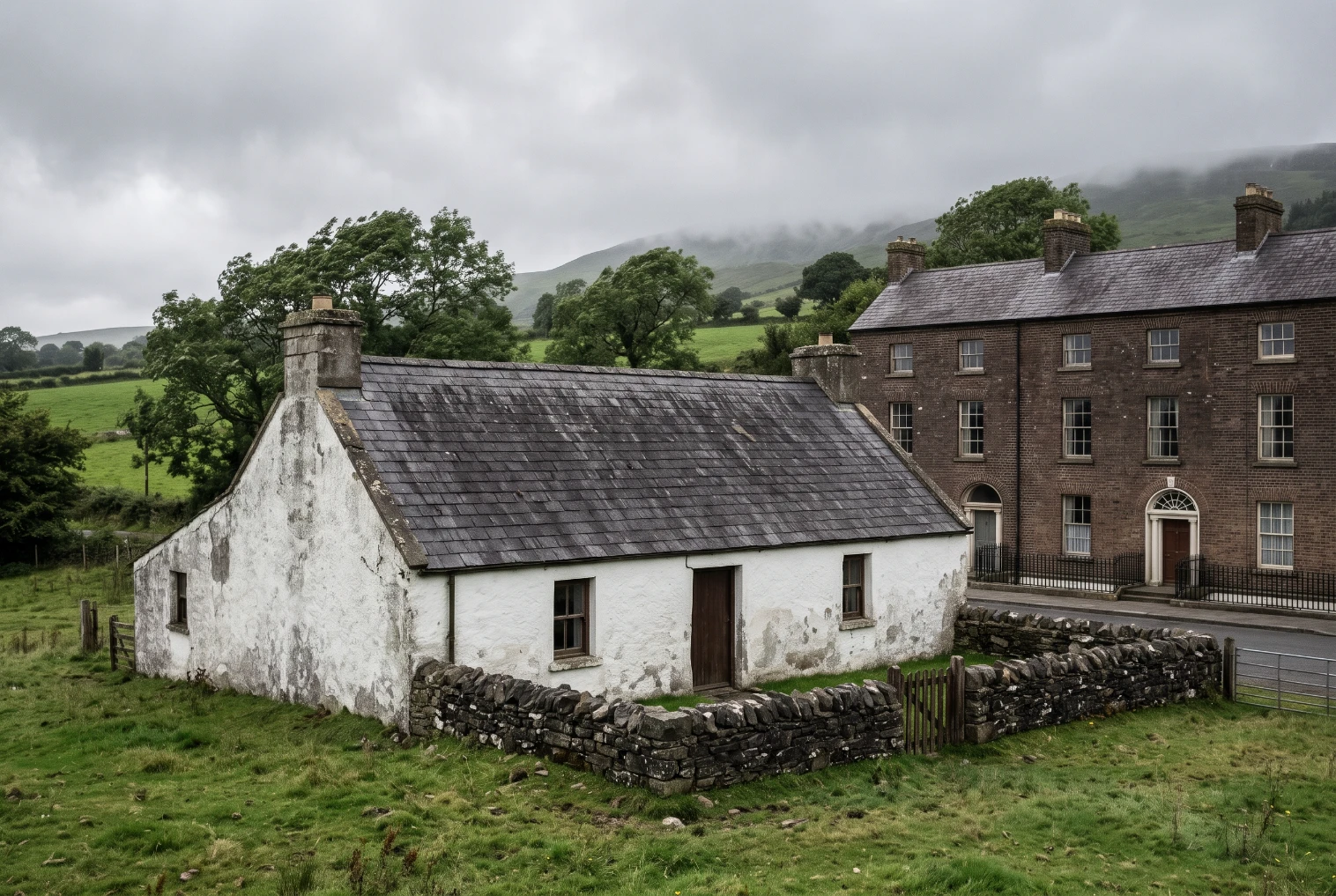
Northern Irish vernacular houses are plain farmhouses and cottages, usually single or two storeys, with thick walls, whitewash or render, a central door and a chimney at each gable. Georgian town houses in places such as Armagh and Belfast follow the same classical ideas as English ones.
Older Ulster farmhouses were often thatched, with a central hearth, but slate roofs replaced thatch from the 19th century. The Georgian houses of towns such as Armagh show the influence of Dublin and London designers.
c. 1700-1900
Regional building traditions have no single start date, so the band shows the main period of building. Periods are drawn at equal width, so the line is not to scale.
How to recognise it
| Feature | What to look for |
|---|---|
| Farmhouse form | A long, low house with a central door, a window each side and a chimney at each end. |
| Walls | Rubble stone or brick, rendered and whitewashed. |
| Roof | Slate, or thatch in older houses, with a simple ridge and eaves. |
| Georgian town house | Symmetrical brick front with sash windows, a fanlight and a panelled door. |
| Detail | Plain stone sills, iron railings and fine doorcases in towns. |
| Setting | Fields, hedges and stone walls in the country, and squares and terraces in towns. |
Not sure what a term means? See our guides to sash and casement windows and eaves, fascia, soffit and verge, or browse the full architectural glossary.
Where and when they were built
Farmhouses in Northern Ireland share many features with those across Ireland and Scotland, but have their own forms. Georgian town building flourished in the 18th century, with planned streets and squares.
Buildings in Northern Ireland are listed by the Department for Communities, Historic Environment Division, not by Historic England. Check the Northern Ireland register before planning any work.
Ulster vernacular, English Georgian or Scottish croft?
- Northern Irish vernacular and Georgian: whitewashed farmhouses and brick town houses in Ulster.
- Georgian townhouse and terrace: the English version. See our Georgian townhouse and terrace page.
- Scottish croft and Highland cottage: a related farmhouse tradition across the North Channel. See our croft and Highland cottage page.
- Palladian house: the grander classical style behind many country houses. See our Palladian house page.
Many farmhouses have been altered or extended, so check the roof, the windows and the walls for original features.
What to check when buying one
- Thatch or slate roof: check the roof covering and timbers. Thatch needs specialist repair and insurance.
- Lime and whitewash: repair with lime render and limewash so the walls can breathe.
- Georgian sash windows: repair original sashes rather than replacing them.
- Damp: see our damp and mould guide.
- Listing in Northern Ireland: listed buildings are protected under separate legislation in Northern Ireland, so check the register and rules.
- Choose the right survey: use a surveyor with experience of traditional buildings. See our home survey guide.
- Listed status and conservation areas: many surviving traditional houses are listed or lie in conservation areas, and most changes need consent. See our listed buildings guide.
Sources and further reading
- Department for Communities: Historic Environment Check whether a building in Northern Ireland is listed
External links open in a new tab. Last checked November 2026.
Frequently asked questions
What is an Ulster farmhouse?
A traditional farmhouse in Northern Ireland, usually long, low and whitewashed, with a central door and chimneys at the gables.
Are Northern Irish Georgian houses different?
They follow the same classical ideas as English ones, in brick or stone, with local variations.
Why were houses whitewashed?
Limewash protected walls from weather and made rooms brighter inside.
Who lists buildings in Northern Ireland?
The Department for Communities, Historic Environment Division.
Do Historic England rules apply?
No. Northern Ireland has its own legislation and register.