A gable is the triangular end of a pitched roof. A pediment is a decorative triangle over a door, window or portico. A column stands free and carries load, and a pilaster is a flat column pressed against a wall for decoration.
Each pair looks alike, but one in each is structural and the other is decorative. Classical fronts use the decorative versions to give a simple house the look of a temple.
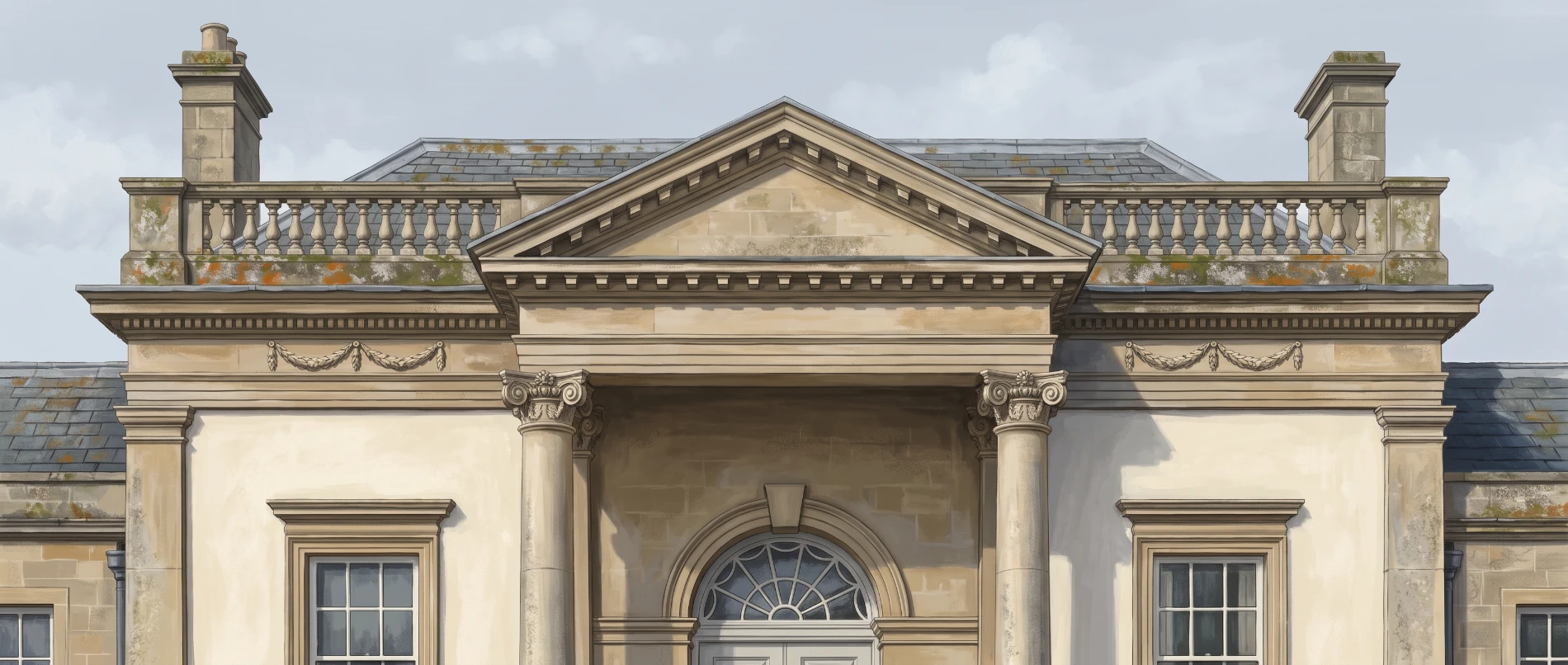
Pediment vs gable, drawn out
Pilaster vs column, drawn out
Simplified drawings. Real pediments, pilasters and columns come in many proportions and orders, with more mouldings and capital details than shown here.
Pediment vs gable at a glance
| Feature | Pediment | Gable |
|---|---|---|
| What it is | A decorative triangle or curve over a door, window or portico. | The triangular end wall under a pitched roof. |
| Purpose | Decoration and emphasis. | The structural end of the roof. |
| Where | Over openings and across the front of a temple-style portico. | At the end of the roof. |
| Shape | Triangular, curved or broken. | Triangular, stepped or shaped. |
| Moulding | Has a moulded cornice and a flat panel (the tympanum). | Usually plain, with a bargeboard or verge. |
Pilaster vs column at a glance
| Feature | Pilaster | Column |
|---|---|---|
| Form | A flat rectangular column attached to a wall. | A round shaft that stands free. |
| Load | Mostly decorative. | Carries weight. |
| Projection | Only a few centimetres from the wall. | Stands clear of the wall or in front of it. |
| Where | Beside doors, at corners or between windows. | In porticos, colonnades and large houses. |
| Parts | Has a base, a shaft and a capital, like a column. | Has a base, a shaft and a capital. |
How to tell them apart
- Look at the top of a door. A triangle or curve above it with a flat panel inside is a pediment.
- Look at the roof. A triangle formed by the end wall under the slope of the roof is a gable.
- Look at the profile. If the shaft sticks out round and free, it is a column. If it is flat against the wall, it is a pilaster.
- Look at the capital. Both can have capitals, so check the top for plain, scrolled or leafy details.
Where you will see them
- Palladian house: Temple fronts with pediments.
- Greek Revival house: Columns and pilasters.
- Georgian townhouse and terrace: Pedimented doorcases.
- Regency house: Pilasters and stucco.
What it means for owners
- Check the moulding. Pediments and pilasters are often plaster or stone, and cracks let water in.
- Repair with matching materials. Replace missing mouldings with the same material and profile.
- Listed buildings. Changes to a classical front, including doorcases, usually need consent. See our listed buildings guide.
For the full set of definitions, see our classical and decorative details page and the architectural glossary.
Sources and further reading
- Historic England: the National Heritage List for England Check whether a building is listed
External links open in a new tab. Last checked November 2026.
Frequently asked questions
What is the difference between a pediment and a gable?
A pediment is a decorative classical triangle over an opening, and a gable is the structural end of a pitched roof.
What is a pilaster?
A flat column set against a wall, with a base and capital but only a shallow projection.
Is a pilaster structural?
Usually not. It is mostly decorative, though it can add some stiffness to a wall.
What is a broken pediment?
A pediment whose sloping sides are cut off before they meet at the top, often with an urn or ornament in the gap.
What is a portico?
A porch with columns and a pediment at the entrance of a classical building.