A Greek Revival house is a house built in the early 19th century, from about 1800 to 1850, with the look of an ancient Greek temple: a portico of columns under a low pediment, plain smooth walls and very little other ornament.
Greek Revival followed the more Roman Palladian and Adam styles. Architects such as William Wilkins and Robert Smirke used it for villas, country houses, churches and public buildings. It appears on houses mostly as a portico or doorway.
c. 1800-1850
The band runs from the late Georgian period into the early Victorian period. Periods are drawn at equal width, so the line is not to scale.
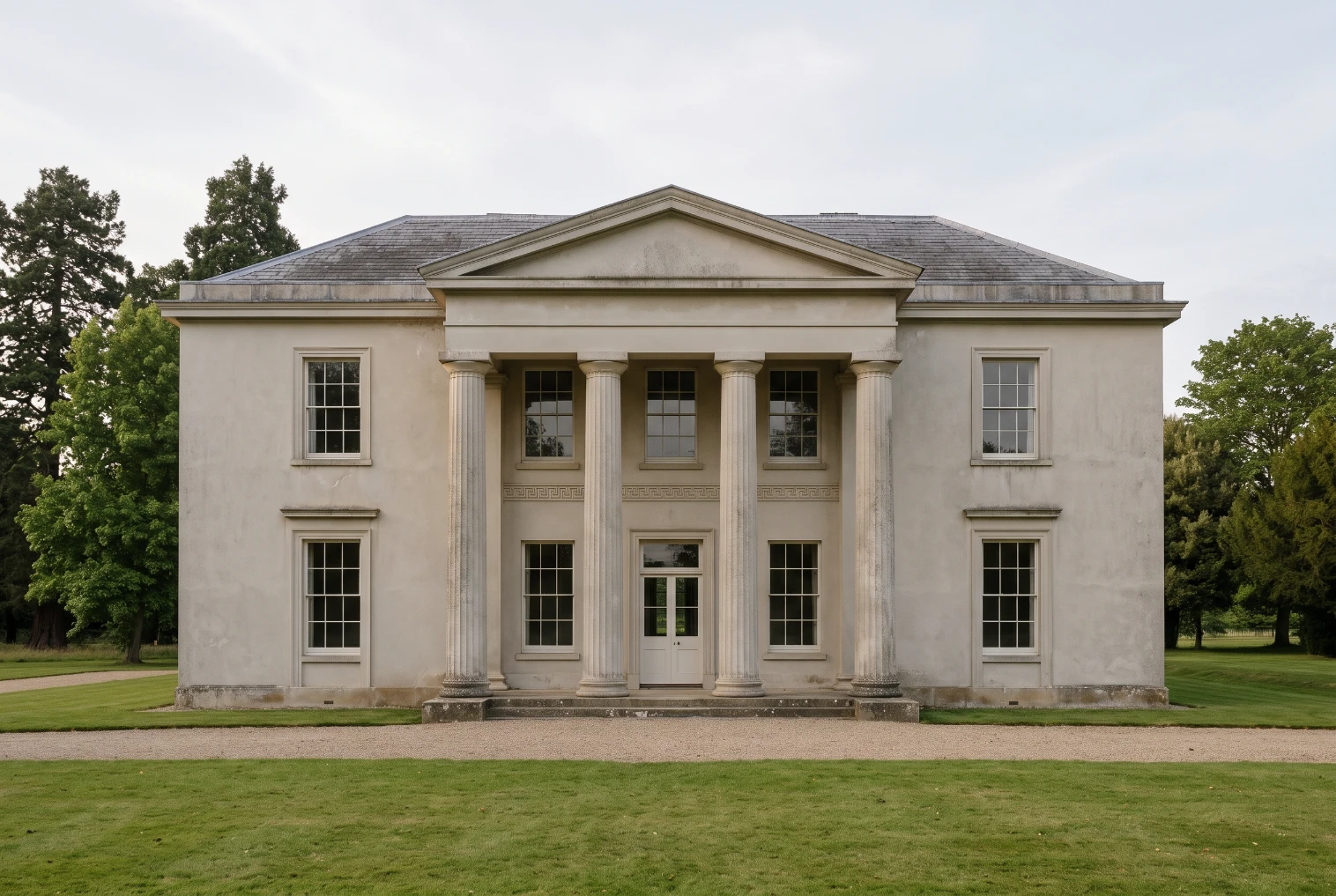
How to recognise it
| Feature | What to look for |
|---|---|
| Portico | A temple-style portico, most often Greek Doric, with sturdy fluted columns that have no base, or Ionic with scroll capitals. |
| Pediment | A low triangular pediment, shallower than a Palladian one. |
| Walls | Plain smooth stucco or ashlar, with minimal decoration. |
| Windows | Simple sashes, often with plain surrounds and no carved decoration. |
| Roof | A low-pitched slate roof, often hipped and hidden behind a parapet. |
| Details | Greek key, anthemion and palmette ornament, used sparingly. |
| Where used | Villas, country houses, lodges and public buildings, with a few terraces and doorways on ordinary houses. |
Not sure what a term means? See our guides to hipped, gable and mansard roofs and render, stucco, roughcast and pebbledash, or browse the full architectural glossary.
Where and when they were built
Interest in Greece grew after travellers and archaeologists published drawings of Athenian buildings in the 18th century. The Greek Revival arrived in Britain in the early 19th century and was at its height in the 1820s and 1830s.
Historic England records The Grange at Northington in Hampshire, remodelled by William Wilkins, as stucco over brick with a large Greek Doric portico and an important early example of the style. Houghton Hall near Carlisle is described as stucco with an entrance portico of fluted Greek Doric columns, and Kelston at Ryde, of about 1820 to 1830, has a four-column Greek Doric portico.
Greek Revival, Neoclassical or Regency?
- Neoclassical and Adam: lighter and more delicate. See our Neoclassical and Adam house page.
- Greek Revival: about 1800 to 1850. Plain walls and a Greek temple portico.
- Regency: more decorative, with bows and iron balconies. See our Regency house page.
- Palladian: based on Roman models, with deeper porticos and a raised main floor. See our Palladian house page.
The difference between Greek and Roman orders is the main clue. A Greek Doric column stands directly on the step without a base, while Roman columns have bases.
What to check when buying one
- Portico columns: stucco-covered columns can crack and hide rotten timber or rusted iron inside. Check for hollow patches and rust staining.
- Portico roof: flat or low roofs over a portico can leak into the front rooms. Check lead and drainage.
- Stucco: repair with lime and use breathable paint. Cement and masonry paint trap damp.
- Plain surfaces: large flat walls show every crack and repair, so ask what has been done before.
- Damp: see our damp and mould guide before choosing repairs.
- Choose the right survey: use a surveyor with experience of older buildings. See our home survey guide.
- Listed status: most surviving Georgian houses are listed or in a conservation area, and most alterations need consent. See our listed buildings guide.
Sources and further reading
- Historic England: The Grange, Northington A Grade I house with a large Greek Doric portico
- Historic England: Houghton Hall, Stanwix An early 19th-century stucco house with a Greek Doric portico
- Historic England: Kelston, Ryde A house of about 1820 to 1830 with a Greek Doric portico
- Historic England: the National Heritage List for England Check whether a building is listed
External links open in a new tab. Last checked November 2026.
Frequently asked questions
What is Greek Revival architecture?
A style based on ancient Greek temples, with columned porticos, low pediments and plain walls, popular in Britain from about 1800 to 1850.
What is a Greek Doric column?
A sturdy fluted column with no base that stands directly on the floor, topped by a plain, simple capital.
How is Greek Revival different from Georgian?
It is a late Georgian and early Victorian style. Compared with earlier Georgian classical design, it is plainer and based on Greek, not Roman, models.
Where are Greek Revival houses found?
Across Britain, mostly as country houses, villas and lodges. Many town terraces use a Greek Doric doorway or portico, and public buildings often use the style.
Are Greek Revival houses listed?
Many are. Check the National Heritage List for England and speak to the conservation officer before planning work.