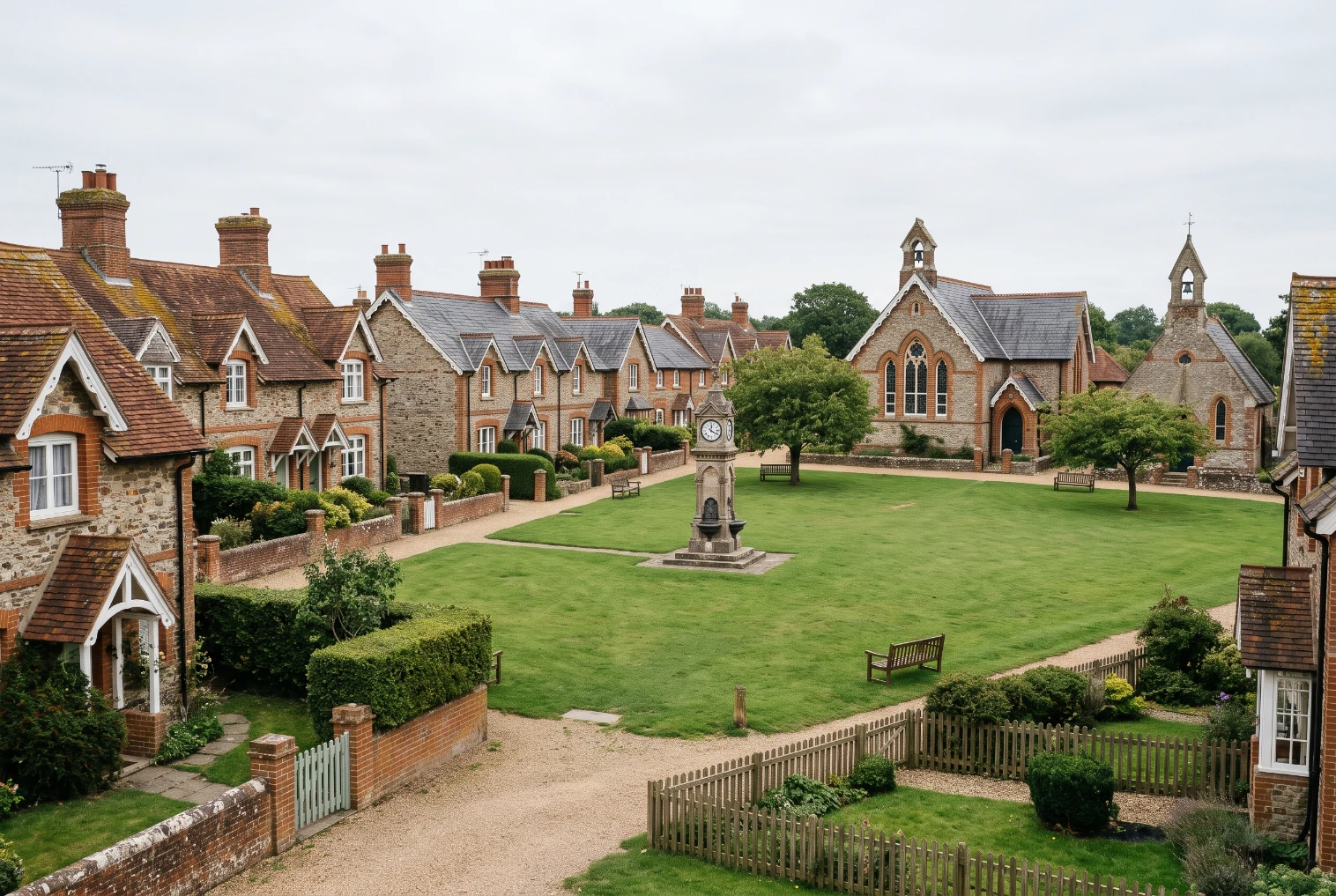
A model village is a planned settlement built by a landowner, mill owner or factory owner to house workers, with houses, a school, a church or chapel, a green and often a shop or institute, all designed together. Examples include Saltaire, Port Sunlight and Bournville.
Model villages grew from a mix of paternalism and good business, as owners saw that healthy, well-housed workers worked better. They influenced the garden city movement and the design of later estates.
c. 1780-1930
Regional building traditions have no single start date, so the band shows the main period of building. Periods are drawn at equal width, so the line is not to scale.
How to recognise it
| Feature | What to look for |
|---|---|
| Layout | Houses arranged around a green or along planned streets, with open space and trees. |
| Houses | Short terraces or pairs, in varied but related designs, often in brick or stone. |
| Public buildings | A school, church, institute, bathhouse and shops, in the same style. |
| Detail | Gables, dormers, carved bargeboards and decorative brickwork. |
| Gardens | Gardens or allotments for each house, and shared greens. |
| Setting | Close to a mill, factory or estate, often with a park. |
Not sure what a term means? See our guides to hipped, gable and mansard roofs and eaves, fascia, soffit and verge, or browse the full architectural glossary.
Where and when they were built
Early model villages such as Milton Abbas in Dorset were created in the 18th century when a landowner moved a whole village. Industrial examples followed, with Saltaire in 1851, Port Sunlight from 1888 and Bournville from the 1890s.
Historic England includes Port Sunlight on the Wirral in its 100 Places project on homes and gardens. Many model villages are conservation areas, and some have special controls on changes to houses.
Model village, garden suburb or estate cottage?
- Model villages: whole planned settlements built by an employer or landowner.
- Garden city and garden suburb: a planned community idea that grew partly from model villages. See our garden city and garden suburb page.
- Tied farm cottages and estate cottages: smaller groups on an estate. See our estate cottages page.
- Railway cottages: company housing in railway towns. See our railway cottages page.
Many model villages have their own rules or management schemes, so check what controls apply before you plan work.
What to check when buying one
- Local controls: many model villages have Article 4 directions or management schemes that limit changes to fronts, windows and roofs.
- Original features: check for original windows, doors and brickwork, which are often protected.
- Charges and estate rules: some villages are managed by a trust and may have charges or covenants. Check the title.
- Solid walls and damp: older houses need breathable repairs. See our damp and mould guide.
- Extensions: extensions may need consent even where they would normally be permitted development.
- Choose the right survey: use a surveyor with experience of traditional buildings. See our home survey guide.
- Listed status and conservation areas: many surviving traditional houses are listed or lie in conservation areas, and most changes need consent. See our listed buildings guide.
Sources and further reading
- Historic England: 100 Places, Homes and Gardens Includes Port Sunlight on the Wirral
- Historic England: the National Heritage List for England Check whether a building is listed
External links open in a new tab. Last checked November 2026.
Frequently asked questions
What is a model village?
A planned village built by an employer or landowner to house workers, usually with shared public buildings and green spaces.
Which are the best-known model villages?
Saltaire in Yorkshire, Port Sunlight on the Wirral, Bournville in Birmingham and New Earswick near York are well known.
Why were model villages built?
To give workers better housing, and because owners believed it would improve health and loyalty.
Can I change a house in a model village?
Often only with consent. Many are conservation areas with extra restrictions.
Are model villages listed?
Many buildings are, and whole villages may be conservation areas. Check the National Heritage List for England.