A mock Tudor house is a 20th-century house built to look like a Tudor timber-framed one, with applied half-timbering, steep gables, tall chimneys and leaded windows. The timber is usually decoration, not structure.
It was most popular between about 1920 and 1939 on suburban estates and in wealthy areas, where it was nicknamed Stockbroker Tudor. Its roots lie in the Victorian Old English revival.
c. 1920-1939
The band covers the interwar years. Periods are drawn at equal width, so the line is not to scale.
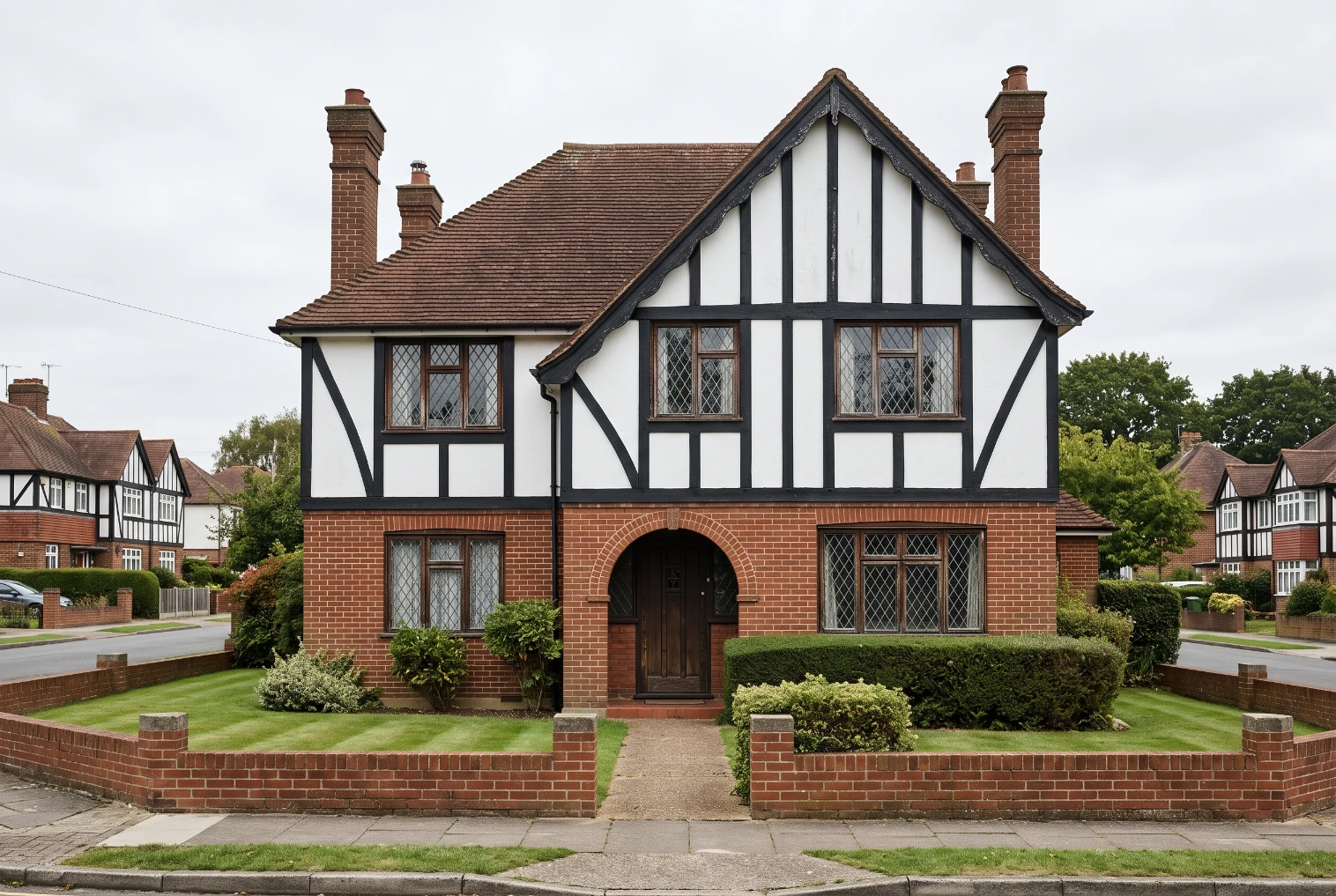
How to recognise it
| Feature | What to look for |
|---|---|
| Timber | Applied black-painted timbers on the upper floor and gables, with white render or plaster between them. |
| Walls | Brick on the ground floor, often with tile hanging, roughcast or render above. |
| Gables | Steep, front-facing gables, often jettied, with bargeboards. |
| Windows | Casement windows with leaded or diamond panes, often in timber or metal frames. |
| Chimneys | Tall brick chimneys, often patterned or with ornamental pots. |
| Porch | A deep arched or gabled porch with a heavy, studded-looking door. |
| Roof | A steep clay-tile roof with varied levels, sometimes swept low. |
Not sure what a term means? See our guides to sash and casement windows and hipped, gable and mansard roofs, or browse the full architectural glossary.
Where and when they were built
Mock Tudor offered buyers a sense of age and character in a new house. It came in many forms, from small semi-detached houses with a decorated gable to large detached houses with elaborate timbering.
The Historic England listing guide on modern houses and housing notes that Stockbroker Tudor could reach real quality and that imaginative and intact examples may be worth listing, though most are not. The earlier Victorian version is covered on our Old English revival page.
Mock Tudor, Old English or genuine Tudor?
- Mock Tudor: about 1920 to 1939. Applied timber on a modern house, usually on a suburban estate.
- Old English and Tudorbethan revival: the Victorian version. See our Old English revival page.
- Tudor house: the original, with structural timber. See our Tudor house page.
- Interwar suburban semi: often has a mock-timber gable. See our interwar semi page.
A good test is the depth of the timber. Applied timber is thin and flat, while genuine timber is thick and often distorted by age.
What to check when buying one
- Applied timber: check where the timber meets the render or brick. Peeling paint and rot are common.
- Render and roughcast: cracks let water in behind the timber. Repair with a breathable finish.
- Leaded windows: metal frames can rust and leaded lights can sag. Check them closely.
- Roof: steep tiled roofs have valleys and gables. See our roof tile calculator.
- Damp: see our damp and mould guide.
- Choose the right survey: a surveyor who knows 20th-century construction will spot the problems typical of the period. See our home survey guide.
- Listed status and conservation areas: most houses of this period are not listed, but some are, and many lie in conservation areas with controls on fronts and windows. See our listed buildings guide.
Sources and further reading
- Historic England: Domestic 4, Modern Houses and Housing Listing selection guide covering 20th-century houses and housing
- Historic England: the National Heritage List for England Check whether a building is listed
External links open in a new tab. Last checked November 2026.
Frequently asked questions
What is a mock Tudor house?
A 20th-century house designed to look like a Tudor one, with applied half-timbering, gables and leaded windows.
Is the timber real?
Usually it is applied as decoration to a brick or rendered wall, not structural.
What is Stockbroker Tudor?
A nickname for large mock Tudor houses built in wealthy suburbs between the wars.
What is the difference between mock Tudor and Tudorbethan?
The terms overlap. Tudorbethan usually refers to the Victorian and Edwardian versions, and mock Tudor to the interwar ones.
Are mock Tudor houses listed?
A few good examples are, but most are not. Check the National Heritage List for England.