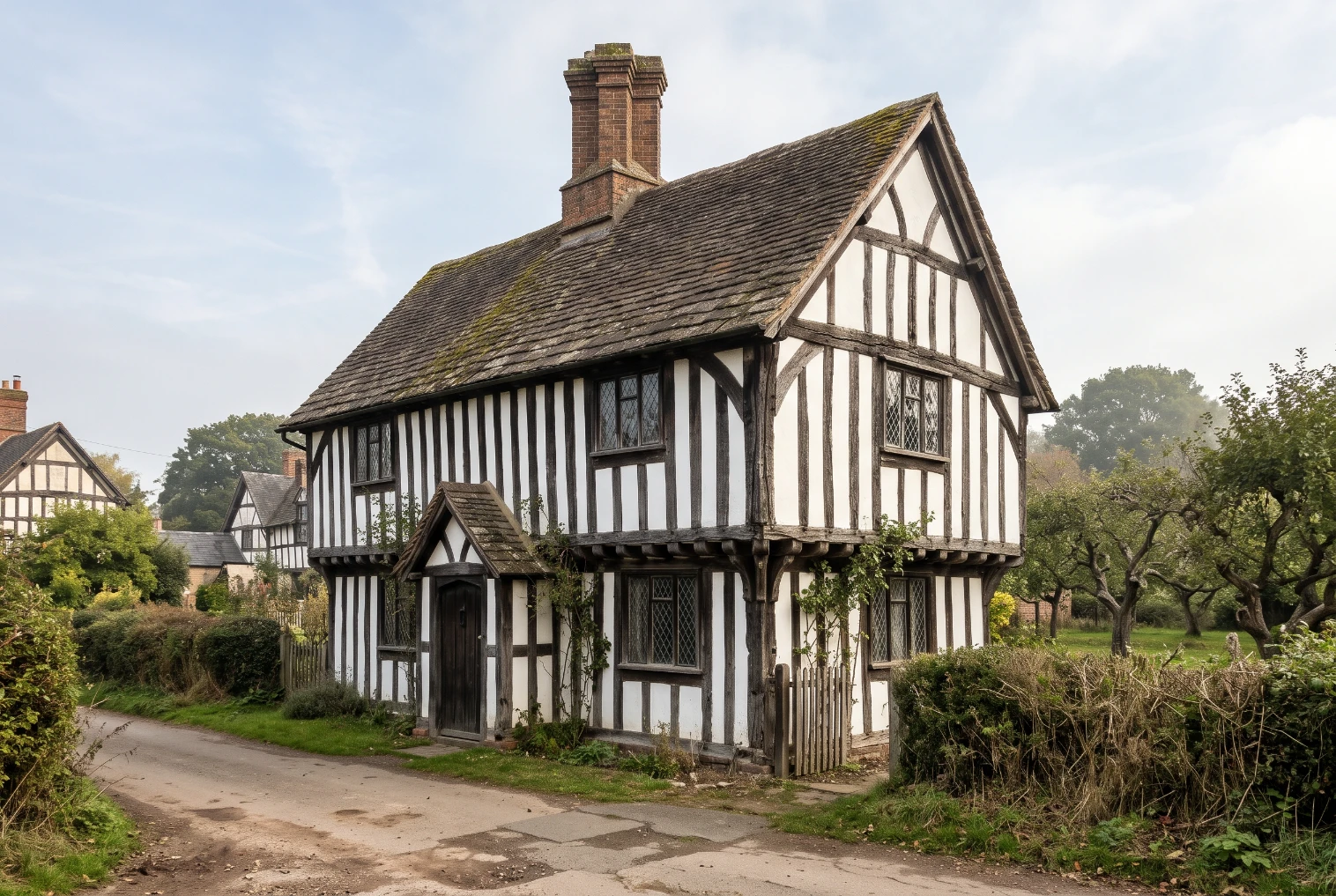
A black-and-white Marches house is a timber-framed house of Herefordshire, Shropshire, Cheshire and the Welsh border, with close-studded oak frames and panels of white plaster or limewash. The frames are often painted black, giving a strong contrast.
The area had good oak and the tradition of close studding, which uses many closely set vertical timbers, was a sign of wealth. Famous examples include the black-and-white villages of Herefordshire and Little Moreton Hall in Cheshire.
c. 1450-1700
Regional building traditions have no single start date, so the band shows the main period of building. Periods are drawn at equal width, so the line is not to scale.
How to recognise it
| Feature | What to look for |
|---|---|
| Frame | Oak frames with closely spaced vertical studs, called close studding, or decorative patterns. |
| Panels | White plaster or limewash infill between the timbers, often on wattle and daub. |
| Jetty | An overhanging upper floor, projecting over the street. |
| Roof | Clay tiles, stone slates or sometimes thatch, with tall brick or stone chimneys. |
| Windows | Timber mullioned windows with leaded lights, in groups. |
| Setting | Villages and market towns, with timber barns and farmhouses. |
Not sure what a term means? See our guides to render, stucco, roughcast and pebbledash and timber frame terms, or browse the full architectural glossary.
Where and when they were built
The Welsh Marches had plentiful oak and a strong carpentry tradition. Close studding and decorative framing show off the owner's wealth, and many houses of the 16th and 17th centuries still stand.
The black paint on the timbers is partly a later tradition. Many frames were originally left natural and weathered to silver, and the black-and-white look was popularised in the Victorian period. The Historic England guide to vernacular houses covers regional timber-framing traditions.
Marches black-and-white, box-frame or Tudor?
- Black-and-white Marches: close-studded and decorative frames in the border counties.
- Box-frame timber house: the general timber-frame type. See our box-frame timber house page.
- Tudor house: the national style of the period. See our Tudor house page.
- Old English and Tudorbethan revival: a Victorian imitation. See our Old English revival page.
Many black-and-white houses are 19th-century or later imitations, so check whether the frame is real.
What to check when buying one
- Oak frame and joints: check for rot, beetle and movement at joints and the base of the posts. Ask for a survey by someone who knows timber frames.
- Plaster panels: cracks and cement repairs let water in. Repair with lime and breathable materials.
- Black paint and coatings: modern coatings can trap moisture in oak. Use traditional finishes.
- Settling and leaning: old frames lean and sag. Get advice on whether movement is old or active.
- Listed status: most are listed, so changes need consent. See our listed buildings guide.
- Choose the right survey: use a surveyor with experience of traditional buildings. See our home survey guide.
- Listed status and conservation areas: many surviving traditional houses are listed or lie in conservation areas, and most changes need consent. See our listed buildings guide.
Sources and further reading
- Historic England: Domestic 1, Vernacular Houses Listing selection guide covering traditional regional houses
- Historic England: the National Heritage List for England Check whether a building is listed
External links open in a new tab. Last checked November 2026.
Frequently asked questions
What is close studding?
A style of timber framing with many closely spaced vertical timbers, which showed off the owner's wealth.
Why are the timbers black?
Black paint or pitch became fashionable later, and many frames were originally left natural.
Where are the best examples?
Weobley, Pembridge and Eardisland in Herefordshire, and Ludlow in Shropshire, are well-known examples, and Little Moreton Hall in Cheshire is famous.
Is the frame always oak?
Usually, in the Marches, because oak was plentiful.
Are black-and-white houses listed?
Most are. Check the National Heritage List for England.