New Town housing is housing built from 1946 to 1970 in the planned towns created after the New Towns Act of 1946, such as Stevenage, Harlow, Crawley and Basildon. It is laid out in neighbourhoods with green space and separated roads and footpaths.
New towns were meant to relieve overcrowded cities and give people modern homes with gardens. The housing often mixes terraces, semis and flats, built in brick and increasingly in modern materials as the period went on.
1946-1970
The band covers most of the post-war period. Periods are drawn at equal width, so the line is not to scale.
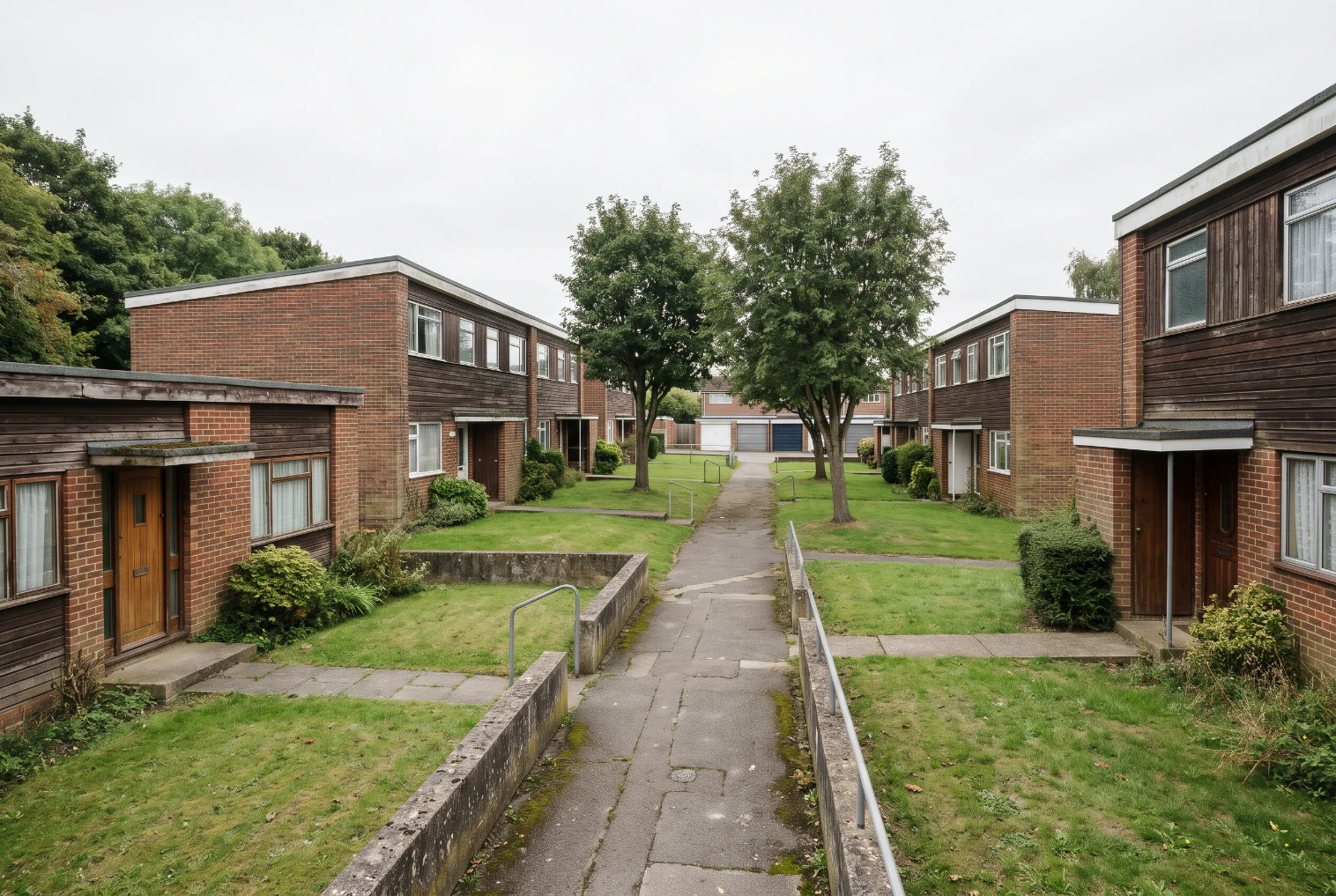
How to recognise it
| Feature | What to look for |
|---|---|
| Layout | Neighbourhood units with local shops and schools, and green spaces and footpaths running between them. |
| Roads | Roads separated from footpaths, with cul-de-sacs, garage courts and, in some, a separate cycle network. |
| Houses | Short terraces and semis in brick, often with timber boarding or tile hanging for variety. |
| Roofs | Low-pitched or mono-pitched roofs, and sometimes flat roofs on the later schemes. |
| Flats | Low blocks and some tall point blocks, set in landscaped grounds. |
| Landscape | Mature trees, public greens, ponds and play areas planned from the start. |
| Style | Clean, modern and functional, with little ornament. |
Not sure what a term means? See our guides to parts of a roof and wall and brickwork terms, or browse the full architectural glossary.
Where and when they were built
The New Towns Act of 1946 allowed the government to build whole new towns, and Stevenage was the first to be designated. Others followed, including Harlow, Crawley, Hemel Hempstead and Basildon, and later towns such as Milton Keynes.
The Historic England listing guide on modern houses and housing covers the planning and design of post-war housing and discusses how landscaping and layout are part of the interest of the best schemes.
New Town housing, post-war council housing or Radburn?
- New Town housing: 1946 to 1970. Planned estates with separated roads and footpaths.
- Post-war council housing: similar, but usually on the edge of an existing town. See our post-war council housing page.
- Radburn-layout estates: a stricter version of the separation of cars and people. See our Radburn-layout estates page.
- Garden city and garden suburb: the earlier planning idea that inspired new towns. See our garden city page.
Many New Town houses were built in several different phases, so even within one town the styles can vary widely.
What to check when buying one
- Construction type: check whether the house is traditional brick or a system-built type. Ask a surveyor.
- Flat roofs: later schemes used flat roofs that often leak. Check the covering and drainage.
- Walkways and parking: check how you reach the house and where you can park, because many layouts lack parking at the door.
- Windows and cladding: timber boarding and tile hanging can rot or loosen. Check them closely.
- Management: some estates have shared areas, so check responsibility for maintenance.
- Choose the right survey: use a surveyor who knows post-war construction, because the problems are different from those of older houses. See our home survey guide.
- Mortgage and insurance: some post-war construction types are harder to mortgage or insure. Check with a lender and insurer before you commit.
Sources and further reading
- Historic England: Domestic 4, Modern Houses and Housing Listing selection guide covering 20th-century houses and housing
- Historic England: the National Heritage List for England Check whether a building is listed
External links open in a new tab. Last checked November 2026.
Frequently asked questions
What is a New Town?
A planned town built under the New Towns Act of 1946 and later acts, to house people from crowded cities.
Which were the first New Towns?
Stevenage was the first, designated in 1946, followed by towns such as Crawley, Hemel Hempstead, Harlow and Basildon.
What is separated layout?
A layout where roads and footpaths are kept apart, so that people can walk to schools and shops without crossing traffic.
Is New Town housing high quality?
It varies. Many estates are well planned and have good landscaping, but some used materials or layouts that have not aged well.
Is New Town housing listed?
A few buildings are, and some areas are in conservation areas. Check the National Heritage List for England.