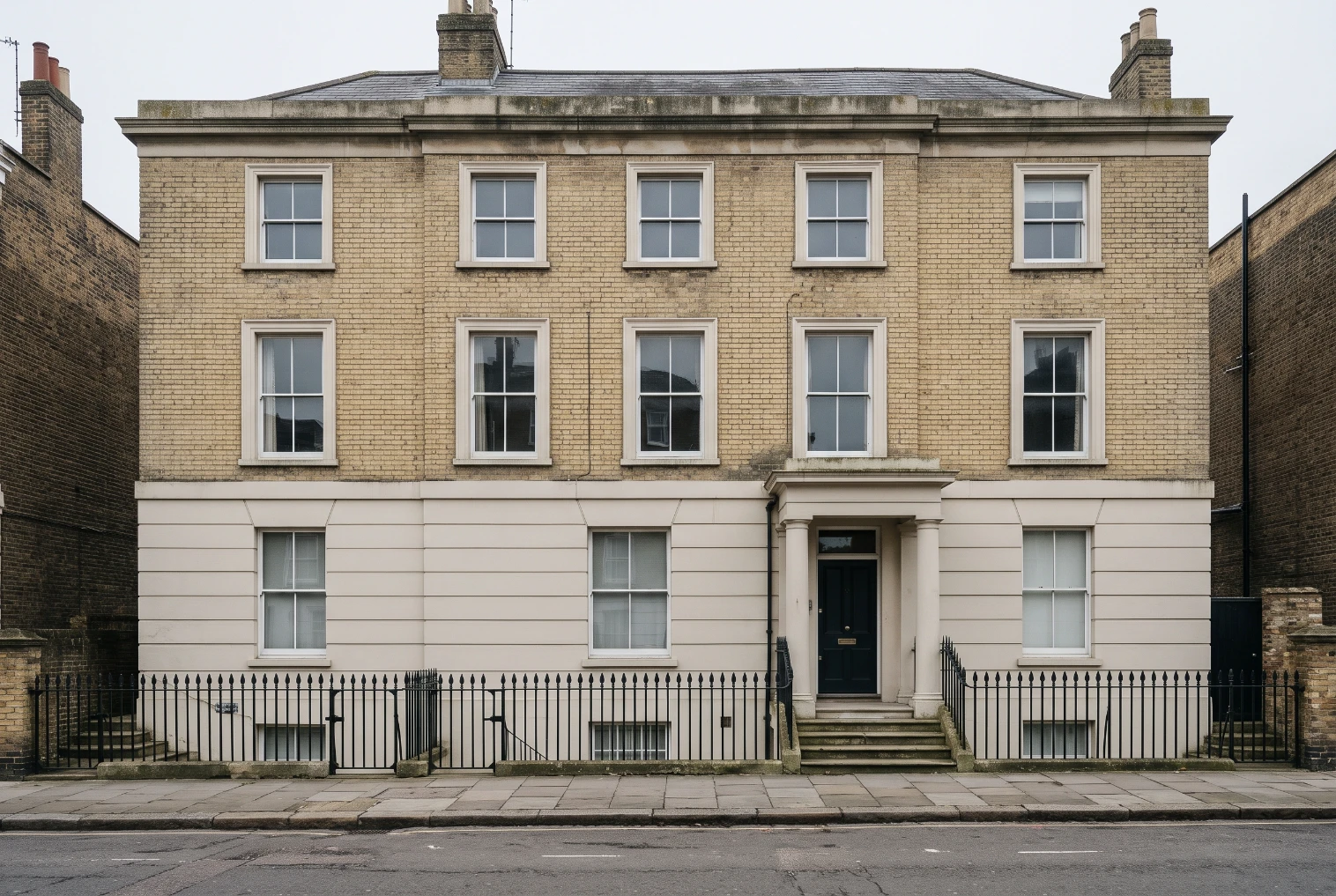
An early Victorian house is a house built from 1837 to about 1860 that still follows Georgian proportions but is plainer, with larger panes of glass, shallow roofs and little decoration. Bay windows and heavy ornament came later.
Many early Victorian houses look like late Georgian ones, because builders kept using the same pattern books. The easiest clues are bigger window panes, simpler doorways and the first bay windows on the ground floor.
1837-1860
The band covers the first part of the Victorian period. Periods are drawn at equal width, so the line is not to scale.
How to recognise it
| Feature | What to look for |
|---|---|
| Front | A flat, symmetrical front in brick or stucco, plainer than a Regency house and less decorated than a later Victorian one. |
| Windows | Timber sashes with larger panes, often two-over-two, as plate glass became cheaper after the glass duty ended in 1845. |
| Doorway | A panelled door under a simple porch or a plain doorcase, with a fanlight or a glazed panel. |
| Walls | Brick, often stock brick in the south and local brick or stone elsewhere, or stucco on the ground floor of a better house. |
| Roof | A low-pitched slate roof, often hipped and set behind a simple cornice or with deep eaves. |
| Plan | A front and back room on each floor, with the stair to one side and a rear service wing. |
| Detail | Little ornament. Look for plain stone sills, simple mouldings and cast iron railings. |
Not sure what a term means? See our guides to hipped, gable and mansard roofs and eaves, fascia, soffit and verge, or browse the full architectural glossary.
Where and when they were built
The early Victorian period followed the Regency, and house design changed gradually, not suddenly. Pattern books and local builders carried Georgian layouts into the 1840s, and cheaper bricks, glass and Welsh slate arrived with the railways.
The Historic England guidance on Georgian and Victorian terraced housing describes how terraces of both periods share a basic form and how the details change over time. Look at the windows, the porch and the roof edge to tell an early Victorian house from a late Georgian one.
Early Victorian, Georgian or Victorian terrace?
- Early Victorian: 1837 to about 1860. Georgian shape, larger window panes and plainer detail.
- Late Georgian and Regency: smaller panes, finer proportions and more delicate detail. See our Regency house page.
- Victorian terrace: later, with bay windows, tiled paths and decorative brick. See our Victorian terrace page.
- Italianate: a showier version with deep bracketed eaves and towers. See our Italianate house page.
Because the styles overlap, the date is better judged from several clues together than from one feature.
What to check when buying one
- Solid walls and lime mortar: most have solid brick walls laid in lime. Repointing in hard cement can trap moisture, so use lime mortar.
- Sash windows: original sashes can usually be repaired and draught-proofed. Check the cords, the sills and the lower rails for rot.
- Slate roof: look for slipped or broken slates, rusted fixings and worn lead flashings. See our roof tile calculator for covering costs.
- Damp: raised ground levels, blocked air bricks and cement render are common causes. See our damp and mould guide.
- Services: older wiring, lead pipes and tired plumbing are common and worth pricing before you buy.
- Choose the right survey: use a surveyor who knows solid-wall Victorian buildings. See our home survey guide.
- Listed status and conservation areas: some Victorian houses are listed and many lie in conservation areas, where windows, roofs and fronts may be controlled. See our listed buildings guide.
Sources and further reading
- Historic England: Conserving Georgian and Victorian Terraced Housing Guidance on terraced houses and how they were built
- Historic England: the National Heritage List for England Check whether a building is listed
External links open in a new tab. Last checked November 2026.
Frequently asked questions
What is an early Victorian house?
A house built between 1837 and about 1860 that keeps Georgian proportions but is plainer, with larger panes of glass and a shallow slate roof.
How can I tell early Victorian from Georgian?
Look at the windows and the detail. Early Victorian windows have larger panes, often two-over-two, and the doorways and cornices are plainer.
Did early Victorian houses have bay windows?
Some did, usually a shallow bay on the ground floor. Full two-storey bays and decorative fronts are more typical of the later Victorian period.
Are early Victorian houses solid wall?
Yes. They were built with solid brick or stone walls and no cavity, so insulation and damp control need a breathable approach.
Are early Victorian houses listed?
Some are, especially in good terraces or squares, and many lie in conservation areas. Check the National Heritage List for England first.