Self-Build Routes Explained
The route you choose determines your cost, your risk, your programme, and how much of your time the build will consume. Get this decision right before you start.
The route you choose determines your cost, your risk, your programme, and how much of your time the build will consume. Get this decision right before you start.
There are three main ways to deliver a self-build project. Each is a genuine route, each is used successfully by UK self-builders every year, and each involves real trade-offs. The right choice depends on your experience, your budget, your tolerance for risk, and how much time you have available.
You appoint one company - the main contractor - who takes responsibility for the entire build. They manage all trades, coordinate the programme, and supply or procure most of the materials. You deal with one point of contact. The main contractor takes the project from groundworks to practical completion.
Self-builders with full-time jobs who cannot commit significant time to site management, those without construction industry experience, and those building in areas where labour is scarce and coordinating trades independently would be very difficult.
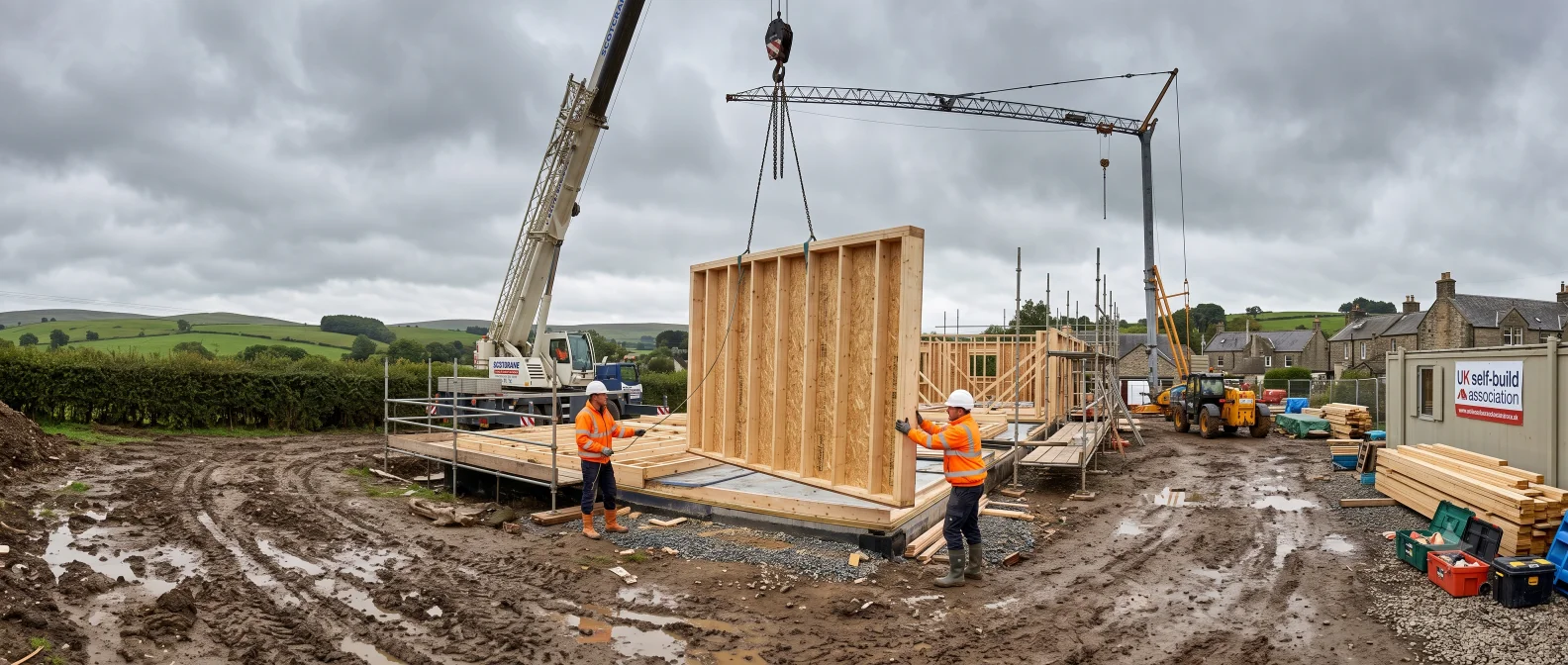
A package company (also called a kit home supplier or system build company) provides the structural system for your home - typically a timber frame, SIP panel, or ICF system - and manages its delivery and erection. You manage all subsequent trades yourself: groundworks, first fix, plastering, second fix, and fit-out.
Well-known UK package companies include Potton, Scandia-Hus, Baufritz, Fleming Homes, and Kingspan Timber Solutions. Each has a different product range, price point, and level of support.
Self-builders who want predictability and quality on the structural envelope but are comfortable managing trades for fit-out. Particularly good for those targeting high energy performance, as factory-built systems are easier to detail correctly than site-built alternatives.
You act as the project manager, appointing and coordinating all trades directly and buying materials yourself. There is no main contractor. You deal with groundworkers, bricklayers or frame erectors, roofers, plumbers, electricians, plasterers, carpenters, and decorators separately - coordinating their programmes, managing payments, resolving problems, and taking responsibility for quality at every stage.
Self-builders with construction industry experience or project management skills, those with flexibility in their working pattern to be on site regularly, and those for whom maximising cost savings is the primary objective.
| Factor | Main Contractor | Package Company | Direct Labour |
|---|---|---|---|
| Relative cost | Highest | Medium | Lowest |
| Time on site | Low | Medium | High |
| Risk to you | Low | Medium | High |
| Programme certainty | Good | Good for shell | Variable |
| Mortgage lender appetite | High | High | Medium |
| Experience needed | None | Some | Significant |
Many self-builders use a hybrid approach - for example, appointing a package company for the structural shell and then using direct labour for all subsequent trades. Or using a main contractor for groundworks and structure, then switching to direct labour for first and second fix. There is no rule that says you must use one route throughout the entire project.
The key is to be clear about where the responsibility boundaries lie at each transition point, and to document them in your build contract.
The route you choose significantly affects your total project cost. Use our Self-Build Cost Estimator to model your budget, and the Self-Build Mortgage Calculator to understand the financing implications.