The Hidden Cost of Over-Ordering
How Waste Adds Up on a Build
Ask most builders why they order more materials than their calculation says they need, and the answer is the same: "just in case." It is a reasonable instinct. Running out of materials mid-job is disruptive and embarrassing. But habitual over-ordering has a cost that most building businesses never properly account for - and it is larger than you might think.
Where the Money Goes
The materials themselves
This is the obvious one. If you consistently order 20% more than you need on every job, that is 20% of your material spend that generates no value. On a job with £5,000 of materials, that is £1,000 of unnecessary spend. On a business turning over £250,000 a year with 40% material costs, consistent 20% over-ordering costs around £20,000 per year.
Skip hire and disposal
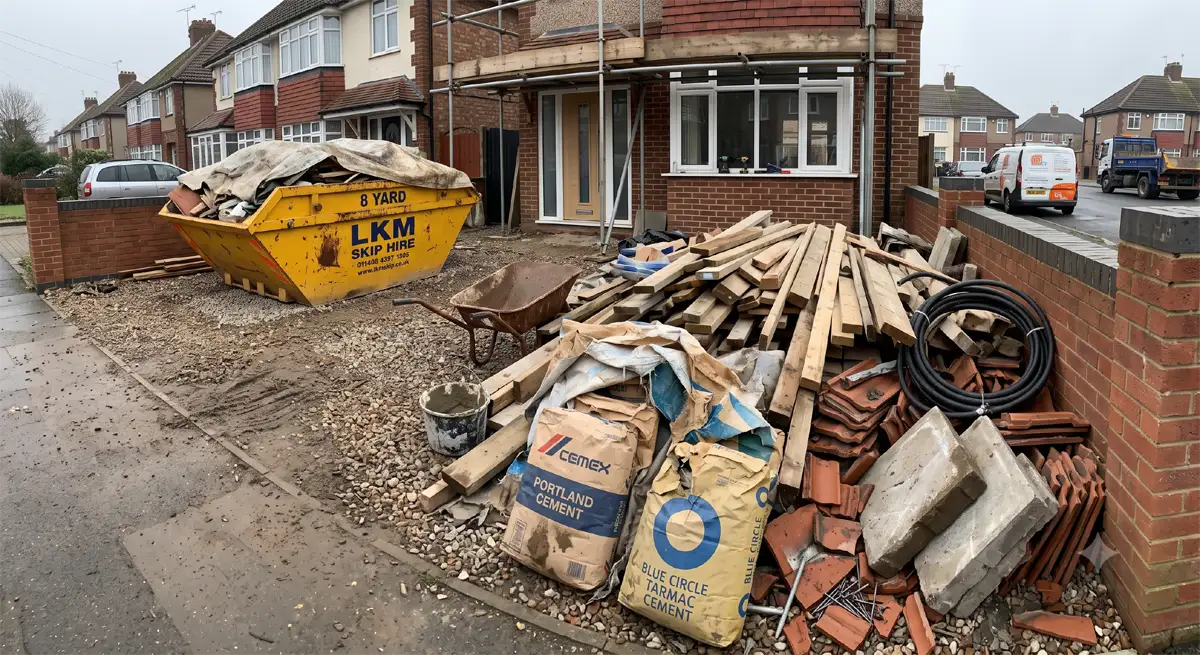
Most surplus material ends up in a skip. Skip hire costs have risen significantly - a standard 6-yard skip now commonly costs £250-400 in most parts of the UK. If surplus materials are filling skips on every job, the disposal cost alone runs to thousands per year.
Storage and handling
Material that cannot be returned needs somewhere to go. Storing it on site takes up space and can create hazards. Storing it at your yard ties up space and requires handling twice. Heavy materials like bags of cement and sand have a limited shelf life once opened - over-ordered stock that sits in a damp yard for months may not be usable when you next need it.
Return logistics
Some merchants will accept returns, but rarely without conditions. Many charge a restocking fee of 10-25%. Some materials (cut items, mixed paint, opened bags of cement) cannot be returned at all. And returning materials takes time - a trip to the merchant, paperwork, waiting for credit notes. Time that could be spent on something productive.
Cashflow impact
Materials that sit in a skip or a storage yard represent cash that has left your business and generated nothing in return. For businesses operating on tight margins, this ties up working capital that could be deployed elsewhere - or simply kept in the business as a buffer.
The Waste Allowance Confusion
Part of the problem is a misunderstanding of what a waste allowance is for. A waste allowance is not a buffer for poor estimating - it is a factor that accounts for the unavoidable off-cuts, breakages and minor losses inherent in the installation process.
A 10% waste allowance on tiles, for example, accounts for cuts around edges, breakages during fixing, and the odd tile lost to a bad cut. It does not account for ordering 30% more because you are not sure of your area calculation.
Materials Most Commonly Over-Ordered
Some materials are more likely to be over-ordered than others, either because quantities are harder to calculate or because the consequences of running out feel more severe:
- Tiles - area calculations are often rounded up aggressively, especially for bathrooms
- Sand and cement - typically ordered in round tonnes or pallet quantities without precise calculation
- Timber - lengths are often over-specified to avoid awkward cuts
- Insulation - roll and board quantities are frequently rounded up by a full pack
- Plasterboard - boards are sometimes ordered board-by-board with heavy rounding at every stage
Getting the Balance Right
The goal is not to order the minimum possible. Running short is genuinely disruptive and the right waste allowances exist for good reason. The goal is to order based on an accurate calculation with an appropriate waste factor - not to layer guess on top of guess until the order feels safe.
A reliable process:
- Calculate the net quantity accurately from measurements
- Apply the correct waste factor for the material and job type
- Round up to the nearest pack or delivery unit
- Stop there - do not add another buffer on top
Calculate Exact Quantities with Waste Built In
Every BuildersCalc.Pro calculator includes an appropriate waste allowance for the material type. Enter your dimensions and get a reliable order quantity - not a guess with padding on top.
Browse All Calculators