Groundworks vs Superstructure
Where Builders Most Often Get Their Quantities Wrong
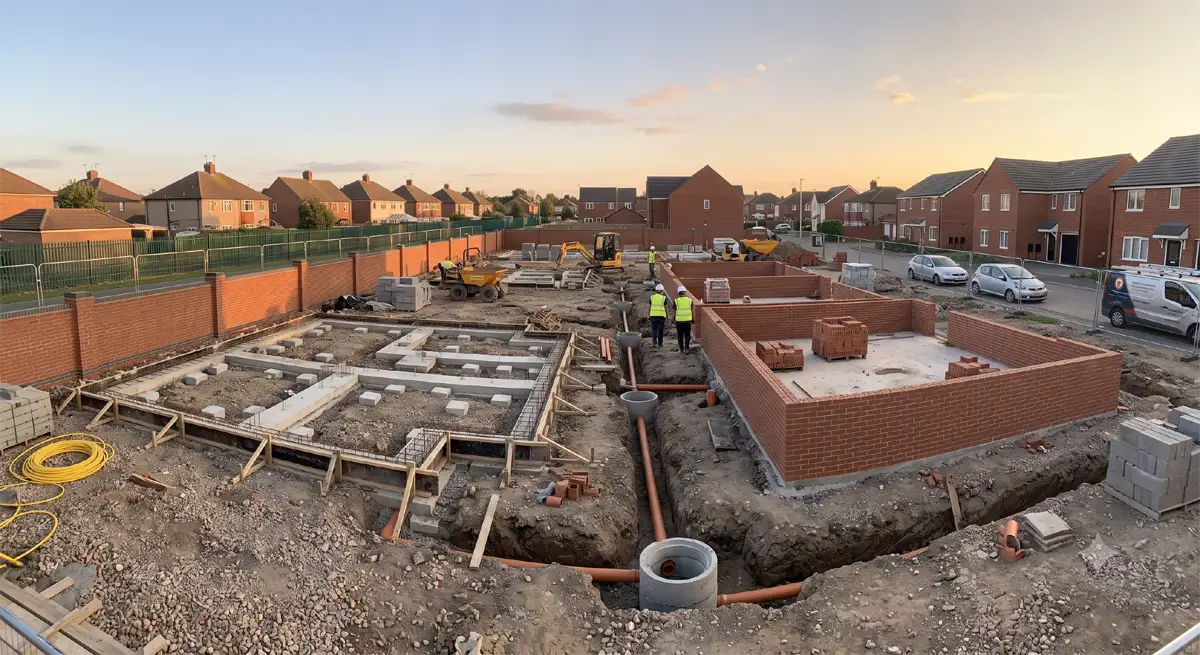
Of all the phases in a construction project, groundworks and superstructure are where quantity errors tend to be most common - and where the financial consequences are most severe. The reasons are different in each phase, but the result is the same: jobs that run over budget before the walls are even up.
Groundworks - The Phase Most Builders Under-Price
Groundworks is consistently the most under-priced phase on smaller residential projects. There are several reasons for this.
1. Excavation volumes are harder to visualise than area
Most builders think in two dimensions - area is easy to picture. Volume is harder. Excavation is priced by the cubic metre, and the difference between a 300mm and a 450mm deep foundation dig across a 60m2 extension footprint is significant:
- 60m2 x 0.3m = 18m3 to excavate
- 60m2 x 0.45m = 27m3 to excavate
That is 50% more excavation, more skip loads, more concrete and a meaningfully different cost - all from a 150mm difference in foundation depth that might not be confirmed until a trial pit is dug.
2. Bulking factor on excavated material
Soil expands when it is excavated - this is called the bulking factor. Clay soils typically bulk by 25-40% when disturbed. This means that 10m3 of excavated clay in the ground becomes 12.5-14m3 of loose material to remove. Under-estimating bulking means under-estimating skip loads and disposal costs.
3. Concrete over-runs
Foundation concrete quantities are calculated from the design dimensions, but the actual pour almost always uses more than the calculation suggests. Irregular trench profiles, soft spots that need deepening, and the inevitable small variations in trench width all consume extra concrete. A 10-15% contingency on concrete volumes for strip foundations is standard practice.
4. Drainage complexity
Drainage is frequently under-priced because the scope is not clear at quote stage. The number of inspection chambers, the depth of existing drains (which affects connection costs), and the distance to the nearest suitable connection point all affect cost significantly - and none of them can be confirmed without investigation.
Common Groundworks Quantity Errors
- Forgetting to include the concrete blinding layer under the slab
- Under-estimating the volume of hardcore required under a ground bearing slab
- Not accounting for DPC, DPM and insulation in the floor build-up
- Missing radon membranes in affected areas
- Forgetting to price temporary works - trench support, temporary drainage
Superstructure - Where the Errors Are Different
Superstructure errors are generally less about volume calculation and more about specification confusion, omissions and incomplete drawings.
1. Wall build-up specification not confirmed
The cost difference between a standard cavity wall and a high-performance thermally broken cavity wall with full-fill insulation is substantial. If the wall build-up is not confirmed before pricing, builders often assume the cheaper option - and then find themselves building the expensive one.
2. Lintels, ties and accessories missed
Structural lintels, wall ties, cavity closers, DPC trays and weep holes are all part of the cavity wall specification but are frequently omitted from material take-offs. On a typical two-storey extension, the cost of these accessories can run to £400-800 depending on specification.
3. Beam and block floors under-specified
Beam and block suspended ground floor quantities depend on the span, beam centres and infill block type. Getting the beam layout wrong - even by one beam - affects both the structural design and the material order. Always calculate from an engineer's layout drawing, not from an approximation.
4. Roof structure complexity
Roof timbers are one of the most complex take-off items on any project. Ridge boards, rafters, ceiling joists, purlin strutting, binders, hangers and trimmers all need to be scheduled individually. A flat count of rafters without allowing for all the secondary timber is a very common source of shortfall.
How to Reduce Quantity Errors at Both Stages
- Always take off from drawings, not from memory - even simple jobs should have enough sketch information to calculate from
- Use a checklist for each trade - missed items are usually not the main material (bricks, concrete) but the accessories (ties, DPC, lintels)
- Confirm the specification before pricing - the difference between a standard and enhanced spec can be 20-30% of the package cost
- Apply separate contingencies for groundworks and superstructure - groundworks warrants a higher contingency (10-15%) than superstructure (5-10%) because ground conditions are less predictable
Calculate Concrete, Brickwork and More
Our calculators cover the key superstructure materials including brickwork, blockwork, concrete, insulation and roof coverings - with waste allowances built in.
Browse All Calculators