The Core Rule: Listed Buildings Lose Most PD Rights
For most dwellings in England, the Town and Country Planning (General Permitted Development) (England) Order 2015 grants automatic permitted development rights for many common works - extensions, outbuildings, roof alterations, porches and more - without the need to apply for planning permission.
For listed buildings, the picture is dramatically different. The GPDO removes the majority of these automatic rights. This is not a matter of grade - all listed buildings, from Grade II cottages to Grade I country houses, lose the same PD rights.
Even where a listed building technically retains a PD right for planning purposes, the works may still require Listed Building Consent if they affect the building's character. The two regimes are separate and both must be satisfied.
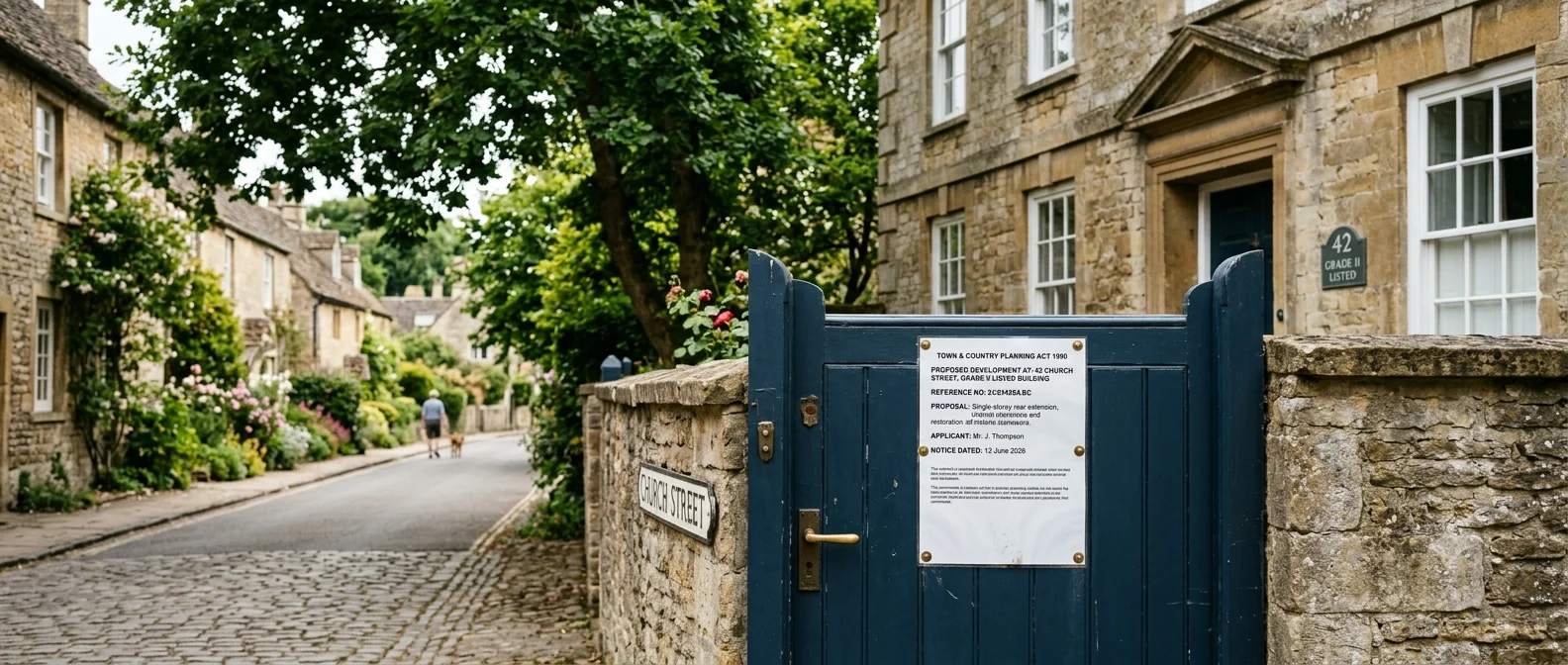
Which PD Rights Are Removed for Listed Buildings?
| Works Type | Unlisted dwelling | Listed building |
|---|---|---|
| Rear / side extensions (Class A) | PD (within limits) | Removed |
| Roof alterations / dormers (Class B) | PD (within limits) | Removed |
| Outbuildings / garden buildings (Class E) | PD (within limits) | Removed |
| Porches (Class D) | PD (within limits) | Removed |
| Hard surfaces / driveways (Class F) | PD (within limits) | Removed |
| Solar panels - roof-mounted (Class A, Part 14) | PD (within limits) | Removed |
| Solar panels - ground-mounted (Class B, Part 14) | PD (within limits) | Removed |
| CCTV cameras (Part 33) | PD (within limits) | Removed |
| Small wind turbines (Part 14) | PD (within limits) | Removed |
| Satellite dishes (Part 1, Class H) | PD (small dishes) | Removed |
| Change of use - commercial to residential (Class MA) | Prior Approval | Removed |
| Change of use - agricultural to residential (Class Q) | Prior Approval | Removed |
What PD Rights Remain for Listed Buildings?
Very few PD rights survive for listed buildings. Some that may still apply include:
- Certain internal works that do not affect the listed building's character (though LBC may still be needed)
- Temporary uses of land under Part 4 (e.g., use as a market for up to 28 days per year, subject to conditions)
- Some agricultural and forestry works on land within listed building curtilages that is used for agriculture or forestry - though LBC is still needed for anything affecting the building itself
- Some telecommunications works - though any works affecting the fabric or character of the building need LBC
In practice, owners of listed buildings should assume that any works that are not pure like-for-like maintenance require consent - either planning permission, Listed Building Consent, or both.
The Relationship Between Planning Permission and LBC
This is a common source of confusion. The two consents are completely separate:
- Planning permission is granted by the Local Planning Authority under the Town and Country Planning Act 1990 and controls what is built and how land is used.
- Listed Building Consent is granted under the Planning (Listed Buildings and Conservation Areas) Act 1990 and controls works to the listed building itself - both external and internal.
For a typical project - say, a rear extension to a listed cottage:
- Planning permission is needed because PD rights for extensions are removed for listed buildings
- Listed Building Consent is also needed because the extension would affect the character of the listed building
- Both applications can be submitted simultaneously but are decided separately
Do not assume that a pre-application response about planning permission covers LBC. Some owners receive positive pre-application advice on the planning side and proceed, not realising they also needed LBC. This can result in criminal prosecution. Always check both regimes.
Conservation Areas and Listed Buildings
Many listed buildings are also within Conservation Areas. This creates a further layer of restriction. In a conservation area:
- Article 4 Directions may remove any surviving PD rights (such as painting of external walls)
- Permitted Development rights for solar panels, satellite dishes and some other equipment that might apply to unlisted buildings are further restricted
- Demolition of structures over a certain size requires Conservation Area Consent (now subsumed into planning permission)
- Works to trees with a trunk diameter over 75mm require prior notification to the LPA
Applying for Planning Permission for a Listed Building
Where works to a listed building require planning permission (because PD rights have been removed), the application process is the same as for any planning permission - submitted via the Planning Portal to your LPA. The key difference is that the planning committee or officer must have regard to the desirability of preserving the building or its setting and must give considerable importance and weight to any harm to the significance of the heritage asset.
This means that planning permission for works that would harm the setting of a listed building will be much harder to obtain than for an equivalent unlisted property, even if the planning merits would otherwise support the development.