What Is Listed Building Consent?
Listed Building Consent (LBC) is a statutory consent required under the Planning (Listed Buildings and Conservation Areas) Act 1990 before carrying out any works to a listed building that would affect its special architectural or historic interest. Unlike planning permission, which controls what is built, LBC controls how the building's character may be changed.
Crucially, LBC covers both external and internal alterations. This sets it apart from the planning system, which generally only concerns itself with external appearance. A listed building's interior - its original staircases, fireplaces, panelling, plaster ceilings and floor surfaces - is equally protected.
LBC applies to the whole listed structure, its interior, any attached structures, and any structures within the curtilage that pre-date 1 July 1948. It is separate from and additional to any planning permission that may also be required.
What Requires Listed Building Consent?
The test is whether works would affect the character of the listed building. This is deliberately broad. Works that require LBC typically include:
- Any external alteration - adding windows, changing doors, re-rendering, re-roofing with different materials
- Any internal alteration that affects original fabric - removing walls, fireplaces, staircases, panelling or cornices
- Extensions and additions to the building
- Demolition of any part of the listed building or a curtilage structure
- Works to structures within the curtilage that pre-date July 1948
- Installing fixtures that affect the fabric - new heating pipes, electrical conduit, CCTV, satellite dishes
- Painting or rendering original masonry that has never been painted
What Does Not Require LBC?
Routine maintenance and like-for-like repair using the same materials and methods generally does not need LBC. This includes:
- Repointing with matching lime mortar (same mix and joint profile)
- Replacing broken roof tiles with identical tiles
- Repairing original windows in situ with matching timber and glass
- General internal decorating that does not affect original fabric
The boundary between repair and replacement is often contested. If in doubt, contact your local authority's conservation officer before starting work.
The Application Process
- Pre-application advice. Contact your LPA's conservation officer before applying. Many authorities offer a pre-application service. For Grade I or II* buildings, consider contacting Historic England at an early stage.
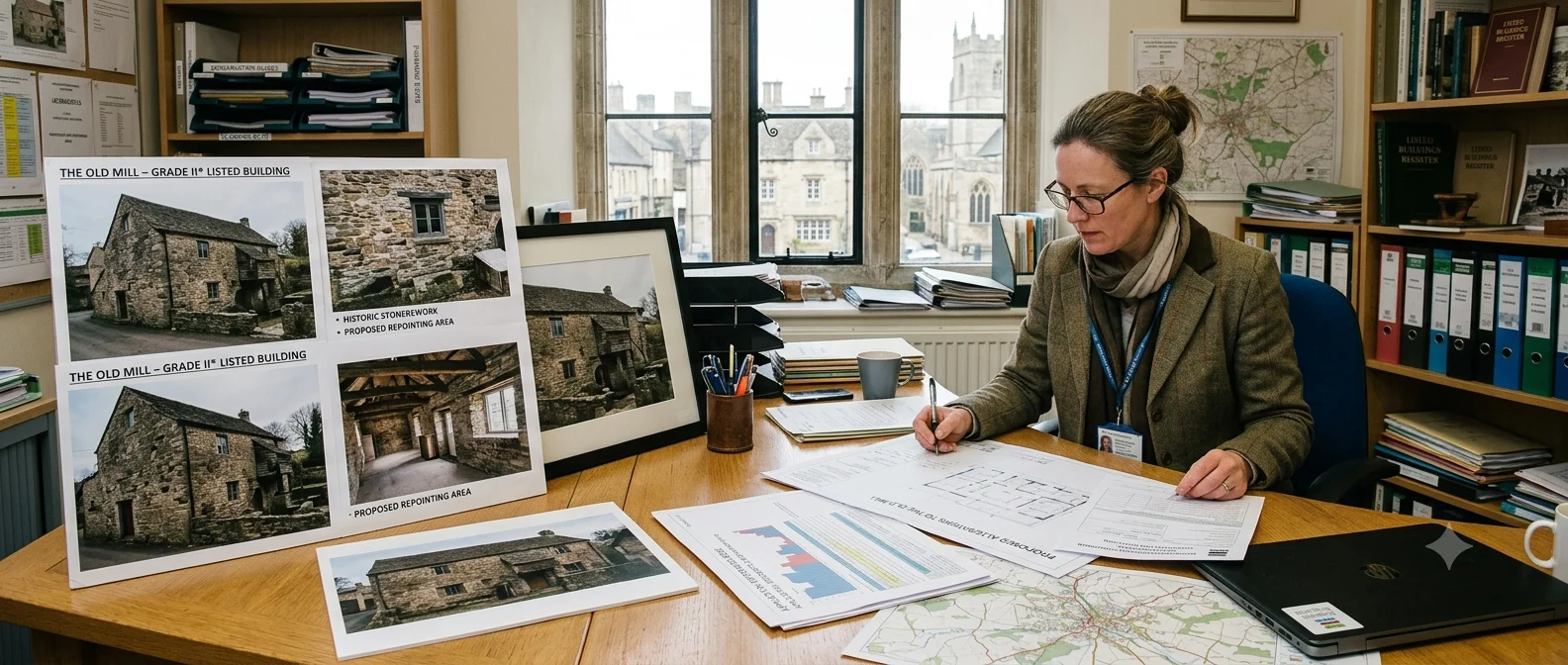
- Prepare the application. You will need: site location plan, existing and proposed drawings to sufficient scale, photographs of the areas affected, and usually a Heritage Statement explaining why the works are necessary and how they have been designed to minimise harm to the building's character.
- Submit via the Planning Portal. LBC applications are submitted through the Planning Portal (planningportal.co.uk) to your local planning authority. The application fee is currently £0 in England.
- Validation and consultation. The LPA validates the application and begins consultation. For Grade I and II* buildings, Historic England must be consulted. The LPA may also consult the local civic society, amenity bodies (such as the Society for the Protection of Ancient Buildings) and the public.
- Decision. The LPA has 8 weeks from validation to make a decision. For complex or controversial applications this may extend. A decision can be: granted unconditionally, granted with conditions, or refused.
- Appeal. If LBC is refused, you may appeal to the Planning Inspectorate within 6 months of the decision.
Grade and the Level of Scrutiny
All listed buildings require LBC regardless of grade, but the level of scrutiny increases significantly with grade:
- Grade II - LBC assessed by the LPA's conservation officer. Most straightforward works can be approved at officer level.
- Grade II* - Historic England must be consulted and may comment. LPA decision-makers give significant weight to Historic England's view.
- Grade I - Historic England must be consulted. For any application that Historic England objects to, the Secretary of State may call in the application for determination. Refusal rates for significant works to Grade I buildings are high.
Conditions and Duration
LBC, if granted, is usually subject to conditions. Common conditions include:
- Works to be carried out in accordance with approved drawings
- Specific materials to be agreed in writing before use
- A record (photographic or drawn survey) to be made before works begin
- An archaeologist or building archaeologist to be present during ground-breaking works
LBC lasts for 3 years from the date of grant. If works have not started within 3 years, the consent lapses and a new application must be made.
Retrospective LBC
It is possible to apply for LBC retrospectively for works already carried out, but this is not a guaranteed route to regularisation. The LPA may refuse retrospective consent and then issue a Listed Building Enforcement Notice requiring reinstatement. Retrospective applications do not grant immunity from prosecution for the original offence.
No time limit on prosecution: Unlike some planning breaches, there is no time limit on prosecution for unlawful works to a listed building. Works carried out 20 years ago without consent can still result in criminal prosecution.