Solar PV or Heat Pump First?
Sequencing Renewables on a Self-Build
Self-builders planning a low-energy home face a decision that rarely gets a straight answer: should the solar PV array go in first, or the heat pump? The two technologies interact in ways that affect sizing, electrical design, grid connection and payback - and getting the order wrong can mean expensive rework or an undersized system you live with for twenty years.
Why the Sequence Matters
Solar PV and heat pumps are not independent systems that you can simply install in any order. The output of your PV array directly influences how much of your heat pump's running cost you can offset with free generation. The heat pump's electrical demand drives your grid connection size and consumer unit specification. And both affect the size of battery storage, if you choose to add it.
Getting the sequence right means designing the systems together rather than bolting one onto a building that was already designed around the other. On a self-build, where you have a blank sheet, this is entirely achievable - but it requires thinking through the interactions before any contractors are appointed.
The Case for Heat Pump First
For most self-builds, the heat pump should drive the design. Here is why:
- It defines your electrical demand. A heat pump is the single largest electrical load in a low-energy home, typically drawing 3-5 kW continuously during a heating cycle. This determines the size of your grid connection (usually 100A single-phase is adequate, but some larger properties or ground source systems may need three-phase), your consumer unit rating and your cable sizes throughout the plant room.
- It determines your hot water strategy. Most modern heat pumps produce domestic hot water as well as space heating, using a buffer cylinder. The cylinder size, pipework layout and plant room space all need to be designed before the building fabric is fixed.
- It affects your heating distribution system. Heat pumps work best with low-temperature distribution - underfloor heating at 35-45 degrees C rather than radiators at 70-80 degrees C. The choice of distribution system needs to be made at first-fix stage, well before commissioning.
- It earns you the Boiler Upgrade Scheme grant. The current BUS grant (PS7,500 for air source, PS7,500 for ground source as of 2026) applies at installation. Installing the heat pump first means you capture this grant at a stage when cashflow on a self-build is typically tight.
The Case for Solar PV Early
There are good reasons to get solar PV specified early too, even if physical installation comes later:
- Roof design decisions. The orientation, pitch and available area of your roof must be settled before the roof structure is designed. A south-facing 30-40 degree pitch gives optimal generation in the UK. If you decide on solar late, you may have already committed to a roof design that limits panel placement.
- Electrical design integration. The inverter, generation meter, export meter and connection back to the consumer unit all need to be planned into the electrical first-fix. Retrofitting solar wiring through a finished building is significantly more expensive and disruptive than running it at first-fix stage.
- Scaffolding efficiency. Installing panels while scaffolding is already in place for the roof covering saves a costly re-erection later. Many self-builders fit the panels during the roofing stage and commission them once the building is complete.
The Recommended Sequence
The answer for most self-builds is not either/or - it is design both together, install the heat pump infrastructure first, and install the PV panels opportunistically during roofing.
- Design stage: Size both systems together. Use your heat pump heat loss calculation to determine required output, then size the PV array to offset as much of the heat pump's annual electricity consumption as possible.
- First fix: Run all electrical cables for both systems - heat pump supply from consumer unit, PV DC cables from roof to inverter location, inverter AC cable to consumer unit. This costs little extra at first fix and avoids expensive retrofit later.
- Roofing stage: Install PV panels on the roof while scaffolding is in place. Leave inverter and metering commissioning until power is available to the building.
- Second fix / completion: Install and commission the heat pump, buffer cylinder and controls. Apply for the BUS grant before the heat pump is commissioned (the application must be made first).
- Post-completion: Commission the PV system, connect to the grid and register for Smart Export Guarantee (SEG) payments.
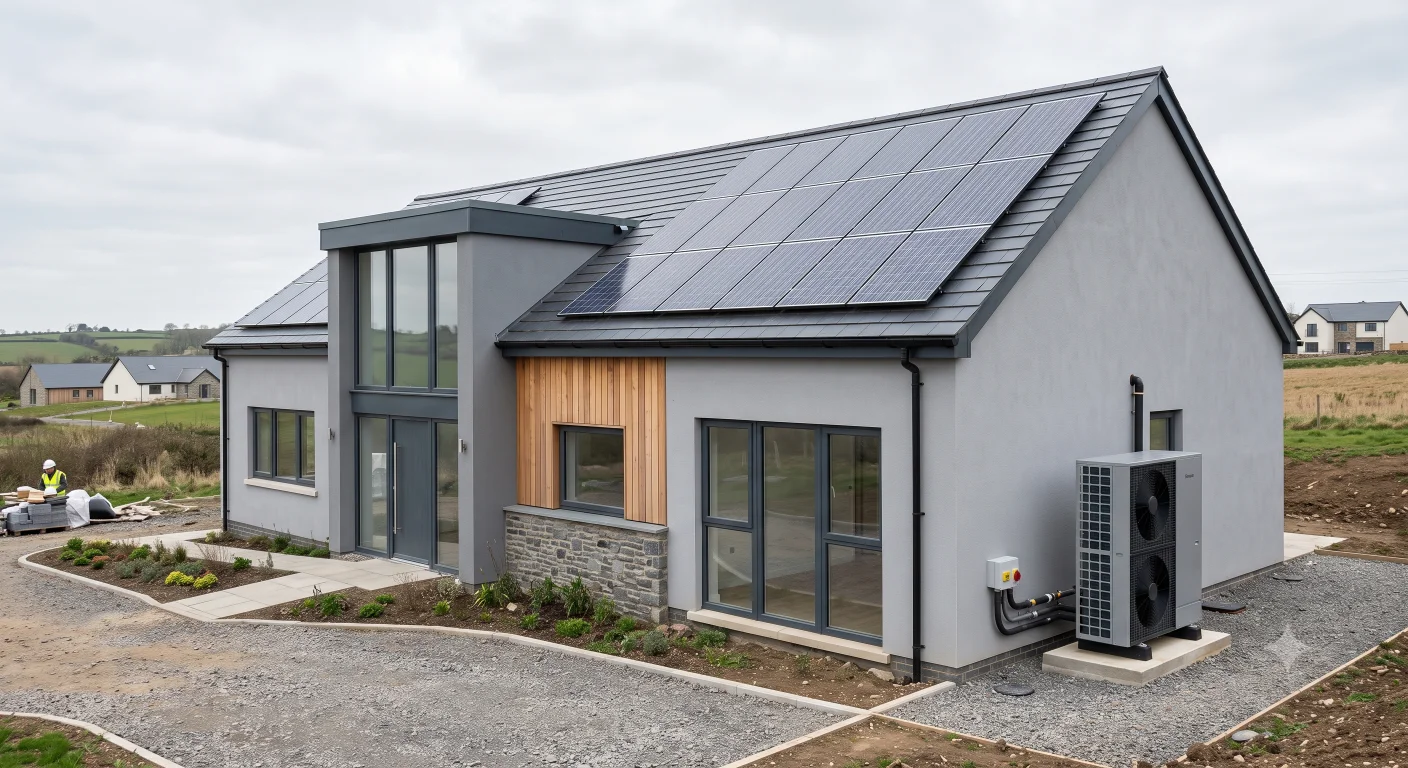
Sizing the Two Systems to Work Together
The interaction between solar PV output and heat pump consumption is the key to maximising self-sufficiency. In the UK, the challenge is that peak heat demand (winter) coincides with minimum solar generation, while peak solar generation (summer) coincides with minimum heat demand.
This means solar PV alone cannot directly power your heat pump through a UK winter. What it can do is:
- Power the heat pump during spring and autumn shoulder seasons when both generation and heating demand are moderate
- Provide free electricity for domestic hot water heating in summer via an immersion heater diverter
- Offset grid electricity costs for lighting, appliances and EV charging year-round
- Charge a battery for evening use if you add storage
A well-sized combination for a 4-bedroom low-energy self-build might be a 10-12 kWp PV array paired with an 8-10 kW air source heat pump and a 10-15 kWh battery. This combination can achieve 60-70% self-sufficiency across the year in a well-insulated building.
Size Your Renewable Systems
Use our free calculators to estimate solar panel count and annual generation, size your air source or ground source heat pump, and plan your renewables budget.
Solar PV Calculator Air Source Heat Pump Calculator Ground Source Heat Pump CalculatorAir Source vs Ground Source: Which to Choose First
If you are considering ground source, the ground array or borehole must be installed before the building is complete - ideally before the ground is landscaped or hardstanding is laid. This is a major groundworks operation: a horizontal ground array for a 4-bedroom house might cover 400-600m2 of ground, and a borehole installation requires a drilling rig to access the site.
Ground source heat pumps have a higher SCOP (Seasonal Coefficient of Performance) than air source - typically 3.5-4.5 vs 2.5-3.5 for air source - meaning they produce more heat per unit of electricity consumed. However, the additional capital cost and site disruption make them harder to justify unless you have the land and the budget.
For most self-builds, an air source heat pump is the more practical choice. It can be installed at any stage of the build, requires no ground preparation, and is easier to size and commission. Ground source makes more sense on rural plots with plenty of land, where access for drilling or trenching is straightforward.
Electrical Capacity: Planning Ahead
One of the most common mistakes on self-builds adding renewables is underspecifying the electrical infrastructure. Points to confirm with your electrical designer before first fix:
- Grid connection size: A 100A single-phase connection is standard for domestic properties and is adequate for most air source heat pump and solar PV combinations. If you are adding an EV charger as well, confirm the total peak demand with your DNO (Distribution Network Operator).
- Consumer unit capacity: You will need separate circuits for the heat pump, immersion heater, PV inverter and any battery system. A larger 3-phase consumer unit may be needed on larger properties.
- Export capacity: The DNO must approve your PV export capacity. Installations over 3.68 kW single-phase require DNO notification (G98) and larger systems require formal approval (G99). Factor this into your programme - G99 approval can take several weeks.
- Cable sizing: Heat pump supply cables and PV DC cables must be sized for their maximum operating currents. These are best specified and installed at first fix, not added later.
Payback: Setting Realistic Expectations
Payback periods depend on your energy consumption, the size of the systems, your electricity tariff and how much of the generated electricity you self-consume. Rough UK figures as a guide:
- Solar PV (10 kWp, south-facing): 8-12 years depending on self-consumption rate and export tariff
- Air source heat pump replacing gas boiler: 10-15 years without the BUS grant; 7-12 years with the grant, depending on gas vs electricity price differential
- Ground source heat pump: 12-18 years due to higher capital cost, improved by better efficiency
- Battery storage added to PV: 10-14 years standalone; shorter if combined with an EV and time-of-use tariff
On a new self-build, the comparison is not against replacing an existing gas boiler - it is against the alternative of installing gas in the first place. As of 2026, new-build homes in England must not use gas boilers as the primary heating system under Future Homes Standard requirements, which means a heat pump is the default starting point rather than an upgrade.
The One Thing Not to Cut
Whatever sequence you choose, do not scrimp on insulation and airtightness to fund the renewable technology. A heat pump in a poorly insulated building will run continuously, consume large amounts of electricity and never achieve a good SCOP. Solar panels on a leaky house generate electricity that disappears through the gaps. The hierarchy is always: fabric first, renewables second. A well-insulated building with modest renewable provision will outperform a poorly insulated one with an oversized system every time.