Why Conditions Are Attached to LBC
Listed Building Consent and planning permission are rarely granted without conditions. Conditions are the mechanism by which the Local Planning Authority ensures that consented works are carried out in a way that protects the building's significance, uses appropriate materials, and preserves the historic record. They are not optional extras - they are part of the consent, and works carried out in breach of a condition may be treated as if carried out without consent at all.
For owners of listed buildings this creates an important practical obligation: conditions must be read carefully, understood, and - where required - formally discharged before work begins. Assuming that receipt of the consent letter means you can start immediately is one of the most common mistakes made on listed building projects.
Read every condition before booking contractors. Pre-commencement conditions must be discharged in writing by the LPA before any works start on site. Starting works before discharge is a breach that can invalidate your consent and expose you to enforcement action.
Types of Planning Condition
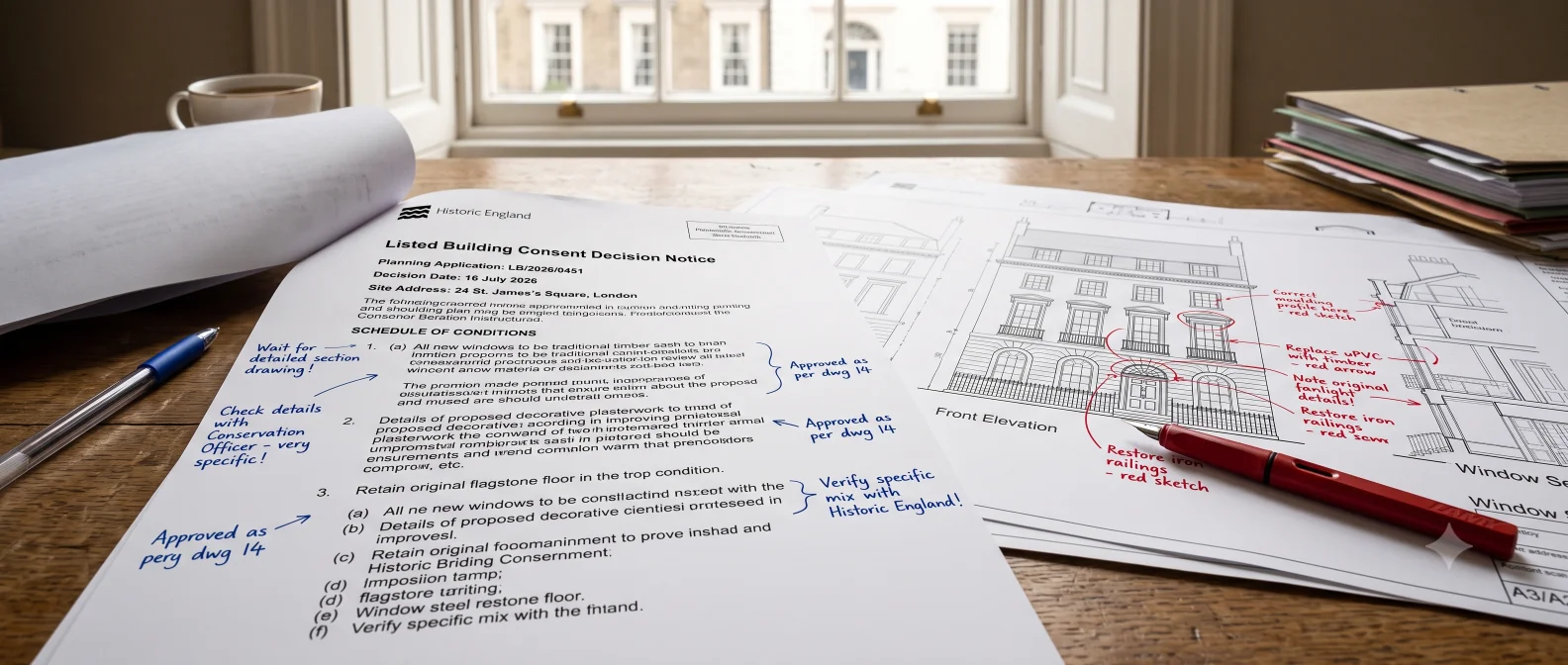
Conditions on listed building consents fall into three broad categories based on when they must be complied with:
| Type | When to act | Common examples |
|---|---|---|
| Pre-commencement | Before any works start on site | Sample materials to be approved; method statement for sensitive works; building recording survey; archaeological watching brief to be arranged |
| Ongoing / during works | Throughout the works programme | Works to be carried out in accordance with approved drawings; archaeologist to be present during ground-breaking; LPA to be notified of unexpected discoveries; no cement mortar to be used |
| Post-completion | Before occupation or use | As-built drawings to be submitted; photographic record of completed works; specific materials schedule to be lodged with the LPA; no further alterations without prior consent |
Common Conditions on Listed Building Consents
While every consent is different, these conditions appear frequently on LBC decisions:
- Sample materials approval: Before ordering materials, samples of lime mortar, stonework, brickwork, render, roofing tiles or slates must be submitted to and approved by the LPA. This ensures the match to the existing fabric is agreed before works proceed, avoiding costly remediation if the LPA rejects materials already installed.
- Detailed joinery drawings: Where windows, doors, shutters or other joinery are to be repaired or replaced, fully dimensioned drawings showing profiles, sections and glazing bar details must be approved before manufacture.
- Method statement: For works to sensitive structural elements - removing a wall, underpinning, opening up a roof - a written method statement explaining how the works will be carried out must be approved before starting.
- Building recording survey: A photographic or drawn survey of the areas to be affected must be completed and submitted before works commence. This creates a permanent record of what existed before alteration.
- Approved drawings compliance: Works must be carried out strictly in accordance with the approved drawing set. Any variation, even minor, must be agreed with the LPA before it is made.
- Lime mortar specification: The type, mix ratio and aggregate of all mortars to be used must match the approved specification. Cement mortar is explicitly prohibited.
- Retention of specified elements: Particular features - a chimney piece, a section of panelling, a staircase - must be retained and not damaged during works.
- No further alterations without consent: A condition specifically preventing any further alterations to the building or specified elements without first obtaining a further Listed Building Consent.
Conditions That Affect Future Owners
Some conditions are permanent and attach to the building rather than expiring when the consented works are completed. These are particularly important when buying a listed building, as they restrict what any future owner can do:
- Occupancy restrictions: A condition requiring that a converted outbuilding is only occupied as an ancillary dwelling to the main house, preventing separate sale or letting as an independent property.
- No further alterations conditions: Conditions placed on a previous consent that specifically restrict any further works to a particular element without prior LBC. These may not be obvious and may not appear in the list entry.
- Approved materials schedules: Conditions requiring that future maintenance uses specific approved materials, binding successors in title to those specifications.
- Public access conditions: In some cases where consent was granted in part because of public benefit, conditions may require ongoing public access to part of the property or building.
When buying a listed building, your solicitor should check for conditions attached to previous planning permissions and LBCs as part of their searches. These conditions can significantly affect what you can do with the property and its value.
How to Discharge a Pre-Commencement Condition
- Identify which conditions are pre-commencement. Read the decision notice carefully. Pre-commencement conditions are worded along the lines of "no works shall commence until..." or "prior to the commencement of works, the following information shall be submitted to and approved in writing by the Local Planning Authority."
- Prepare the required information. Depending on the condition, this may be material samples, specialist drawings, a written method statement, a heritage consultant's report, or a building recording survey. Where specialist expertise is needed, commission it early - lead times for heritage specialists can be several weeks.
- Submit an application to discharge the condition. Use the 'Application to Discharge a Planning Condition' on the Planning Portal. Submit the information required by the condition along with the application. There is a fee (check current Planning Portal fees as these change).
- Wait for written approval. The LPA has 8 weeks to decide. They may approve the discharge, request further information, or (in rare cases) refuse. Do not start works until you have written approval.
- Keep the discharge approval on site. During works, you should have copies of the original decision notice, all discharge approvals, and the approved drawings readily accessible. Building inspectors and conservation officers may ask to see them.
What If You Disagree with a Condition?
If a condition is unreasonable, unnecessary, or imposes an unjustifiable burden, there are two routes:
- Appeal: You can appeal the condition (and only the condition, not the whole consent) to the Planning Inspectorate within 6 months of the decision. This allows the inspector to remove or vary the condition while leaving the consent intact.
- Application to vary or remove: You can apply to the LPA under Section 73 of the Town and Country Planning Act 1990 to vary or remove a condition. For listed building consent conditions, a similar application can be made under Section 19 of the Listed Buildings Act. This is often faster than an appeal and allows negotiation with the conservation officer.
Do not simply ignore a condition you disagree with - the consequences of breach are serious. Seek professional advice and use the formal routes.
Conditions on Pre-Existing Consents: Checking Your Property
Conditions on historical LBC decisions and planning permissions affecting a listed building can be found by:
- Searching your LPA's online planning register for all applications at the property's address
- Reading the decision notices on each application to identify any permanent or long-running conditions
- Asking your solicitor to carry out a planning search as part of conveyancing
- Requesting a formal planning history from the LPA if the online register is incomplete for older applications
Conditions from permissions and LBCs granted in the 1980s and 1990s are sometimes not on accessible online registers but are nonetheless legally binding. A thorough planning history check is particularly important for buildings that have been significantly altered or converted in the past.
LBC Duration and Renewal
Listed Building Consent lasts for 3 years from the date of grant. Works must start within that period - not complete, but meaningfully begin. A token start is not sufficient; the works must genuinely commence.
If a consent lapses before works start, a new application must be made. The LPA is not obliged to grant the same consent again - circumstances, policy or the building's condition may have changed. It is therefore important to:
- Monitor the 3-year deadline actively from the date of grant
- If works are delayed, discharge pre-commencement conditions well before the expiry date so works can start in time
- If the consent is at risk of lapsing, apply for a fresh consent promptly rather than assuming the existing one can be extended